The Sun Stands Still for Kids: Yehoshua at Givon & a Promise Kept
Yehoshua marched all night to rescue people who had tricked him, because he had given his word. Then, in the middle of the day, he called out in front of all of Yisrael: sun, stand still over Givon. Here is the story of Yehoshua chapter 10 retold for children, with the lesson, age-by-age explanations and questions for the Shabbos table.
Published by Torah Tale.
Create this book for your child
The sun standing still at Givon is one of the shortest and most astonishing episodes in Sefer Yehoshua. In perek 10, Yehoshua marches his army all night to rescue a city that had tricked him into a treaty, and then, with the enemy fleeing and the daylight running out, he calls out in front of all of Yisrael: Shemesh b'Givon dom, v'yarei'ach b'emek Ayalon. The pasuk says the sun stood in the middle of the sky and did not hurry to set for about a whole day. Children remember the sky. Parents should make sure they also remember why Yehoshua was out there in the first place.
What happens in the story of the sun standing still?
In the perek before, the people of Givon came to Yehoshua dressed as travelers from a distant land, with dry bread and worn out shoes, and asked for a treaty. The leaders of Yisrael swore to them by Hashem. Three days later the truth came out, but the oath had been given, and Yisrael did not break it.
Then five Emori kings, led by Adoni-Tzedek the king of Yerushalayim, joined together to attack Givon for having made peace with Yisrael. The Givonim sent an urgent message to Yehoshua at Gilgal: do not hold back your hand from your servants, come up to us quickly and save us.
Yehoshua went up from Gilgal with the whole army, marching all night, and came upon them suddenly. Hashem told him not to fear, because the enemy was given into his hand. The pasuk says Hashem threw them into confusion, and as they fled down the descent of Beis Choron, Hashem cast great stones from heaven upon them. The pasuk adds that more died from those hailstones than from the sword of Yisrael. The Midrash relates that these were the hailstones held back during the makkah of barad in Mitzrayim, kept in reserve until the days of Yehoshua.
It was at that point, on the day Hashem gave the Emori before Bnei Yisrael, that Yehoshua spoke to Hashem and said in front of all of Yisrael that the sun should stand still over Givon and the moon over Emek Ayalon. The sun stopped and the moon stood, and the pasuk records: there was no day like it before it or after it, that Hashem listened to the voice of a man, for Hashem was fighting for Yisrael. The five kings hid in a cave at Makkeidah, and Yehoshua had large stones rolled over the mouth of the cave with men posted to guard it while the battle continued.
Why did Yehoshua march all night for people who had deceived him?
This is the question to put to an eight-year-old before you tell him about the sun. The Givonim were not innocent. They lied about where they came from in order to get a treaty. And when they were in danger, Yehoshua did not say they had forfeited their rights. He walked his whole army through the night to defend them.
The reason is in the pesukim: the leaders had sworn by Hashem. A word given in Hashem's name is not cancelled because keeping it turned out to be inconvenient or because the other side behaved badly. That idea is worth far more at a family table than any lecture about honesty, because it is specific. Yehoshua lost a night of sleep over a promise.
What is the lesson of "Shemesh b'Givon dom" for children?
Two lessons sit side by side here, and children can hold both.
- Do everything you can, then turn to Hashem. Yehoshua did not stay in Gilgal and daven for a miracle. He marched all night first. Only when he had done his part, and the light was running out, did he speak to Hashem out loud.
- Hashem runs the sun and the moon. A child who has watched the sun set every erev Shabbos knows that nobody can slow it down. The pasuk says plainly that this is exactly what happened, because Hashem was fighting for Yisrael.
There is a third point for older children. Yehoshua spoke l'einei Yisrael, in front of everyone. He did not whisper. He staked his name publicly on the fact that Hashem hears tefillah, and the pasuk testifies that Hashem listened to the voice of a man. Compare it with the shofros at Yericho and the water that stopped when the kohanim's feet entered the Yarden: in Sefer Yehoshua, the open miracles arrive when Yisrael has already stepped forward.
How to explain the story at different ages
Ages 3 to 5. "Yehoshua promised to help the people of Givon. One night, bad kings came to hurt them, so Yehoshua walked all night with his soldiers to save them. The day was almost finished, so Yehoshua asked Hashem out loud, and Hashem made the sun stay up in the sky until they finished. Hashem made the sun, so the sun listens to Hashem." Leave the fighting out.
Ages 6 to 8. Add the deception in perek 9 and the oath. Ask: should Yehoshua have helped them? Then add the stones from heaven and the pasuk's own comment that more fell from the hailstones than from the sword, which tells a child who really won the battle.
Ages 9 to 12. Learn the pesukim themselves, 10:12 to 10:14. Point out that the pasuk sends the reader to Sefer HaYashar, and that the Gemara in Avodah Zarah 25a brings that Sefer HaYashar is the sefer of Avraham, Yitzchak and Yaakov, who are called yesharim. Note also that the meforshim discuss exactly how long the day was extended, and that the pasuk itself says only that the sun did not hurry to set, for about a whole day.
Five questions for the Shabbos table
- Why did Yehoshua help the Givonim after they had tricked him?
- Yehoshua marched all night before he davened. What does that teach us about when to ask Hashem for help?
- The pasuk says more of the enemy fell from the stones from heaven than from the sword. Why does Tanach tell us that?
- Yehoshua spoke in front of everyone. Why was it important that all of Yisrael heard him?
- If Hashem gave you one extra hour of daylight today, what would you want to finish with it?
That last question is the one that usually keeps going. Children answer it honestly, and it turns the story into something about their own unfinished jobs rather than a long ago battle.
What a personalized Torah Tale book of this story is like
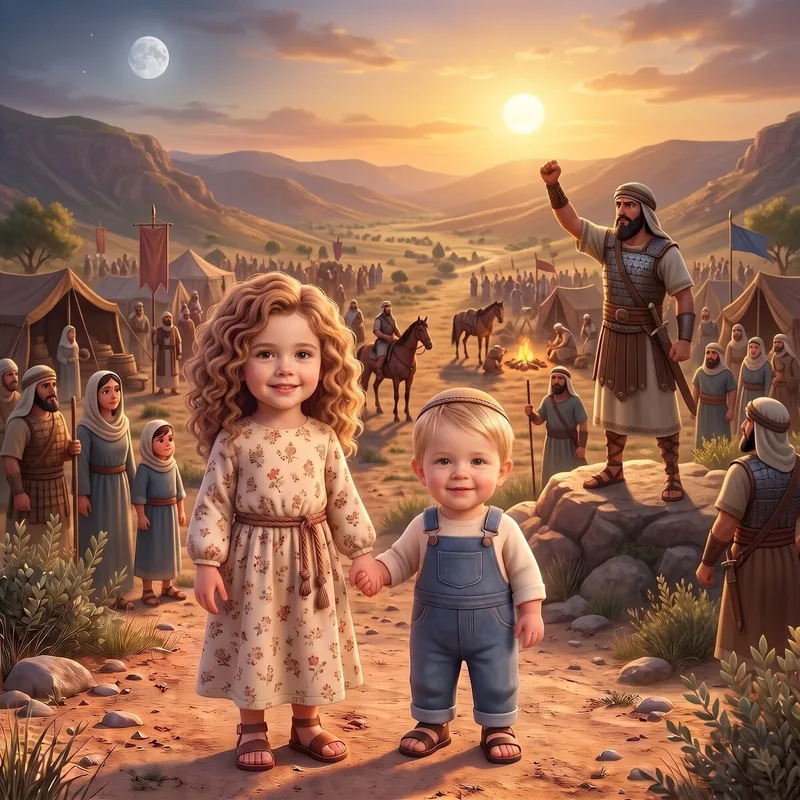
The Sun Stands Still is one of the stories in the Nevi'im collection in the Torah Tale story picker, alongside the other episodes of Sefer Yehoshua. In the book, your child is the hero. Their name appears throughout, and their likeness is illustrated from one uploaded photo in high resolution 3D animated-film style, on every page: on the night march from Gilgal, on the slope of Beis Choron, standing with Yehoshua as the sun holds its place over Givon. Up to eight siblings, ages 0 to 18, can appear in the same book.

Softcover 8″×8″

Hardcover 8″×8″

Board book 6″×6″

Coloring book 8.5″×11″
Three printed formats are available: a 6x6 board book with rounded safety corners for ages 0-4, an 8x8 softcover for ages 4-8, and an 8x8 hardcover for ages 5-18. Softcover and hardcover books end with a page for the child to draw their own picture, and board books have a closing family page. Books can be ordered in English, Hebrew or Yiddish, and every book is written with careful rabbinical guidance and strict tznius and reviewed by our team before printing.
Every book also includes a dedicated discussion page with ten questions about the story, mixing comprehension with middos: what happened, and what it asks of the child. This is the page that turns a Shabbos afternoon read into a conversation. A storybook is exactly the right thing to open on Shabbos or on a long Yom Tov afternoon, and this story in particular reads well out loud.
A weekday activity: watch the sun move
On a weekday afternoon, take a stick or a broom handle outside and stand it upright in the ground or in a bucket of sand. Mark the tip of its shadow with a stone. Come back twenty minutes later and mark it again. Children are genuinely surprised at how far it travels.
Then say it in one sentence: "That line never stops, for anyone. One single day, Hashem told it to wait, because Yehoshua asked." If you add the matching Torah Tale coloring book, in black and white line art, keep it for a weekday afternoon or erev Shabbos preparation, since coloring is melacha and is not for Shabbos or Yom Tov.

If you would like your child to meet Yehoshua at Givon with their own face in the pictures, you can create the book in about five minutes. It takes a free account and a few short questions: each child's name, boy or girl, age and one photo, any siblings, the story, your family's community (asked once), the language and the printed format. If you are new to this, the step by step guide walks through the whole flow.
Frequently asked questions
What is the story of the sun standing still in Sefer Yehoshua?
After Yisrael made a treaty with the people of Givon, five Emori kings came up to attack Givon in revenge. Yehoshua marched his army all night from Gilgal and arrived suddenly, and Hashem confused the enemy and cast great stones from heaven on them as they fled. In the middle of the fighting Yehoshua called out in front of all of Yisrael that the sun should stand still over Givon and the moon over Emek Ayalon, and the pasuk says the sun stood in the middle of the sky and did not hurry to set for about a whole day.
Why did Yehoshua fight to save the Givonim?
In the previous perek the Givonim came to Yehoshua disguised as travelers from a far country and obtained a treaty under false pretenses. Once the leaders of Yisrael had sworn by Hashem, they kept their word even after the deception came to light. When Givon was attacked, Yehoshua went out to save them, and that is the setting of the day the sun stood still.
How do I explain the sun standing still to a 5-year-old?
Tell your child that Hashem made the sun and the moon, so Hashem can also tell them to wait. Yehoshua was helping people who needed him, the day was running out, and he asked Hashem out loud in front of everybody for more daylight. Hashem listened, and the sun stayed up in the sky until the job was finished.
What is the lesson of Shemesh b'Givon dom for children?
Two lessons come straight out of the pesukim. The first is that a promise is binding even when keeping it is expensive, which is why Yehoshua marched all night for the Givonim. The second is that Yehoshua did everything he could and then turned to Hashem out loud, because the pasuk says plainly that Hashem was fighting for Yisrael.
Is this story suitable for younger children?
Yes, when it is told the way it is told in cheder: the rescue, the march through the night, the stones from heaven and the sun that waited. There is no need to describe the fighting in detail, and the part children remember is the sky holding still while Yehoshua finished what he came to do. A Torah Tale book of this story is available as a 6x6 board book with rounded safety corners for ages 0-4, an 8x8 softcover for ages 4-8, or an 8x8 hardcover for ages 5-18.
Can I order this story as a personalized book for my child?
Yes. The Sun Stands Still is part of the Nevi'im collection in the Torah Tale story picker, and your child appears in it by name and by likeness, illustrated from one uploaded photo in 3D animated-film style. Creating a book takes about five minutes at torahtale.com/create and needs a free account plus a few short questions: each child's name, boy or girl, age and one photo, any siblings, the story, your community (asked once), the language and the printed format.