Crossing the Yarden for Kids: The Aron & the Twelve Stones
Forty years after leaving Mitzrayim, Bnei Yisrael reached a river at flood stage with no bridge and no boats. The Kohanim carrying the Aron stepped in first, and the water stopped. Here is how to tell the story to children, what the twelve stones teach, and how to talk about it at the Shabbos table.
Published by Torah Tale.
Create this book for your child
Crossing the Yarden is the story at the beginning of Sefer Yehoshua in which Bnei Yisrael finally walk into Eretz Yisrael. The river was at flood stage, there was no bridge and no boats, and the water stopped only after the Kohanim carrying the Aron stepped into it. Children remember this story because of that detail: the miracle waited for someone to put a foot in the water first.
What happens when Bnei Yisrael cross the Yarden?
Moshe Rabbeinu had been niftar, and Yehoshua bin Nun was leading. The nation was camped on the far side of the Yarden, looking across at the land they had been walking toward for forty years.
Yehoshua told the people to prepare themselves: "Hiskadshu, for tomorrow Hashem will do wonders among you" (Yehoshua 3:5). The officers passed through the camp with instructions. When you see the Kohanim lifting the Aron, get up and follow it, but keep a distance of about two thousand amos, because you have not traveled this way before.
The pasuk is careful to tell us the state of the river. The Yarden was overflowing all its banks, as it did all through the harvest season (3:15). This was not a shallow crossing at a quiet time of year.
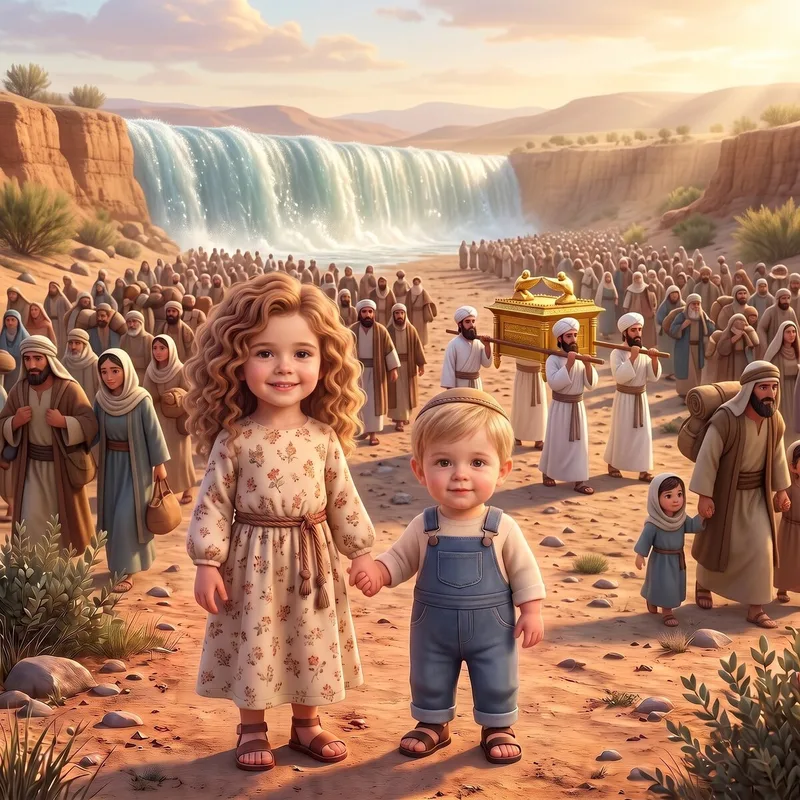
Then the Kohanim carrying the Aron reached the edge, and their feet dipped into the water. The water coming downstream stopped and stood in one heap, very far away, at the city of Adam near Tzarsan. The water flowing down toward the Yam HaMelach was cut off completely, and the riverbed dried.
The Kohanim carried the Aron into the middle of the Yarden and stood there, firm on dry ground, while the entire nation crossed over. Every man, woman and child walked past them. Only when everyone had finished did the Kohanim come up out of the riverbed, and then the water returned to its banks.
It happened on the tenth of Nissan, and they camped at Gilgal, at the eastern edge of Yericho (4:19). The pasuk adds that on that day Hashem made Yehoshua great in the eyes of all Yisrael, and they held him in awe as they had held Moshe.
Why did the water wait for the Kohanim to step in?
This is the question children ask, and it is worth sitting with rather than answering too fast. Hashem could have split the river while the nation was still standing on the bank, dry and safe. Instead the miracle began at the moment a foot touched the water.
It is a lesson in how hishtadlus and bitachon fit together. You do what you are asked to do, even when the water is still high, and then you see what Hashem does. Compare it with Krias Yam Suf, where Chazal tell us that Nachshon ben Aminadav went into the sea first. There the Yidden were fleeing; here they were walking home. Both times, somebody stepped in.
Chazal add that the waters piled up into a towering heap that nations far away could see, and that the Aron carried the very Kohanim who were carrying it. That second idea is a beautiful one for an older child: when you take hold of something holy, it holds you.
What are the twelve stones at Gilgal, and why do they matter to a child?
Before the Kohanim left the riverbed, Yehoshua told twelve men, one from each shevet, to lift a stone from the exact place where the Kohanim's feet had stood and carry it out on their shoulders. Those twelve stones were set up at Gilgal. Yehoshua also set up twelve stones in the middle of the Yarden, where the Kohanim had stood.
The pasuk tells us plainly what the stones are for, and the reason is addressed to parents: "When your children ask you tomorrow, saying, what are these stones to you?" (4:6). You will tell them that the water of the Yarden was cut off before the Aron of Hashem. Yehoshua repeats it again at the end of the chapter, so that all the nations of the earth should know that the hand of Hashem is strong, and so that the Yidden should fear Hashem always.
In other words, the memorial was built so that a child would ask a question at home. That is a striking thing to point out at your own table.
How to explain crossing the Yarden at different ages
The story works from a very young age, as long as you choose the right amount of it.
- Ages 2 to 4: "There was a big river. The Kohanim carried the Aron and put their feet in the water, and the water stopped, and all the Yidden walked across on dry ground." Then let them stamp their feet and say "the water stopped."
- Ages 5 to 7: Add that Moshe Rabbeinu was no longer with them and Yehoshua was leading, that the river was very full because it was harvest time, and that the Kohanim stood in the middle holding the Aron until every last person had crossed. Add the twelve stones, one for each shevet.
- Ages 8 to 12: Add the date, the tenth of Nissan, and the fact that the Pesach was brought four days later at Gilgal. Discuss why the miracle started only once the Kohanim stepped in, and why Yehoshua needed a public miracle at the start of his leadership. An older child can also compare the wording here with Moshe handing leadership to Yehoshua.
What a personalized Torah Tale book of this story is like
Crossing the Yarden is one of the stories in the Nevi'im collection, under Sefer Yehoshua. In a Torah Tale book, your child's own name and likeness appear on every page, illustrated in high-resolution 3D animated-film style from a single photo you upload. They are standing in the camp when the officers pass through, walking behind the Aron at a careful distance, and looking back at the Kohanim standing in the middle of the riverbed.
Up to eight siblings, ages 0 to 18, can appear in the same book, which suits this story well since it is about a whole nation moving together. Books come as a 6x6 board book with rounded safety corners for ages 0-4, an 8x8 softcover for ages 4-8, or an 8x8 hardcover for ages 5-18, in English, Hebrew or Yiddish. Softcover and hardcover books end with a page for the child to draw their own picture, and board books have a closing family page.
Every book includes a discussion page with ten questions about the story that mix comprehension with middos, which matters for a story whose own pesukim are built around a child's question. Everything is written with careful rabbinical guidance and strict tznius and reviewed by our team before printing. If you have not made one before, the step by step walkthrough shows the whole flow.

Softcover 8″×8″

Hardcover 8″×8″

Board book 6″×6″

Coloring book 8.5″×11″
Shabbos-table questions about crossing the Yarden
Reading and talking are exactly right for the Shabbos table. Try a few of these:
- Why do you think Hashem waited until the Kohanim's feet were in the water?
- The Kohanim stood in the middle of the riverbed until everyone had crossed. What does that tell you about a leader?
- Why did the Yidden have to keep a distance from the Aron instead of crowding around it?
- The stones were set up so children would ask about them. What is something in our house that makes people ask questions?
- Is it harder to step into water you cannot see the bottom of, or to wait on the bank? Which one did Hashem ask for?
A weekday activity: your family's twelve stones
On a weekday afternoon or erev Shabbos, go outside and collect twelve stones, one for each shevet. Let each child write or paint a shevet's name on one, or simply count them into a pile by the door the way Yehoshua set them up at Gilgal. Then ask the pasuk's question out loud: "What are these stones to you?" and let a child give the answer.
Coloring, drawing and painting are melacha, so keep this for a weekday, the days before a Yom Tov, or Chol HaMoed. A matching black-and-white coloring book in 8.5x11 can be added to a Torah Tale order for exactly those afternoons. On Shabbos itself, read the story and talk it through.
If you want your child to meet Sefer Yehoshua as someone who was there, you can create the book at torahtale.com/create. It takes about five minutes: a free account, a few short questions about each child's name, whether they are a boy or a girl, their age and one photo, any siblings, the story, your community, the language and the printed format. Order a single book, or the Nevi'im collection as a subscription with 4 books a month in one delivery.
Frequently asked questions
What is the story of crossing the Yarden?
After forty years in the midbar and the petirah of Moshe Rabbeinu, Yehoshua bin Nun led Bnei Yisrael into Eretz Yisrael. The Yarden was overflowing its banks, but when the Kohanim carrying the Aron stepped into the water, the water stopped and stood in a heap far upstream, and the whole nation crossed on dry ground. Twelve men, one from each shevet, carried twelve stones out of the riverbed and set them up at Gilgal as a remembrance. It happened on the tenth of Nissan, as told in Sefer Yehoshua chapters three and four.
How is crossing the Yarden different from Krias Yam Suf?
At the Yam Suf, Bnei Yisrael were running away from Mitzrayim with the sea in front of them, and Chazal tell us that Nachshon ben Aminadav went into the water first. At the Yarden they were walking in, not running away, and the pesukim say plainly that the Kohanim carrying the Aron stepped into the water and only then did it stop. One miracle took the Yidden out of Mitzrayim, the other brought them home into Eretz Yisrael.
How do I explain crossing the Yarden to a 4-year-old?
Say it in one sentence: the Yidden had to cross a big river with no bridge, and when the Kohanim carrying the Aron put their feet in the water, the water stopped so everyone could walk through on dry ground. A young child does not need the geography or the dates. Add that the Yidden picked up twelve big stones to remember it, one for each shevet, and that is enough for a four-year-old.
What are the twelve stones at Gilgal?
Twelve men, one from each shevet, took twelve stones from the middle of the riverbed where the Kohanim's feet had stood, and Yehoshua set them up at Gilgal. The pasuk gives the reason directly: when children would ask in time to come, "what are these stones to you?", their parents would answer that the water of the Yarden was cut off before the Aron of Hashem. Yehoshua also set up twelve stones inside the Yarden itself, where the Kohanim had stood.
Where is crossing the Yarden in Tanach, and when is it read?
The crossing is told in Sefer Yehoshua, chapters three and four, at the start of Nevi'im. The haftarah on the first day of Pesach is taken from Yehoshua chapter five, which picks up right after the crossing with Bnei Yisrael camped at Gilgal. Many children meet the story earlier than that, in cheder or in a Nevi'im storybook at home.
Can I order this story as a personalized book for my child?
Yes. Crossing the Yarden is part of the Nevi'im collection on Torah Tale, and the book is printed with your child's name and likeness on every page, illustrated in 3D animated-film style from one uploaded photo. Up to eight siblings ages 0 to 18 can appear in the same book, and it can be ordered in English, Hebrew or Yiddish, as a 6x6 board book with rounded safety corners for ages 0-4, an 8x8 softcover for ages 4-8, or an 8x8 hardcover for ages 5-18.