Devorah HaNevi'ah for Kids: The Palm Tree, Barak & the Shirah
Devorah sat under a palm tree in Har Ephraim and Klal Yisrael came to her for judgment. Here is her story in Sefer Shoftim, told the way a child can hold onto it, with the middos to talk about at the table.
Published by Torah Tale.
Create this book for your child
Devorah was a nevi'ah who judged Klal Yisrael, and she is the only woman among the Shoftim. Her story is in Sefer Shoftim, chapters 4 and 5: she sat under a palm tree in Har Ephraim and people came to her for judgment, she delivered Hashem's message to Barak ben Avinoam, Klal Yisrael was saved from Sisra and his iron chariots, and then she and Barak sang a shirah. For children, it is a story with a picture they can hold onto right away, a wise woman sitting under a tree while a whole nation walks up the hill to ask her what is right.
What happens in the story of Devorah?
After Yehoshua, Klal Yisrael was led by Shoftim, one after another. When the Yidden did what was right, there was quiet. When they did not, they fell into the hands of enemies, until they cried out to Hashem and He sent a leader to save them. Devorah comes in Sefer Shoftim after Ehud and Shamgar.
In her time, Yavin, a Canaanite king who ruled in Chatzor, pressed hard on Klal Yisrael for twenty years. His general was Sisra, and the pesukim tell us he had nine hundred iron chariots. On open ground, against men on foot, that was overwhelming.
The pasuk says Devorah was a nevi'ah and that she judged Yisrael at that time. She sat under a palm tree between Ramah and Beis El in Har Ephraim, and Bnei Yisrael came up to her for mishpat. She sent for Barak ben Avinoam from Kedesh Naftali and gave him Hashem's message: take ten thousand men from Naftali and Zevulun up to Har Tavor, and Hashem will draw Sisra and his chariots to Nachal Kishon and give him into your hand.
Barak answered that if Devorah would go with him he would go, and if not, he would not go. Devorah said she would certainly go with him, but that the glory of that journey would not be his, because Hashem would deliver Sisra into the hand of a woman. She went up with him to Har Tavor.
When Barak came down with his ten thousand men, the pasuk says Hashem confounded Sisra and all his chariots before Barak. The iron chariots that were supposed to decide everything decided nothing. Sisra himself came down from his chariot and fled on foot, and he came to the tent of Yael, eishes Chever HaKeini. She gave him milk and covered him, and when he was asleep she took a tent peg and ended the danger to Klal Yisrael. Barak arrived to find that it was already done.
Then comes perek heh, the shirah. Devorah and Barak sang on that day, praising Hashem, calling Yael blessed among women, and describing how the Kishon swept the enemy away. The perek closes by telling us that the land was quiet for forty years.
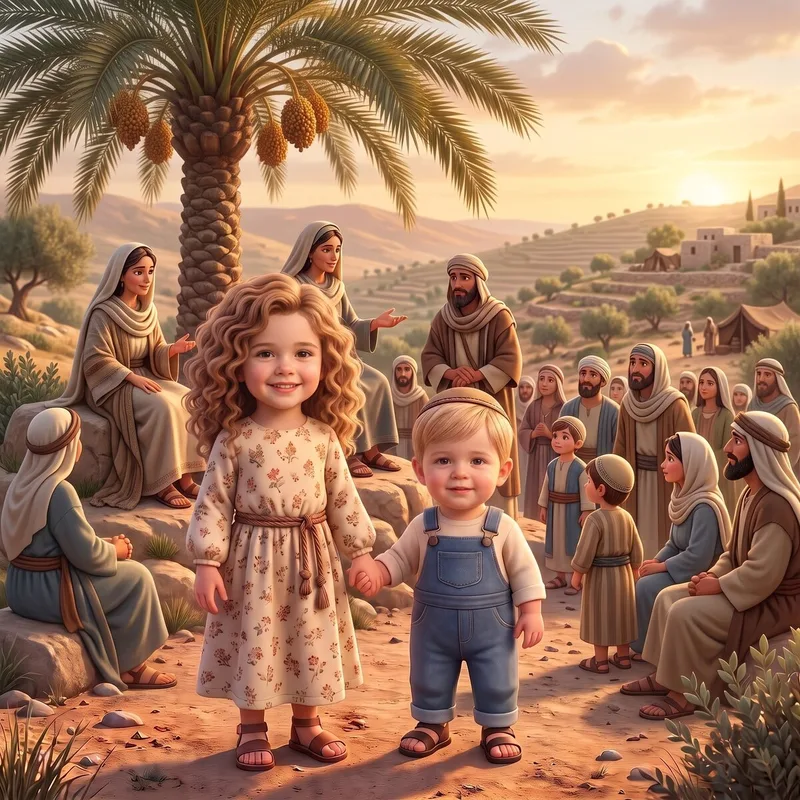
Why did Devorah sit under a palm tree?
The pasuk makes a point of telling us where she sat, and children always ask about it. Rashi explains that she judged outdoors, under the tree, rather than inside a house, for reasons of tznius. Chazal also draw a lesson from the palm: just as a date palm has one heart, so the Yidden of that generation turned their hearts in one direction, to their Father in Shamayim.
There is something useful in that picture for a child. A beis din did not need a marble building. It needed a person whose word people trusted, sitting somewhere everybody could reach. When your child asks why people walked all that way to one tree, the answer is that they knew they would hear the truth there.
Chazal count Devorah among the seven nevi'os: Sarah, Miriam, Devorah, Chana, Avigayil, Chuldah and Esther. Chazal also explain the words eishes Lapidos, "woman of torches," as referring to wicks she prepared for the Mikdash, a quiet avodah done long before anyone called her a leader.
What middos does this story teach?
The first is using what Hashem gave you. Devorah had wisdom and nevuah, and she did not keep them at home. She made herself available, day after day, under a tree, to anyone who needed an answer. Children understand this version of it: whatever you are good at is not only for you.
The second is hakaras hatov. The moment the danger passed, Devorah and Barak did not sit and tell each other how well it had gone. They sang. The whole of perek heh is thanks, and it is the natural partner to other shiros your children already know.
The third is trust. Barak had ten thousand men on foot facing nine hundred iron chariots. On paper they had no chance. The pasuk says Hashem confounded Sisra before Barak, which is the same lesson children meet at the walls of Yericho and at Givon when the sun stood still. The victory belongs to Hashem, and the people's job is to go when they are told to go.
How do I explain Devorah at different ages?
Ages 3 to 5. Keep it to the tree. "Devorah was a very wise lady who loved Hashem. She sat under a big palm tree, and all the Yidden came to ask her what was right. Bad people were hurting the Yidden, so Devorah told Hashem's message to Barak, and Hashem saved them. Then Devorah sang a beautiful song to say thank You to Hashem." No chariots, no tent peg.
Ages 6 to 8. Add the problem and the plan. Sisra had nine hundred iron chariots and the Yidden had none. Devorah told Barak exactly where to go, and Hashem threw the enemy into confusion so that all those chariots were worth nothing. Say that Sisra ran away and Yael saved Klal Yisrael in her tent, and leave it there. Then spend the time on the shirah.
Ages 9 to 12. Now the conversation about Barak's answer is worth having. He wanted the nevi'ah with him, and Devorah agreed to go but told him the glory of that journey would not be his. Ask your child what they think she meant, and why the shirah in perek heh praises Yael by name. Older children can also notice the cycle of Sefer Shoftim and where the forty quiet years fit into it.
What is a personalized Torah Tale book of Devorah like?
Torah Tale prints the story of Devorah as part of the Nevi'im collection, Sefer Shoftim. Your child's name is in the text and their likeness, illustrated from one uploaded photo in high-resolution 3D animated-film style, appears on every page: standing near the palm tree in Har Ephraim, watching the ten thousand men go up Har Tavor, hearing the shirah. Up to eight siblings, ages 0 to 18, can appear in the same book.
Every book includes a discussion page with ten questions about the story, mixing comprehension with middos, what happened and what it asks of the child. That page is what turns this from a book read at bedtime into a conversation at the table on Shabbos.

Softcover 8″×8″

Hardcover 8″×8″

Board book 6″×6″

Coloring book 8.5″×11″
There are three formats: a 6"x6" board book with rounded safety corners for ages 0-4, an 8"x8" softcover photo book for ages 4-8, and an 8"x8" hardcover photo book for ages 5-18. The softcover and hardcover end with a page where the child draws their own picture, and the board book ends with a family page. An 8.5"x11" black-and-white coloring book can be added as a one-time add-on, for weekday use, since coloring is melacha and is never for Shabbos or Yom Tov.
Books are written with careful rabbinical guidance and strict tznius and reviewed by our team before printing. The whole creation flow is a free account and a few short questions: each child's name, boy or girl, age and one photo, any siblings, the story, your community (asked once), the language (English, Hebrew or Yiddish) and the format.
Shabbos-table questions about Devorah
These are for talking, and they work after the fish on Friday night. Pick three, not all seven.
- Why do you think people walked all the way to one tree to ask Devorah their questions?
- Devorah judged outside, under the palm tree, and not in a house. What does that tell us about her?
- Barak had ten thousand men on foot and Sisra had nine hundred iron chariots. Why did Barak go anyway?
- Barak asked Devorah to come with him. Was that a good thing to ask for, or not? Why?
- What did Devorah and Barak do first after they were saved?
- What is something you are good at that could help somebody else this week?
- When was the last time you said thank you to Hashem out loud, not in a bracha?
A weekday activity: your own "palm tree" spot
During the week, pick one chair in the house and call it the Devorah chair for ten minutes after homework. Whoever sits there answers questions from the younger ones honestly and kindly: what should I do if my friend took my pencil, what if I found money in the hallway. It makes the idea of a shofet concrete, and it gives an older child a short, supervised taste of being the one people come to.
If you added the coloring book, the palm tree page is a good erev Shabbos project, finished and put away before candle lighting. For families reading through Nevi'im in order, Devorah sits naturally after crossing the Yarden and the conquest stories, and it helps children see Tanach as one continuing story rather than separate episodes.

If you want your child under that palm tree with Devorah, you can create the book in about five minutes. Choose Sefer Shoftim in the Nevi'im collection, upload one photo, pick the format that matches your child's age, and the ten discussion questions come with it.
Frequently asked questions
Who was Devorah in Tanach?
Devorah was a nevi'ah who judged Klal Yisrael in the time of the Shoftim, and she is the only woman among the Shoftim. Her story is told in Sefer Shoftim, chapters 4 and 5. She sat under a palm tree in Har Ephraim, between Ramah and Beis El, and people came to her with their questions and disputes. Chazal count her among the seven nevi'os.
How do I explain the story of Devorah to a 5-year-old?
Say it in one sentence first: Devorah was a very wise lady who loved Hashem, and all the Yidden came to her tree to ask her what was right. Then add that bad people were hurting the Yidden, Devorah told Hashem's message to a man named Barak, and Hashem saved them. Finish with the happy part, that Devorah sang a song to thank Hashem. A young child does not need the details of the battle.
What is the lesson of the story of Devorah for children?
Two lessons come straight out of the pesukim. The first is that Hashem gives every person something to use, and Devorah used her wisdom and her nevuah to help a whole nation rather than keeping it to herself. The second is hakaras hatov: the moment the danger was over, Devorah and Barak sang a shirah to Hashem instead of talking about what they had done.
Why did Devorah sit under a palm tree?
The pasuk in Shoftim 4:5 tells us she sat under a palm tree between Ramah and Beis El in Har Ephraim, and that Bnei Yisrael came up to her there for judgment. Rashi explains that she judged out in the open, under the tree, rather than inside a house, for reasons of tznius. It is a detail children remember, and it gives a picture of what a judge in Klal Yisrael looked like.
Is the story of Devorah appropriate for young children?
Yes, when it is told the way it is told in a frum home or classroom. The fighting and the end of Sisra can be said simply and without graphic detail: Hashem confused the enemy, their chariots were useless, and Yael saved Klal Yisrael in her tent. The parts children actually hold onto are the palm tree, Devorah's wisdom, and the song of thanks afterward.
Can I order a personalized book about Devorah for my child?
Yes. Devorah is one of the stories in Torah Tale's Nevi'im collection, Sefer Shoftim, and you can order it as a single book or as part of a collection subscription. Creating the book takes about five minutes at torahtale.com/create: a free account and a few short questions, including each child's name, boy or girl, age and one photo, any siblings, the story, the family's community (asked once), the language and the printed format.