Elisha's Miracles for Kids: The Jug of Oil, Naaman & the Floating Axe
Elisha HaNavi's miracles happen in kitchens, fields and a small guest room, which is exactly why children remember them. Here is the jug of oil, the woman of Shuneim, Naaman's seven dips in the Yarden and the borrowed axe head that floated, retold for ages 3 to 12, with questions for the Shabbos table.
Published by Torah Tale.
Create this book for your child
Elisha HaNavi was the talmid who took over from Eliyahu HaNavi, and Sefer Melachim records a long string of miracles he did for ordinary people: a widow's small jug of oil that filled every empty vessel she could borrow, the son of the woman of Shuneim, Naaman the general healed after dipping seven times in the Yarden, and an iron axe head that floated back up to the surface. Children remember these stories because almost all of them happen in a kitchen, a field or a small guest room rather than on a battlefield.
Who was Elisha, and where are his miracles written?
Elisha ben Shafat came from Avel Mecholah. Melachim I 19:19-21 tells how Eliyahu found him plowing with twelve pairs of oxen and threw his mantle over him. Elisha left the oxen behind, said goodbye to his parents, and went to serve his rebbe. Later he is described as the one who poured water on Eliyahu's hands, which is the pasuk's way of saying he was the attendant who did the small jobs for years.
Before Eliyahu was taken up, Elisha asked for pi shnayim b'ruchacha, a double measure of his rebbe's spirit. Eliyahu answered that he had asked a hard thing, but if he would see him being taken away, it would be his. Elisha saw, picked up the mantle that fell, struck the water of the Yarden and said "Ayei Hashem Elokei Eliyahu", and the water split for him too. That moment is told in full in our article on Eliyahu's chariot of fire.
Which of Elisha's miracles do children remember best?
The small jug of oil (Melachim II 4:1-7)
A widow came to Elisha crying: her husband had died, a creditor was coming to take her two sons, and she had nothing in the house except one small jug of oil. Rashi brings that she was the wife of Ovadiah, who had borrowed money to feed the nevi'im he hid from Izevel.
Elisha told her to go to all her neighbors and borrow empty vessels, and not to borrow few. She shut the door, poured, and the oil kept coming until the last vessel was full. Then it stopped. She sold the oil, paid the debt, and lived on what was left.
The woman of Shuneim and her little upper room (Melachim II 4:8-37)
A woman in Shuneim noticed that a holy man passed by often, and she told her husband they should build him a small upper room with a bed, a table, a chair and a lamp. Elisha asked what could be done for her in return. Gechazi, his attendant, pointed out that she had no son, and Elisha told her that at that season the next year she would be holding a son.
The boy was born. Years later he went out to his father among the reapers and said "roshi, roshi" - my head, my head. He was carried to his mother and died on her lap. She laid him on Elisha's bed, rode to Har HaCarmel and would not leave the navi's side. Elisha sent Gechazi ahead with his staff, then came himself, went into the room alone, davened to Hashem, and the child sneezed seven times and opened his eyes.
Naaman and seven dips in the Yarden (Melachim II 5)
Naaman was the commander of the army of Aram, a great man in his country, and he had tzaraas. A young Jewish girl who had been taken captive and served his wife said that if only her master would go to the navi in Shomron, he would be healed of his tzaraas.
Naaman arrived with horses, chariots and expensive gifts. Elisha did not even come out; he sent a messenger with instructions to wash seven times in the Yarden. Naaman was insulted and turned to leave, saying that the rivers of Damascus were better. His servants said to him: if the navi had told you to do something great, you would have done it. How much more so when he only said wash and be clean. Naaman went down and dipped seven times, his skin became healthy like that of a young boy, and he came back and declared that there is no G-d in all the earth except in Yisrael. Elisha refused to take any gift at all. Older children can also be told, briefly, that Gechazi ran after Naaman to take silver and clothing for himself, and tzaraas came upon him.
The borrowed axe head that floated (Melachim II 6:1-7)
The bnei hanevi'im told Elisha their study place was too small, and they went down to the Yarden to cut beams. As one of them was felling a tree, the iron head flew off into the water, and he cried out that it had been borrowed. Elisha cut a stick, threw it in, and the iron floated. A whole miracle happened because someone cared about somebody else's tool.
Horses and chariots of fire at Dotan (Melachim II 6:8-23)
The king of Aram kept setting ambushes, and Elisha kept warning the king of Yisrael, so Aram sent an army by night to surround Dotan. Elisha's na'ar woke up, saw the city ringed with horses and chariots, and was afraid. Elisha told him not to fear, because those who are with us are more than those with them, and davened that his eyes be opened. The young man looked and saw the mountain full of horses and chariots of fire around Elisha. Elisha then davened that the soldiers be struck with confusion, led them into Shomron, and told the king of Yisrael not to strike them but to give them bread and water and send them home.
Sefer Melachim also records that Elisha healed the bad water near Yericho with salt in a new vessel, made a harmful pot of stew safe again with flour, and fed a hundred men from twenty barley loaves with food left over.
What is the lesson of Elisha's miracles?
Three ideas run through these stories, and all three are sized for children.
- Hashem's bracha often comes through what you already have. The widow thought she had nothing. She had one jug, and the size of the miracle matched how many empty vessels she went out and collected.
- Great people are made by small kindnesses. The woman of Shuneim is remembered for a bed, a table, a chair and a lamp, in the spirit of the hachnasas orchim we learn from Avraham Avinu's tent. A navi stopped everything because somebody's borrowed axe was lost.
- Do the small thing you were told to do. Naaman nearly went home with his tzaraas because the instruction felt too plain. The advice that saved him came from a captured girl and from his own servants.
How do I explain Elisha's miracles at different ages?
Ages 3-4. Keep it to one picture: "Elisha was a navi who loved Hashem. A mommy had only one little jug of oil, so she borrowed lots and lots of empty jars, and Hashem made the oil keep pouring until every single jar was full." Let them count jars with their fingers.
Ages 6-7. Tell Naaman. This is the age that understands being insulted by an easy instruction. Ask them afterward: what was the hardest part for Naaman, going into the water or agreeing to go into the water?
Ages 9-12. Put two people side by side: Elisha, who refused every gift Naaman offered, and Gechazi, who ran after Naaman for them. Then add Dotan, and the line that those who are with us are more than those with them. A child this age can also be asked why Elisha fed the enemy soldiers instead of letting them be struck down.
Five questions for the Shabbos table
- The widow had one small jug of oil. What is something small we have in our house that Hashem could make into something big?
- Why do you think Elisha's miracle stopped exactly when the vessels ran out?
- The woman of Shuneim gave Elisha a bed, a table, a chair and a lamp. If a guest stayed with us, what four things would you want to put in the room?
- Naaman almost went home because the instruction was too easy. When has something easy felt too small to bother doing?
- Elisha stopped everything for a borrowed axe head. Is there something borrowed in our house that we need to return?
These are talking questions, and they fit a Shabbos table or a long Yom Tov afternoon. They pair nicely with the Elisha story told after the fire on Har HaCarmel, if your children already know that one.
A weekday activity: the borrowed-things check
During the week, give the children ten minutes to walk through the house and find everything that belongs to somebody else: a library book, a neighbor's dish, a sibling's marker, a cousin's sweatshirt. Make a list and return them. Connect it back out loud: the navi split his attention from everything else because one man's borrowed iron fell in the river.
If you order the matching coloring book, that is a weekday or erev Shabbos activity, not a Shabbos one. Coloring is melacha. A jug pouring into a row of empty vessels is a satisfying page to fill in on a Sunday afternoon.
What is a personalized Torah Tale book of Elisha's miracles like?
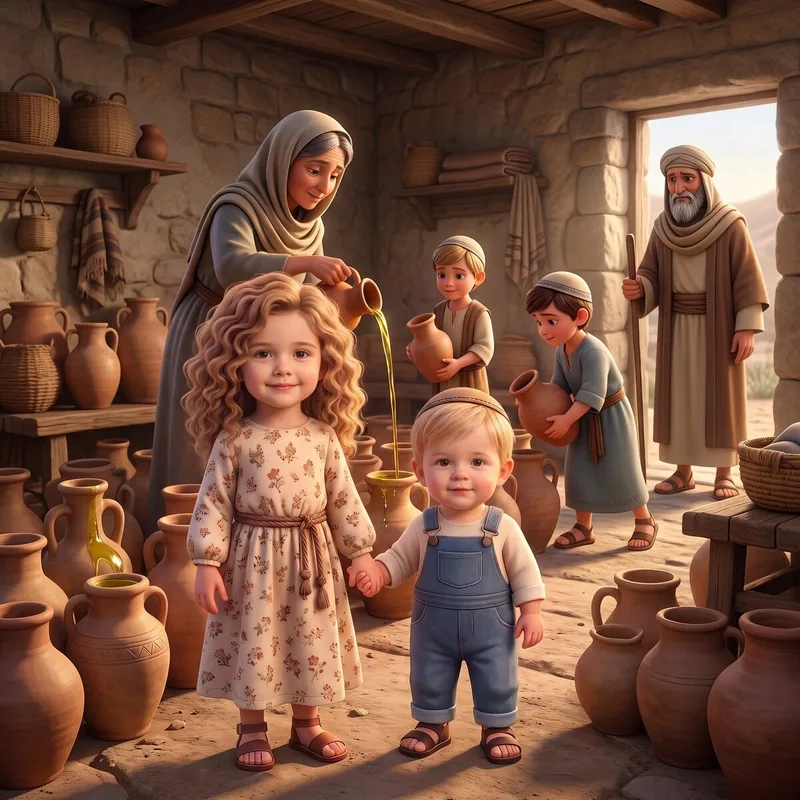
Elisha's Miracles is a story in the Nevi'im collection at Torah Tale. The book is printed with your child's name throughout, and from one uploaded photo their likeness is illustrated on every page in high-resolution 3D animated-film style, so the child is standing there in the room while the vessels fill and by the Yarden when the iron floats. Up to eight siblings, ages 0 to 18, can appear in the same book.

Softcover 8″×8″

Hardcover 8″×8″

Board book 6″×6″

Coloring book 8.5″×11″
There are three formats: a 6x6 board book with rounded safety corners for ages 0-4, an 8x8 softcover for ages 4-8, and an 8x8 hardcover for ages 5-18, with an optional matching 8.5x11 coloring book in black-and-white line art. Softcover and hardcover open with a dedication page. If you add parents and grandparents with their photos, they appear with the children on a closing family page, in every format. Books can be ordered in English, Hebrew or Yiddish.
Every book ends with a dedicated discussion page carrying ten questions about the story, mixing comprehension with middos, which is what turns it from a book you read to your child into a conversation at the table. Every Torah Tale book is written with careful rabbinical guidance and strict tznius and reviewed by our team before it goes to print.

You can order Elisha's Miracles as a single book, or subscribe to the Nevi'im collection, which comes as four books a month in one delivery (billed monthly, or the whole collection paid once with $30 off). Other stories from the same part of Tanach include Dovid and Golyas and Shlomo HaMelech's judgment.
Creating the book takes about five minutes: a free account and a few short questions covering each child's name, boy or girl, age and one photo, any siblings, the story, your community (asked once), the language and the format. You can create the book at torahtale.com/create and have your child standing beside Elisha the next time the oil starts to pour.
Frequently asked questions
What miracles did Elisha do in Sefer Melachim?
Sefer Melachim II records that Elisha split the Yarden with Eliyahu's mantle, healed the bad water of Yericho with salt in a new vessel, filled a widow's borrowed vessels from one small jug of oil, promised the woman of Shuneim a son and later davened for that boy until he sneezed seven times and opened his eyes, fixed a pot of harmful stew with flour, fed a hundred men from twenty loaves with food left over, healed Naaman the Aramean general when he dipped seven times in the Yarden, and made a borrowed iron axe head float. At Dotan his na'ar saw horses and chariots of fire surrounding him. Most of these are in chapters 2 through 7.
How do I explain the story of Naaman to a 6-year-old?
Tell it like this: Naaman was a very important general who had tzaraas, and a young Jewish girl who had been taken captive told his wife that there was a navi in Shomron who could help. Elisha sent word that he should go wash seven times in the Yarden River. Naaman was insulted that he was not given something grand to do, but his servants told him that if the navi had asked for something big he would have done it, so surely he could do something small. He dipped seven times, his skin became healthy like a young boy's, and he declared that there is no G-d in all the earth except in Yisrael.
What is the lesson of the widow's jug of oil?
The widow told Elisha she had nothing in the house except one small jug of oil, and Elisha told her to borrow empty vessels from all her neighbors and not to borrow few. The oil poured until the last vessel was full, and then it stopped. The lesson children can hold onto is that Hashem's bracha came through the little she already had, and that how much she received depended on how many empty vessels she was willing to go out and get.
Where in Tanach is the story of Elisha?
Elisha is in Nevi'im, not in the Chumash. Eliyahu HaNavi throws his mantle over him in Melachim I chapter 19, and Elisha's own miracles run through Melachim II, mainly chapters 2 to 7. It is worth telling children clearly that these events are in Sefer Melachim, so they know where to find them when they learn Nevi'im.
Is there a personalized book about Elisha's miracles for children?
Yes. Torah Tale prints Elisha's Miracles as a personalized storybook from the Nevi'im collection, with the child's name and, from one uploaded photo, their likeness illustrated on every page in 3D animated-film style. Up to eight siblings aged 0 to 18 can appear in the same book, and it comes as a 6x6 board book with rounded safety corners for ages 0-4, an 8x8 softcover for ages 4-8, or an 8x8 hardcover for ages 5-18. Every format ends with a discussion page of ten questions mixing comprehension with middos.
How long does a Torah Tale book take to arrive?
A one-time book order with US standard shipping is $5.99, free on orders of $75 or more, and arrives in about 12 business days counted from the order. US express is priced by the weight of the box at exactly what our printer charges, from $29.39, and arrives 2 to 6 business days after the book goes to print. We ship worldwide, with rates shown at checkout.