Dovid & Golyas for Kids: Five Smooth Stones and a Battle That Was Hashem's
A Pelishti champion taunted the armies of Yisrael twice a day for forty days. A young shepherd from Beis Lechem answered him with a staff, a sling, five smooth stones and one sentence: the battle is Hashem's. Here is the story of Dovid and Golyas, retold for children, with what to say to a 4-year-old and to a 7-year-old.
Published by Torah Tale.
Create this book for your child
The story of Dovid and Golyas is in Nevi'im, in Sefer Shmuel (Shmuel Aleph, chapter 17). A Pelishti champion named Golyas stood between the two camps and taunted the armies of Yisrael twice a day for forty days, and no one answered him, until a young shepherd from Beis Lechem went out to meet him with a staff, a sling and five smooth stones. Children remember it because the smallest person in the story is the only one who is not afraid, and because he says out loud exactly why: the battle is Hashem's.
What happens in the story of Dovid and Golyas?
The Pelishtim gathered for war and camped on one mountain, and Shaul and the men of Yisrael camped on the other, with the valley of Emek HaElah between them. Out of the Pelishti camp came a man from Gas named Golyas, whom the pasuk calls ish habeinayim, the man of the space between the camps. The pesukim describe him in detail: his height of six amos and a zeres, a copper helmet, armor of scales, copper on his legs, a spear whose shaft was like a weaver's beam, and a man walking in front of him carrying his shield.
His challenge was simple and it was repeated morning and evening for forty days: let one man come out and fight me, and let the result decide everything. The pasuk says that when Shaul and all of Yisrael heard it, they were afraid.
Meanwhile, Yishai of Beis Lechem had eight sons, and his three oldest had gone to war with Shaul. He sent his youngest, Dovid, who had been shepherding the sheep, to bring bread and roasted grain to his brothers and cheeses to their officer, and to come back with news of them. Dovid arrived at the camp just as the armies were going out in formation, and he heard Golyas call out his challenge.
Dovid asked the men standing there what would be done for the man who answers this Pelishti, and he said the thing nobody else was saying out loud: who is this man that he should taunt the armies of the living God? His oldest brother Eliav heard him and spoke to him sharply, asking why he had come down and with whom he had left those few sheep in the wilderness. Dovid turned to someone else and asked again. Word reached Shaul, and Shaul sent for him.
What did Dovid say to Shaul before the fight?
Shaul told him the obvious: you are a na'ar, a boy, and he has been a man of war since his youth. Dovid's answer is one of the most useful things in the whole story for a child.
He told Shaul that he used to shepherd his father's sheep, and when a lion or a bear came and carried off a sheep, he went after it and rescued the sheep from its mouth. Then he said that the same Hashem who saved him from the lion and from the bear would save him from this Pelishti. Shaul answered, go, and Hashem should be with you.
Shaul dressed him in his own clothing, put a copper helmet on his head and armor on him, but Dovid said he could not walk in them because he had never tried them, and he took them off. He took his staff in his hand, chose five smooth stones from the stream and put them in his shepherd's bag, took his sling, and went toward the Pelishti.
Golyas looked at him and scorned him, asking whether he was a dog, that someone was coming at him with sticks. Dovid answered that Golyas was coming with a sword and a spear and a kidon, and that he himself was coming in the name of Hashem Tzevakos, the God of the armies of Yisrael whom Golyas had taunted. He added the line that the whole story stands on: Hashem does not save with a sword and a spear, ki laHashem hamilchamah, for the battle is Hashem's.
Then Dovid ran toward the battle line, took a stone from his bag, slung it, and struck the Pelishti in his forehead, and Golyas fell to the ground. The pasuk notes that there was no sword in Dovid's hand, so he ran and took Golyas's own sword and finished what had begun. The Pelishtim saw that their champion had fallen and fled, and the men of Yisrael pursued them.
What is the lesson of Dovid and Golyas?
Three things are worth drawing out at home, and children can hold all three.
- Where strength comes from. Dovid does not claim to be stronger than Golyas. He says plainly that Hashem saves, and that armor and spears are not what decides a battle. It is the same idea a child meets in Gidon's three hundred men and in the story of Shimshon.
- Quiet work counts. Nobody was watching when Dovid guarded his father's sheep and went after a lion to rescue one of them. That is exactly what he brought with him into Emek HaElah. Doing a small job faithfully is not a small thing.
- Use what is really yours. Dovid took off the king's armor because he had never worn it, and went out with the staff and the sling he knew. A child who is told to be someone else rarely succeeds; a child who brings what Hashem gave him often does.
How do I explain Dovid and Golyas at different ages?
A 3 or 4-year-old needs one picture and one sentence: a big, loud man said mean things about Hashem in front of the whole army, and a young shepherd named Dovid said, I am not afraid, because Hashem helps me. Leave out the armor, the measurements and the sword.
A 6 or 7-year-old can hold the shape of the story: forty days of taunting, a boy who came to bring food to his brothers, an older brother who told him to go home, a king who said you are too young, and an answer about a lion and a bear. Ask what Dovid said just before he ran forward.
A 9 to 12-year-old can look at the pesukim themselves and notice how carefully the Navi describes Golyas's equipment, piece by piece, and then describes Dovid with a staff, a bag, five stones and a sling. The contrast is the point, and it is written into the text.
If you are choosing a book for this story, the child's age is one of the short questions in the Torah Tale creator, and the formats are matched to it: a 6"x6" board book with rounded safety corners for ages 0-4, an 8"x8" softcover for ages 4-8, and an 8"x8" hardcover for ages 5-18.

Softcover 8″×8″

Hardcover 8″×8″

Board book 6″×6″

Coloring book 8.5″×11″
What is a personalized Torah Tale book of Dovid & Golyas like?
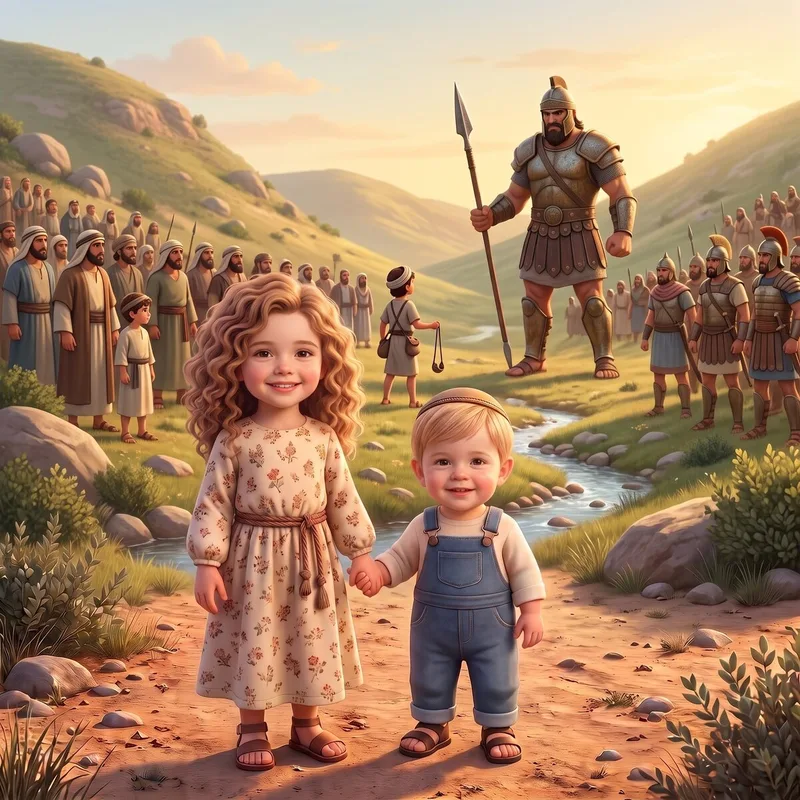
Dovid & Golyas is one of the stories in Torah Tale's Nevi'im collection, from Sefer Shmuel, alongside stories such as the birth of Shmuel and Chana's tefillah at Shiloh. In the book, your child is the hero of the story. Their name appears throughout, and from one uploaded photo their likeness is illustrated on every page in high-resolution 3D animated-film style, standing in the camp in Emek HaElah while the story unfolds.
Up to eight siblings aged 0 to 18 can be in the same book. The softcover and hardcover open with a dedication page, every format ends with a family page where parents, grandparents and other relatives you add appear with the children, and every book ends with a dedicated discussion page of ten questions about the story, mixing comprehension with middos. Every book is written with careful rabbinical guidance and strict tznius and is reviewed by our team before it goes to print.
You can order a single book, or subscribe to the Nevi'im collection on the Monthly plan (four books a month in one delivery, billed monthly) or the Yearly plan (the whole collection paid once, $30 off, still four books a month until it is done).

Five questions for the Shabbos table
These work well after the fish, and they work even better if the children have the story fresh. Ask them in this order:
- Golyas called out every morning and every evening for forty days. Why do you think nobody answered him?
- Dovid told Shaul about the lion and the bear. What was he really trying to say?
- Why did Dovid take off Shaul's armor, even though it was the best armor in the camp?
- Dovid said, the battle is Hashem's. What does that mean when you are the one who has to run forward?
- Is there something small you do that nobody sees, which is quietly making you stronger?
If you have the Torah Tale book, the discussion page at the end gives you ten more, so nobody has to invent questions on the spot.
A weekday activity: five smooth stones
On a weekday afternoon or on erev Shabbos, take a walk and let each child collect five smooth stones, the way the pasuk describes Dovid choosing his from the stream. Count them out loud, and then ask how many Dovid actually used. The answer, one, is the whole idea: he prepared properly, and Hashem did the rest.
Families who order a book can add the matching 8.5"x11" black-and-white coloring book as a one-time add-on, which belongs to the same kind of weekday afternoon, before Shabbos or during Chol HaMoed, never on Shabbos or Yom Tov. The storybook itself is exactly right for Shabbos: it is made to be read at the table or on a long Yom Tov afternoon.
Creating a book takes about five minutes and starts with a free account and a few short questions: each child's name, boy or girl, age and one photo, any siblings, the story, your community (asked once), the language (English, Hebrew or Yiddish) and the printed format. Ready to put your child in Emek HaElah? Create the book and let them hear Dovid's answer in their own name.
Frequently asked questions
Where is the story of Dovid and Golyas found?
It is in Nevi'im, in Sefer Shmuel, in Shmuel Aleph chapter 17. It is not in the Torah (the Chumash), so when you learn it with children it is worth saying plainly that this happened later, in the days of Shaul HaMelech, after the time of the Shoftim and after Shmuel HaNavi anointed Dovid in Beis Lechem.
What is the lesson of Dovid and Golyas for children?
Dovid says the lesson himself: Hashem does not save with a sword and a spear, and the battle is Hashem's. A child learns that being small, young or less experienced is not a reason to give up on doing the right thing, and that courage comes from knowing Who is really fighting for you. The story also teaches that what you have already done faithfully in private, like Dovid guarding his father's sheep, is what prepares you for the moment everyone is watching.
How do I explain Dovid and Golyas to a 5-year-old?
Say it in one or two sentences: a very big, very loud man stood in front of all of Yisrael every day and said nasty things about Hashem, and nobody would answer him. Dovid was a young shepherd, and he said, I will go, because Hashem helps me. Then he took his sling and a stone, and Hashem helped him, and the whole army of Yisrael was saved.
How many stones did Dovid take, and why five?
The pasuk (Shmuel Aleph 17:40) says Dovid chose five smooth stones from the stream and put them in his shepherd's bag. The pasuk itself does not explain the number. In the end he used one stone, which is a nice detail to point out to a child: he was prepared, and Hashem did the rest.
Is the story of Dovid and Golyas too frightening for young children?
Told simply it is not frightening, because the danger is over quickly and the ending is a rescue. For a young child, stay with the picture of a loud, boastful man who scared everyone and a boy who was not scared because he trusted Hashem, and leave out the weapons, the measurements and the end of the battle. Older children can handle the details as the pesukim give them.
Can I get a personalized book of Dovid and Golyas for my child?
Yes. Dovid & Golyas is one of the stories in Torah Tale's Nevi'im collection, from Sefer Shmuel, and the book stars your own child, with their name and, from one uploaded photo, their likeness on every page in 3D animated-film style. It comes as a 6"x6" board book with rounded safety corners for ages 0-4, an 8"x8" softcover for ages 4-8 or an 8"x8" hardcover for ages 5-18, and up to eight siblings aged 0 to 18 can appear in the same book. Creating it takes about five minutes at torahtale.com/create.