Welcoming Guests (הכנסת אורחים) for Kids: Avraham's Tent
Hachnasas orchim is the mitzvah of welcoming guests warmly into your home. Here is how Avraham Avinu kept it, what it asks of a child, and how to explain it to a 4-year-old and an 8-year-old.
Published by Torah Tale.
Create this book for your child
Hachnasas orchim (הכנסת אורחים) is the mitzvah of welcoming guests into your home and caring for what they need, and children usually grasp it faster than almost any other mitzvah because they can see it happen at their own front door. Its great example is Avraham Avinu in Parshas Vayeira, who ran toward strangers instead of waiting for them to knock.
What is hachnasas orchim, and where does it come from?
The mitzvah means opening your home and your table to a guest, whether for a meal, a place to sleep or just a warm welcome. We learn its spirit from Avraham and Sarah's tent, described in Parshas Vayeira.
Chazal take it very seriously. The Gemara in Shabbos (127a) teaches that welcoming guests is greater than receiving the Shechinah, and it learns this from Avraham's words and actions at the start of the parsha. That is a remarkable thing to tell a child: a warm welcome at home really matters to Hashem.
What happens when Avraham welcomes the three guests?
The Torah tells us that Avraham was sitting at the entrance of his tent in the heat of the day when he looked up and saw three men standing nearby. Right away he ran to meet them and bowed down. He asked them not to pass by, and offered water, a chance to wash their feet, rest under the tree and a little bread to refresh themselves.
Rashi explains, based on Chazal, that it was the third day after Avraham's bris, and that he was sitting at the door hoping that guests would come. Even while recovering, he was looking for someone to welcome.
Then he did far more than he had promised. He hurried to Sarah and asked her to bake bread. He ran to the cattle himself, chose a good calf and gave it to his na'ar to prepare. He set out butter, milk and the calf in front of them and stood over them while they ate. Chazal learn from this that a righteous person says little and does much.
The guests then brought wonderful news that Sarah would have a son. A simple meal in a tent became the setting for one of the most important moments in the Torah.
What does the mitzvah teach a child?
Hachnasas orchim teaches several middos at once, and each one is within a child's reach:
- Running toward a mitzvah. Avraham did not wait to be asked. A child can learn to notice who just walked in and move toward them.
- Doing more than you said. He offered a little and gave a lot. A child can offer a drink, then also pull out a chair.
- Making someone feel wanted. A good welcome is about how the guest feels, not only about the food.
- Working together. Avraham, Sarah and the na'ar each had a part, and a family can share jobs the same way.
For a related middah, see Loving Every Yid, which talks about caring for a fellow Yid at the table.
How do I explain hachnasas orchim to a 4-year-old and an 8-year-old?
For a 4-year-old, keep it to one picture and one job. Say: "When someone comes to our house, we smile, say hello and give them something to drink, like Avraham Avinu did." Then let your child do one real thing: open the door with you, carry the napkins or set out a cup at the extra place.
For an 8-year-old, add the why and the how. Talk about how Avraham ran even though he was recovering, how he promised a little and gave a lot, and how the whole household helped. Then ask what a guest might be feeling when they arrive, since a newcomer may feel shy, tired or hungry. Let your child choose one thing to do for the next guest and notice how it goes.
One practical note: parents decide who is invited. Children welcome the guests the family has invited, and your child can ask you privately if they are ever unsure about someone.
What is the Torah Tale book about welcoming guests like?
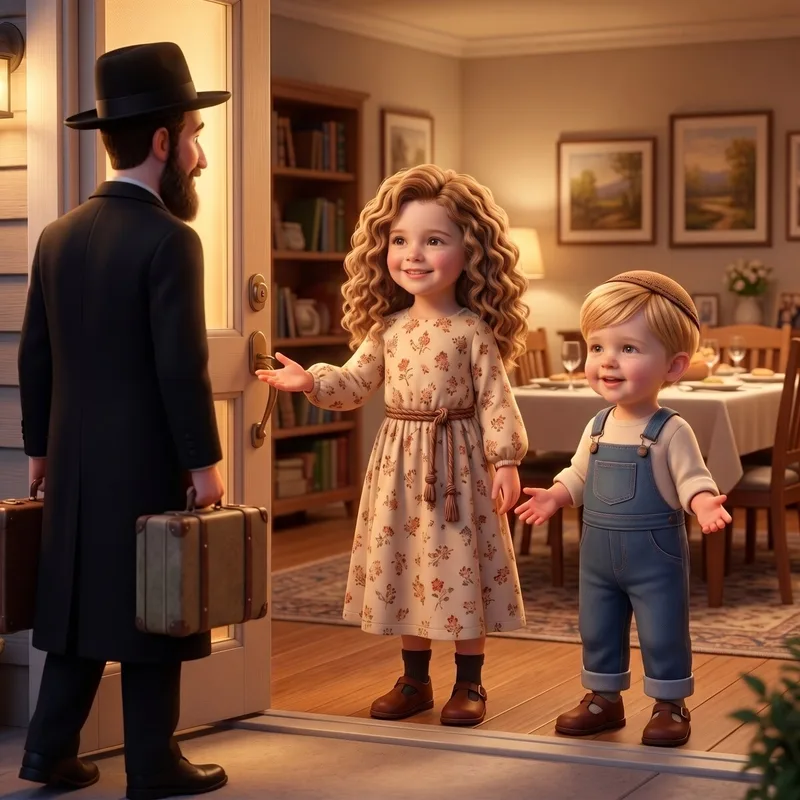
The Welcoming Guests book is part of the Mitzvos collection, which presents the mitzvos a child keeps, set in everyday life today. It stars your child by name and likeness, drawn in 3D animated-film style from the one photo you upload. Up to eight siblings can appear in the same book.
Every Torah Tale book ends with a dedicated discussion page with 10 questions about the story, mixing comprehension with middos. That page turns the book from something read to a child into something talked about at the table. Softcover and hardcover books open with a dedication page, and if you add parents and grandparents with their photos, they appear with the children on a closing family page in every format.

Softcover 8″×8″

Hardcover 8″×8″

Board book 6″×6″

Coloring book 8.5″×11″
Torah Tale offers three formats: a 6x6 board book with rounded safety corners for ages 0-4, an 8x8 softcover for ages 4-8, and an 8x8 hardcover for ages 5-18. You can choose English, Hebrew or Yiddish, and each book is written with careful rabbinical guidance and strict tznius. An optional matching coloring book is a weekday activity, for an erev Shabbos or a weekday afternoon, never for Shabbos or Yom Tov.
What can we ask at the Shabbos table about welcoming guests?
Reading is entirely appropriate on Shabbos, and a storybook is a good fit for the table. Whether or not you have guests that week, these questions use talking only:
- Why do you think Avraham ran to the guests instead of just waving hello?
- What did Avraham offer first, and what did he end up giving them?
- Who helped Avraham in the story, and what did each one do?
- How do you feel when someone is happy that you came to their house?
- What is one small thing we could do for the next guest that would make them feel welcome?
- Is it ever hard to welcome someone? What might make it easier?
Parents of a younger child can ask only the first, third and fifth. For an older child, the sixth question often starts the longest conversation. You can also tie in bikur cholim, since Chazal connect this scene to Hashem's visit to Avraham after his bris.
If you would like a book where your child is the one keeping the mitzvah, you can create the book. It takes a free account and a few short questions: each child's name, boy or girl, age and one photo, any siblings, the story, your community (asked once), the language and the format.
Frequently asked questions
What is hachnasas orchim in simple words for a child?
Hachnasas orchim means welcoming guests into our home and making them feel comfortable and wanted. It includes greeting them kindly, offering something to drink or eat, and giving them a place to sit or rest. We learn it from Avraham Avinu, who ran to welcome travelers in Parshas Vayeira.
What is the lesson of Avraham and the three guests?
The Torah shows that welcoming guests is done with energy and care, not reluctantly. Avraham ran to meet them, offered water and rest, and then had a full meal prepared. Chazal learn from this that a righteous person says little and does much.
How do I explain welcoming guests to a 4-year-old?
Keep it concrete: when someone comes to our house, we say hello with a smile, offer a cup of water and show them where to sit. Practice before a guest arrives by letting your child be the one to open the door with you, or set out the cups. One sentence is enough: a guest should feel happy that they came.
Is hachnasas orchim only for Shabbos guests?
No. Shabbos guests are a well-known way families keep it, but the mitzvah applies on any day of the week to anyone who needs a welcome, a meal or a place to rest. Parents decide whom to invite, and children take part in welcoming the guests the family has invited.
What does a personalized Torah Tale book about welcoming guests include?
It is part of the Mitzvos collection, set in everyday life today, and it shows your child by name and likeness in 3D animated-film style, based on the one photo you upload. Every book ends with a discussion page of 10 questions mixing comprehension with middos, and if you add parents and grandparents they appear with the children on a closing family page. It comes in English, Hebrew or Yiddish.