Eliyahu's Chariot of Fire for Kids: Elisha, the Mantle & Staying Close
Eliyahu HaNavi is taken up in a whirlwind while Elisha refuses to leave him. A parent's guide to the story, its lessons, how to explain it to a 3-4-year-old, a 6-7-year-old and a 9-12-year-old, and questions for the Shabbos table.
Published by Torah Tale.
Create this book for your child
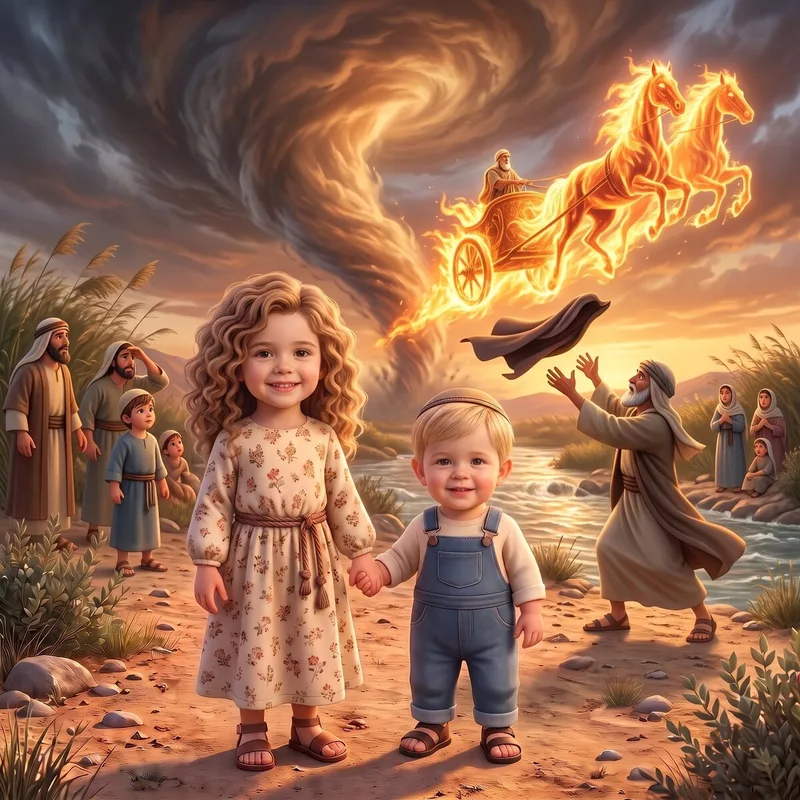
Eliyahu's chariot is the story from Sefer Melachim Bet, chapter 2, in which Eliyahu HaNavi is taken up to the shamayim in a whirlwind while his talmid Elisha walks beside him and refuses to turn back. Children are drawn to the chariot and horses of fire, and parents can use it for something quieter: staying close to a rebbi, asking for what really matters, and carrying on the work.
What happens in the story of Eliyahu's chariot?
The pasuk tells us in Sefer Melachim that Hashem was about to take Eliyahu up to the shamayim in a se'ara, a whirlwind. Eliyahu and Elisha were walking together from Gilgal.
Three times Eliyahu told Elisha to stay where he was, because Hashem was sending him on to Beis El, then to Yericho, then to the Yarden. Each time Elisha answered, "As Hashem lives and as you live, I will not leave you." In Beis El and again in Yericho, the bnei haneviim came to Elisha and asked if he knew that Hashem was taking his master that day. He answered that he knew, and asked them to be quiet.
At the Yarden, fifty of the bnei haneviim stood at a distance. Eliyahu took his mantle, rolled it up and struck the water. The water split, and the two of them crossed on dry land. If your children know the story of crossing the Yarden in the days of Yehoshua, they will remember that this river has parted before.
While the two were walking and talking, a chariot of fire and horses of fire appeared and came between them, and Eliyahu went up in the whirlwind to the shamayim. Elisha saw it and cried out, "Avi, avi, rechev Yisrael u'farashav" - my father, my father, the chariot of Yisrael and its horsemen. Then he could no longer see him.
Why did Elisha refuse to leave Eliyahu?
The pasuk gives us Elisha's words, and from them we can learn what a talmid is. He knew what day it was, since he told the bnei haneviim so, and he still would not step away. A talmid who wants to learn from his rebbi stays for the last hour too.
Elisha also calls Eliyahu "my father." That is how a child can understand the relationship: a rebbi is someone who gives you something of himself, and you hold on to him because of that.
You may already know Eliyahu from the story of Eliyahu on Har HaCarmel. This story shows the other side of the navi, the one who taught a talmid so well that the talmid could take his place.
What is the double portion Elisha asked for?
Before Eliyahu was taken, he told Elisha to ask what he should do for him. Elisha asked for pi shnayim b'ruchacha, a double portion of Eliyahu's spirit. The meforshim explain this in terms of the double share a firstborn son receives: Elisha was asking to be Eliyahu's true successor.
Eliyahu answered that it was a hard thing to ask. If Elisha saw him as he was taken, it would be so, and if not, not. Elisha was watching closely, and he saw.
When Eliyahu was gone, Elisha tore his own clothes in grief. Then he picked up the mantle that had fallen from Eliyahu, went back to the bank of the Yarden and struck the water, asking, "Where is Hashem, the God of Eliyahu?" The water split. The bnei haneviim from Yericho who were watching said that the spirit of Eliyahu rested on Elisha, and they came to meet him and bowed to him.
How do I explain Eliyahu's chariot to children of different ages?
- Ages 3-4: Tell it as a short story with a few pictures in your head: Eliyahu the navi, Elisha who loved him and stayed close, the river that split, and the fire chariot from Hashem. End with the mantle: Elisha picked it up and carried on. Skip the question of what happens after the whirlwind.
- Ages 6-7: Count the three times Elisha said "I will not leave you." Ask why he kept saying it, and what it means to stay with someone when it would be easier to stop. Introduce the idea of a talmid and a rebbi.
- Ages 9-12: Talk about the request for pi shnayim and Eliyahu's answer that it depended on whether Elisha saw him. What does it take to really learn from a rebbi: being there, paying attention, and seeing what he is doing? Look together at the pesukim of Melachim Bet chapter 2.
What is a personalized Torah Tale book of this story like?
Torah Tale makes a book of Eliyahu's chariot from the Nevi'im collection, with your child's name and, from one uploaded photo, their likeness on every page, in 3D animated-film style. It is written with careful rabbinical guidance and strict tznius, and our team reviews each book before it goes to print.
Every book ends with a discussion page of 10 questions about the story, mixing comprehension with middos: what happened, and what it asks of the child. For this story that means a child can answer what Elisha said at each stop, and also what it means to stay loyal to someone who teaches you.

Softcover 8″×8″

Hardcover 8″×8″

Board book 6″×6″

Coloring book 8.5″×11″
For the format, go by age: a board book (6x6 with rounded safety corners) is for ages 0-4, a softcover (8x8) for ages 4-8, and a hardcover (8x8) for ages 5-18. Softcover and hardcover open with a dedication page. If you add parents, grandparents and other relatives with their photos, they appear with the children on a closing family page in every format. You can also add a matching black-and-white coloring book (8.5x11), which is a weekday activity for erev Shabbos or a weekday afternoon, never for Shabbos or Yom Tov. The storybook itself is a good fit for reading at the Shabbos table.
Creating a book takes about five minutes. You open a free account and answer a few short questions: each child's name, boy or girl, age and one photo, any siblings, the story, your community (asked once), the language and the format. Languages are English, Hebrew and Yiddish.
What questions can we ask about this story at the Shabbos table?
These are for talking, not writing, so they work well at the Shabbos table or on a long Shabbos afternoon:
- Where did Eliyahu tell Elisha to stay, and what did Elisha answer each time?
- Elisha knew this was Eliyahu's last day. Why do you think he stayed anyway?
- What did Elisha ask Eliyahu for? Why did Eliyahu say it was a hard thing to ask?
- What did Elisha do when Eliyahu was gone? Why did he pick up the mantle?
- Who is someone you stay close to so you can learn from him or her? What do you learn?
- When something important is happening, how can we really pay attention, the way Elisha did?
If you would like a quiet follow-up for a weekday, a child can act out the mantle splitting the water with a scarf. Save any drawing of the fire chariot for a weekday as well.
A book that carries your child's name through this story gives you a way to talk about loyalty and learning. When you are ready, create the book.
Frequently asked questions
What is the story of Eliyahu's chariot?
It is the story in Melachim Bet, chapter 2, of the day Hashem took Eliyahu HaNavi up to the shamayim in a whirlwind. Eliyahu's talmid Elisha stayed beside him the whole way, and a chariot of fire and horses of fire appeared between the two of them. Elisha then took up Eliyahu's mantle and carried on as navi.
Why did Elisha refuse to leave Eliyahu?
The pasuk records that each time Eliyahu told Elisha to stay behind, Elisha answered that as Hashem lives and as Eliyahu lives, he would not leave him. He knew Hashem was taking his master that day and he stayed anyway. We learn from this how a talmid holds on to his rebbi right to the end.
What did Elisha mean by asking for pi shnayim?
Elisha asked for pi shnayim b'ruchacha, a double portion of Eliyahu's spirit. The meforshim explain the request in terms of the double share a firstborn son receives, meaning that Elisha asked to be Eliyahu's true successor. Eliyahu told him it was a hard thing to ask, and that it would be granted if Elisha saw him as he was taken.
How do I explain Eliyahu's chariot to a 4-year-old?
Keep it simple: Eliyahu was a navi who spoke for Hashem, Elisha loved him and stayed close, and Hashem took Eliyahu up to the shamayim in a special way. Focus on Elisha's staying close, on the mantle he picked up, and on the Yarden splitting for him. Show the chariot of fire as something wondrous from Hashem, with no frightening detail.
Is there a personalized book about Eliyahu's chariot?
Yes. Torah Tale has a book of this story from the Nevi'im collection, with your child's name and likeness, from one uploaded photo, on every page in 3D animated-film style. Every book ends with a discussion page of 10 questions, and it is available as a board book (ages 0-4), a softcover (ages 4-8) or a hardcover (ages 5-18).