Eliyahu on Har HaCarmel for Kids: The Fire & Hashem Hu HaElokim
Eliyahu on Har HaCarmel, retold for children: the question he asked all Yisrael, the two bulls, the fire from Hashem and the rain that followed, with ways to explain it to a 3 or 4-year-old, a 6 or 7-year-old and a 9 to 12-year-old.
Published by Torah Tale.
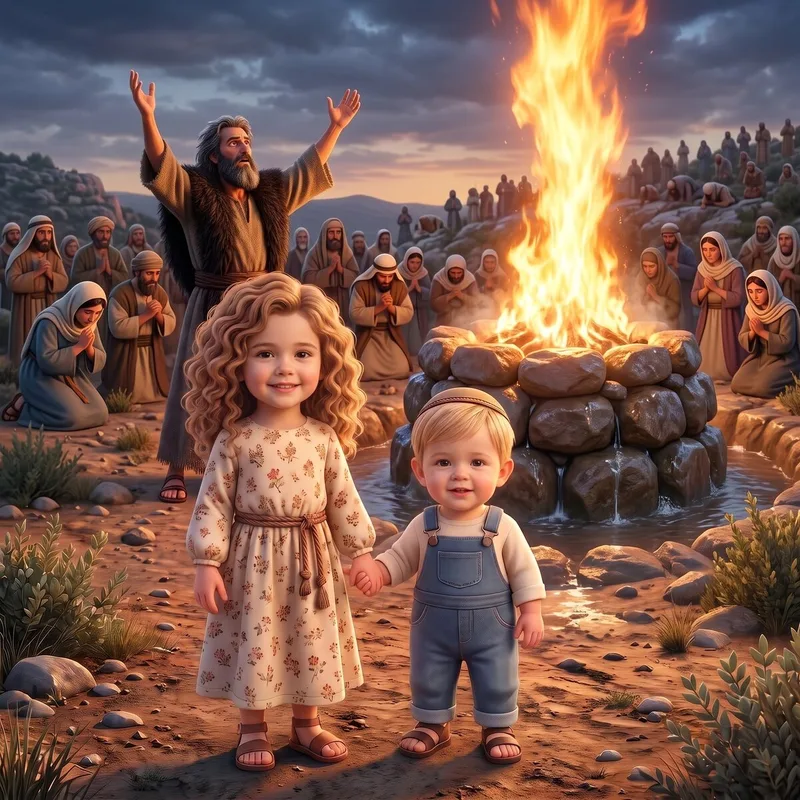
Create this book for your child
Eliyahu on Har HaCarmel (Melachim I, chapter 18) is the story of a navi who stood before all Yisrael and the 450 prophets of the Ba'al, asked the people to stop wavering, and davened that Hashem's name be known. Hashem answered with fire from heaven, and the people declared Hashem hu haElokim. Children connect to it because it has a clear question, a visible answer, and a navi who does not give up.
What happens in Eliyahu on Har HaCarmel?
Ahav was king, and Yisrael had been led into serving the Ba'al. There had been a long drought, and in its third year Hashem told Eliyahu to go and show himself to Ahav, because rain would come. On the way, Eliyahu met Ovadyahu, a man who feared Hashem and had hidden a hundred prophets of Hashem in caves. Eliyahu asked him to tell Ahav that Eliyahu was there.
Ahav called Eliyahu the troubler of Yisrael. Eliyahu answered that it was Ahav and his father's house who had caused the trouble, by leaving Hashem's mitzvos and following the Ba'alim. Then he told Ahav to gather all Yisrael and the 450 prophets of the Ba'al on Har HaCarmel.
Eliyahu proposed a test. Each side would prepare a bull on an altar, with no fire placed under it. The prophets of the Ba'al would call on their god, Eliyahu would call on Hashem, and the one who answered with fire was the true Elokim. The people said, Tov hadavar, the plan is good.
The prophets of the Ba'al called from morning until noon and kept going until the time of the evening offering. The pasuk says there was no voice, no answer, and no one paying attention.
What question did Eliyahu ask the people?
Before the test, Eliyahu asked the people, Ad masai atem poschim al shtei haseifim: how long will you hop between two opinions? If Hashem is the Elokim, follow Him, and if the Ba'al is, follow that. The pasuk tells us the people did not answer him a word.
That silence is worth pausing on with children. The people were not shouting for the Ba'al. They were standing in the middle, hoping not to have to choose.
Why did Eliyahu pour water on the mizbeach?
When it was Eliyahu's turn, he called the people close. He repaired the broken mizbeach of Hashem and took twelve stones, matching the number of the shevatim, the sons of Yaakov. He dug a trench around it, arranged the wood, and laid the bull on top.
Then he asked for four jugs of water to be poured over the offering and the wood, and then a second time and a third time. The water ran around the mizbeach and filled the trench. The pasuk does not give his reason, but the effect is plain: no one could say there was a hidden spark.
Eliyahu davened to Hashem, Elokei Avraham, Yitzchak and Yisrael, that it be known that day that Hashem is Elokim in Yisrael and that Eliyahu acted by Hashem's word. He asked Hashem to answer him so that the people would know that Hashem had turned their hearts back. Fire of Hashem fell and consumed the offering, the wood, the stones and the dust, and licked up the water in the trench. The people fell on their faces and said, Hashem hu haElokim, Hashem hu haElokim.
What is the lesson for children?
The first lesson is to choose clearly. Eliyahu was not asking for a show. He was asking Yisrael to decide whom they belonged to, and it is the same question a child meets in small ways, like whether to say a bracha when no one is watching.
The second lesson is in his tefillah. He asked that Hashem's name be known and said he had acted by Hashem's word. We learn from this that courage and humility can go together.
The third lesson comes at the end. After the fire, Eliyahu went up to the top of the Carmel and bowed down. He sent his na'ar to look toward the sea, and the na'ar found nothing, six times. The seventh time he reported a small cloud, like a man's palm, rising from the sea, and soon the sky filled and great rain fell. A child can hear in this that we keep davening and keep looking.
The words Hashem hu haElokim are also said at the end of Yom Kippur. Our Yom Kippur story for kids goes through that day with children. This chapter is also the haftarah of Parshas Ki Sisa, the parsha of the Eigel, and our Parshas Ki Sisa article gives the background to that connection.
How do I explain Eliyahu on Carmel to a 3-year-old, a 6-year-old and a 10-year-old?
Ages 3 and 4. Say it in a few sentences: some people forgot who Hashem is. Eliyahu davened, Hashem sent fire from heaven, and everyone said that Hashem is the Elokim. Then it rained, and everybody was happy. You can leave out what happened afterward to the prophets of the Ba'al.
Ages 6 and 7. Focus on the question. Ask, 'What does it mean to stand in the middle?' Children this age understand being unsure which side to join. Point out that Eliyahu was standing in front of hundreds of prophets and a whole nation, and he still said what he believed. You can compare it to Gidon's small army, where a few trusted Hashem against many.
Ages 9 to 12. Talk about the details. Why did the people say nothing at first? Why did Eliyahu make the test harder by adding water? What did he ask for in his tefillah, and what did he not ask for? Older children can notice that he asked Hashem to answer so that the people would know, which shows what he cared about.
What can we ask at the Shabbos table?
Reading from a storybook at the Shabbos table is entirely appropriate, and these questions are just for talking:
- What did Eliyahu ask the people, and why do you think they did not answer?
- What was the test, and who answered?
- Why twelve stones? Can anyone name the shevatim?
- Eliyahu waited for the rain and kept looking. When is something worth waiting and asking for again?
- What is one small way a child can show he or she chooses Hashem today?
For a weekday afternoon, collect twelve smooth stones or blocks and name a shevet for each one. When it rains, you can point out how a small cloud can grow into a full sky.
What is a personalized Torah Tale book of Eliyahu on Carmel like?

Softcover 8″×8″

Hardcover 8″×8″

Board book 6″×6″

Coloring book 8.5″×11″
This story is in the Nevi'im collection in the story picker. Your child's name and likeness, from one uploaded photo, appear on every page in high-resolution 3D animated-film style. The book is written with careful rabbinical guidance and strict tznius, and our team reviews it before it goes to print.
Every book ends with a discussion page of 10 questions about the story, mixing comprehension with middos. That page helps turn the book into something talked about at the table and not only read to a child. If you add parents and grandparents, they appear with the children on a closing family page in every format.
The formats are a 6x6 board book with rounded safety corners (ages 0-4), an 8x8 softcover (ages 4-8) and an 8x8 hardcover (ages 5-18). An optional matching coloring book is a weekday activity, for erev Shabbos or a weekday afternoon, never for Shabbos or Yom Tov itself. Creating a book needs a free account and a few short questions: each child's name, boy or girl, age and one photo, any siblings, the story, your community (asked once), the language and the printed format. It comes in English, Hebrew and Yiddish.
Ready to start? You can create the book and put your child into the story of Eliyahu on Har HaCarmel.
Frequently asked questions
What is the story of Eliyahu on Har HaCarmel?
In a long drought, Eliyahu gathered Yisrael and the 450 prophets of the Ba'al on Har HaCarmel. Each side prepared a bull and called on its god to answer with fire. The Ba'al's prophets called from morning on and received no answer, while Eliyahu davened to Hashem and fire fell from heaven. The people said Hashem hu haElokim, and rain came afterward.
What is the lesson of Eliyahu on Carmel for children?
The lesson is to choose Hashem clearly and not stay stuck in the middle. Eliyahu stood before all Yisrael and asked how long they would hop between two opinions. We also learn from his tefillah, which asked that the people know that Hashem is Elokim, and not that he be honored.
How do I explain Eliyahu and the prophets of the Ba'al to a 4-year-old?
Keep it short and simple: some people forgot who Hashem is, so Eliyahu davened that everyone would see the truth. Hashem sent fire from heaven, and everyone said that Hashem is the Elokim. You can leave out the end of the story about what happened to the prophets of the Ba'al and finish with the rain coming down.
Where is Eliyahu on Har HaCarmel in Tanach?
It is in Sefer Melachim I, chapter 18, in Nevi'im. It is also read as the haftarah of Parshas Ki Sisa, though the starting pasuk differs by minhag.
Does Torah Tale have a personalized book about Eliyahu on Har HaCarmel?
Yes, it is in the Nevi'im collection. Your child's name and likeness, from one uploaded photo, appear in 3D animated-film style, and the book ends with a discussion page of 10 questions about the story. Formats are a 6x6 board book with rounded safety corners (ages 0-4), an 8x8 softcover (ages 4-8) and an 8x8 hardcover (ages 5-18).