The Two Sticks in Yechezkel for Kids: Yehuda, Yosef & One Nation
In Sefer Yechezkel, Hashem tells the navi to take two sticks, one for Yehuda and one for Yosef, and join them in his hand as one. Here is the story, the lesson of achdus, how to explain it to children of different ages, and questions for the Shabbos table.
Published by Torah Tale.
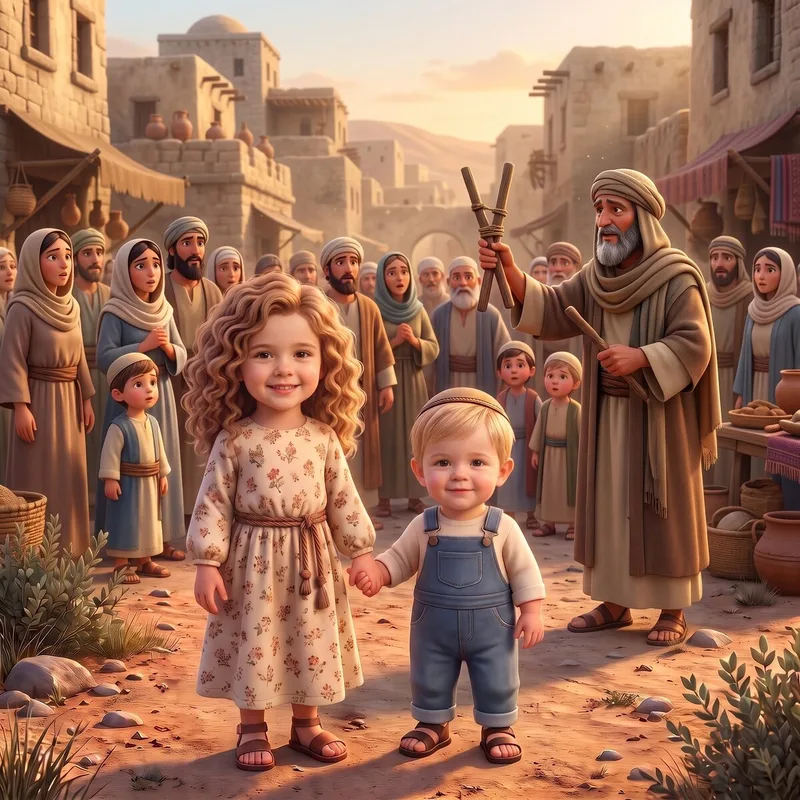
Create this book for your child
The story of the two sticks comes from Sefer Yechezkel, chapter 37. Hashem tells the navi to write on two sticks, one for Yehuda and one for Yosef, and to hold them together until they become one in his hand. Children understand it quickly because it is something they can picture and even hold: two separate things made into one.
What happens in the story of the two sticks?
Hashem tells Yechezkel to take one stick and write on it: for Yehuda and the Bnei Yisrael who are his companions. Then he takes a second stick and writes: for Yosef, the stick of Efraim, and all of Beis Yisrael his companions. The pasuk then says that Yechezkel is to bring the two close to each other, to become one stick, and they will be one in his hand.
The people are watching. The pasuk says that when the sons of his people ask, "Won't you tell us what these mean to you?", Yechezkel is to answer them in the name of Hashem. The writing on the sticks is done in front of their eyes, so the message is something they see before they hear it.
Hashem's explanation is clear in the pesukim. He will take the Bnei Yisrael from among the nations where they went, gather them from all sides and bring them to their own land. He will make them one nation in the land, on the mountains of Yisrael, with one king for all of them. They will never again be two nations or be divided into two kingdoms.
Why were the sticks for Yehuda and for Yosef?
Sefer Melachim tells that after Shlomo HaMelech the kingdom split in two. One part was led by Yehuda's side, and the other, called Yosef or Efraim in the pasuk, went its own way. The sticks in Yechezkel stand for these two parts of Bnei Yisrael, and the promise is that they will be joined again.
The passage also goes on to promise that they will no longer defile themselves with idols, that Dovid, Hashem's servant, will be king over them and one shepherd for all of them, and that Hashem will make a covenant of peace with them. His Mishkan will be among them forever, and He will be their G-d while they are His people. This is one of the great promises of the geulah, and it is a gentle one for children to hear.
The same perek also contains the vision of the dry bones, which comes right before the sticks. If your child already knows that one, our article on the Valley of Dry Bones is a good place to start. The two sticks continue the same message of hope.
This passage is also the haftarah of Parshas Vayigash. In that parsha Yehuda steps forward to Yosef, so the pairing is easy to see. You can read more in Parshas Vayigash for Kids.
What is the lesson of the two sticks for children?
The lesson is achdus. Hashem wants the Yidden to be one, and the two sticks show that things which were separated can be joined. A child does not need to understand kingdoms to understand that a quarrel can make two friends feel like two sticks, and that a kind word can bring them back together.
Notice that Yechezkel does not do this by force. He holds the sticks and Hashem makes them one, as the pasuk says: they will be one in My hand. Children can learn from this that we do our part by speaking kindly and making peace, and we trust that Hashem brings everyone together in the end.
Two of our articles fit well alongside this one: Making Peace with Friends and Loving Every Yid.
How do I explain the two sticks to a 4-year-old, a 7-year-old and an 11-year-old?
Ages 3 to 5. Keep it to one picture. Hold two sticks, say that Hashem told Yechezkel to make them one, and say that Hashem wants all Yidden together like one big family. A child this age can hold the sticks together and say "one."
Ages 6 to 8. Add the names Yehuda and Yosef, and explain that the people were split into two groups. Tell them that the people asked Yechezkel what the sticks meant, and Hashem answered through him. Then ask who in their own life they might want to be "one stick" with again after a quarrel.
Ages 9 to 12. Read the pesukim together and notice what Hashem promises: one nation, one king, no more idols, a covenant of peace and the Mishkan among them. Ask why a sign that people can see is sometimes stronger than words. You can also connect it to Parshas Vayigash and ask what it took for Yehuda to bring peace in his family.
What is a personalized Torah Tale book of this story like?
Torah Tale makes a personalized book of this story in the Nevi'im collection. Your child's name and likeness, taken from one uploaded photo, appear on every page, illustrated in high-resolution 3D animated-film style. Up to eight siblings, ages 0 to 18, can appear in the same book, so it can be a shared story for the whole family.

Softcover 8″×8″

Hardcover 8″×8″

Board book 6″×6″

Coloring book 8.5″×11″
The book comes in three formats: a 6x6 board book with rounded safety corners for ages 0-4, an 8x8 softcover for ages 4-8, and an 8x8 hardcover for ages 5-18. Softcover and hardcover books open with a dedication page. If you add parents and grandparents, they appear with the children on a closing family page in every format.
Every book is written with careful rabbinical guidance and strict tznius, and reviewed by our team before it goes to print. Every book also ends with a discussion page of 10 questions that mix comprehension with middos. That page is what turns the book from something you read to your child into something talked about at the table.
What can we talk about at the Shabbos table?
Reading is a lovely thing to do on Shabbos, and so is talking about a story. These questions need only conversation:
- What did Hashem tell Yechezkel to write on the two sticks?
- Why did the people ask Yechezkel what the sticks meant?
- What does Hashem promise will happen to the two groups of Yidden?
- When have you felt like "two sticks" with a friend or a brother or sister? What helped you become one again?
- What is one thing we can do this week to bring someone closer?
For a weekday activity, not for Shabbos or Yom Tov, since writing is melacha, take two craft sticks and write a name on each. Then join them with a rubber band or tape while you retell the story. If you have a coloring book of the story, a weekday afternoon or erev Shabbos is the time for it, never Shabbos itself.
Ready to make this story your child's own? It takes about five minutes: a free account and a few short questions, such as the child's name, boy or girl, age and photo, plus your community (asked once), the language and the format. You can create the book now.
Frequently asked questions
What is the story of the two sticks in Yechezkel?
In Sefer Yechezkel chapter 37, Hashem tells Yechezkel to take one stick and write on it for Yehuda and the Bnei Yisrael who are his companions, and another stick for Yosef, the stick of Efraim, and all of Beis Yisrael his companions. Yechezkel brings the two together so that they become one stick in his hand. Hashem explains that this shows He will gather the Yidden from among the nations and make them one nation in their land.
What is the lesson of the two sticks for kids?
The central lesson is achdus, being one. The two sticks stand for two groups of Yidden who were separated, and Hashem promises to bring them together. For children this becomes a question of how we act: speaking kindly, making peace, and not letting a quarrel keep us apart.
How do I explain the two sticks to a 4-year-old?
Hold up two sticks, or two pencils, and say that Hashem told Yechezkel to join them and make them into one. Then explain that the sticks stand for Yidden, and Hashem wants all of us to be together like one family. Keep it short and let your child hold the two sticks together.
Why were there two sticks, one for Yehuda and one for Yosef?
The pasuk names Yehuda on one stick and Yosef, called the stick of Efraim, on the other. Sefer Melachim tells that the kingdom split in two after Shlomo HaMelech, and the two sticks stand for those two parts of Bnei Yisrael. The promise in the passage is that they will never again be two nations or two kingdoms.
Is there a Torah Tale book about Sefer Yechezkel?
Yes, this story is in the Nevi'im collection. The child's name and likeness, from one uploaded photo, appear on every page in 3D animated-film style, and the book ends with a discussion page of 10 questions mixing comprehension with middos. Creating it takes a free account and a few short questions, starting at torahtale.com/create.