The Valley of Dry Bones for Kids: Yechezkel's Vision & Hope
Yechezkel sees a valley of very dry bones, speaks as Hashem commands, and they come together and stand up. Here is the story, what the pasuk says it means, and how to explain it to children of different ages.
Published by Torah Tale.
Create this book for your child
The Valley of Dry Bones is the vision in Sefer Yechezkel, chapter 37, where the navi sees a valley full of very dry bones, speaks to them as Hashem commands, and watches them come together and stand up. The pasuk explains it as a promise to Bnei Yisrael, who felt that their hope was lost. Children respond to it because the message is simple and strong: nothing is too far gone for Hashem.
What is the story of the Valley of Dry Bones?
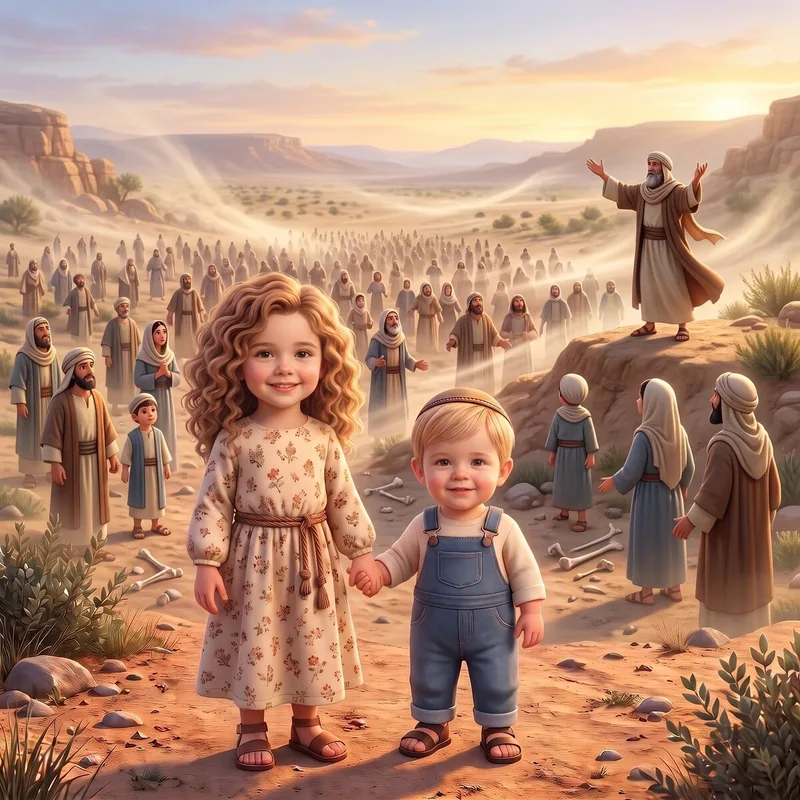
The ruach of Hashem carries Yechezkel out and sets him down in a valley that is full of bones. He is led around them, and the pasuk tells us there are very many, and that they are very dry.
Hashem asks him, "Ben adam, will these bones live?" Yechezkel does not say yes or no. He answers humbly that Hashem knows.
Then Yechezkel is told to speak to the bones: "Dry bones, hear the word of Hashem." Hashem says He will bring ruach into them and they will live, with sinews, flesh and skin.
As Yechezkel speaks, there is a noise, a rattling, and the bones come together, bone to its bone. Sinews and flesh appear and skin covers them, but there is still no ruach in them.
So Yechezkel is told to speak to the ruach: come from the four winds and breathe into these. He does, and the ruach enters them. They live and stand on their feet, a very, very great army.
What does the Valley of Dry Bones mean?
The pasuk itself gives the explanation, so we do not have to guess. Hashem tells Yechezkel that these bones are the whole house of Yisrael. They are saying, "Our bones have dried up, our hope is lost, we are cut off."
Hashem's answer is a promise. He will open their graves, bring His people up, and bring them to the land of Yisrael. He will put His ruach in them, they will live, and He will place them on their own land. Then they will know that He is Hashem.
The chapter continues with a second vision. Yechezkel takes two sticks, one marked for Yehudah and one for Yosef, the stick of Efrayim, and joins them into one in his hand. Hashem promises that Yisrael will no longer be two nations, but one nation in the land. He also promises that His Mishkan will be among them.
Chazal discuss this vision at length in Maseches Sanhedrin 92b. For a child, the best place to start is the pasuk's own explanation.
What is the lesson for children?
The lesson is hope, which is bitachon in practice. The Yidden said their hope was lost, and Hashem sent Yechezkel to tell them the opposite. A child can learn that when something looks finished, whether a broken friendship or a hard time, we keep davening and we keep hoping.
There are other things worth noticing in the story:
- Humility. When asked if the bones can live, Yechezkel says Hashem knows. It is a good model for how a child can answer a question that is bigger than he is.
- Listening. Yechezkel speaks exactly when and as he is told, first to the bones and then to the ruach.
- Stages. The bones come together first, and only then does the ruach come. One thing we can notice is that big changes can happen in steps, and we need patience between them.
- Unity. The two sticks become one in Yechezkel's hand, a picture of Yidden joined together.
How do I explain it to a 4-year-old, a 7-year-old and an 11-year-old?
Around 4: "Yechezkel was a navi. Hashem showed him a valley of old, dry bones, and then made them into a big group of people standing up. Hashem can make sad things good again." That is enough. There is no need to dwell on what the bones were.
Around 7: Add the question and the stages. Hashem asked if the bones could live and Yechezkel said Hashem knows. Then the bones came together, and then the ruach came. Ask what the bones stood for, and let your child find the pasuk's answer: the Yidden who thought their hope was lost.
Around 11: Read the words of the Yidden in the pasuk, "our hope is lost," and Hashem's answer, and talk about what it means to keep hoping in a long galus. Add the two sticks and the promise of one nation. It is also the haftarah of Shabbos Chol HaMoed Pesach, so an older child may have already heard it.
What can we ask at the Shabbos table?
Talking, questions and stories are all that is needed here. Try these:
- Why do you think Yechezkel answered, "You know," and did not guess?
- What happened to the bones first, and what was still missing?
- Who were the bones, according to Hashem?
- What did the Yidden say when they felt hopeless?
- When did you feel something was finished, and then it got better?
- What can we say to a friend who is feeling hopeless?
What is a personalized Torah Tale book of this story like?
Torah Tale makes a personalized storybook of Sefer Yechezkel and the Valley of Dry Bones, from the Nevi'im collection. Your child is the hero: their name and, from one uploaded photo, their likeness appear on every page, illustrated in 3D animated-film style. Up to eight siblings, ages 0 to 18, can appear in the same book. If you add parents and grandparents with their photos, they appear with the children on a closing family page in every format.

Softcover 8″×8″

Hardcover 8″×8″

Board book 6″×6″

Coloring book 8.5″×11″
Every book ends with a discussion page of 10 questions that mix comprehension with middos, so it becomes something talked about at the table and not only read to a child. The book is written with careful rabbinical guidance and strict tznius, and our team reviews it before it goes to print. Customers do not preview or approve the book before printing.
There are three formats: a board book, 6"x6" with rounded safety corners, for ages 0-4; a softcover photo book, 8"x8", for ages 4-8; and a hardcover photo book, 8"x8", for ages 5-18. Softcover and hardcover open with a dedication page. A book can be ordered in English, Hebrew or Yiddish.
The storybook is for reading, including on Shabbos and Yom Tov. An optional matching coloring book, 8.5"x11" in black-and-white line art, can be added to a one-time order. Coloring is a weekday activity, for erev Shabbos, a weekday afternoon or Chol HaMoed, and never for Shabbos or Yom Tov itself.
Which other stories from Nevi'im go well with it?
If your child likes a vision of a navi, read Yeshayahu and the glowing coal. For a navi who feels unready to speak, there is Yirmiyahu's call. Together they show a child that a navi has a message from Hashem to deliver, and that it takes humility to deliver it.
Ready? Creating a book takes about five minutes: a free account and a few short questions covering each child's name, boy or girl, age and one photo, any siblings, the story, your community (asked once), the language and the format. You can create the book and choose Sefer Yechezkel in the Nevi'im category.
Frequently asked questions
What is the story of the Valley of Dry Bones?
In Sefer Yechezkel chapter 37, the ruach of Hashem carries Yechezkel to a valley full of very dry bones. Hashem tells him to speak to the bones, and they come together, are covered with sinews, flesh and skin, and then receive ruach and stand up as a very great army. Hashem then explains that the bones are the whole house of Yisrael and that He will bring them back to their land.
What is the lesson of the Valley of Dry Bones for children?
The main lesson is hope, or bitachon. Bnei Yisrael said their hope was lost, and Hashem answered through Yechezkel that He would bring them back. Children can take from it that no situation is too far gone for Hashem, and that we keep davening and hoping.
How do I explain the Valley of Dry Bones to a 4-year-old?
Keep it short and gentle. Yechezkel was a navi, someone who tells Yidden what Hashem says. Hashem showed him a valley of old dry bones and then made them into a big group of people standing up, to show that Hashem can make sad things good again. Leave out the word graves, which the pasuk uses only when it explains the vision.
Is the Valley of Dry Bones read on a Yom Tov?
It is read as the haftarah on Shabbos Chol HaMoed Pesach. Many families therefore meet the story around Pesach. It is a good story to read at any time of year, though.
Is the Valley of Dry Bones too scary for young children?
It does not have to be. The pasuk describes bones coming together and standing up, and it explains the vision as a promise of hope. You can focus on that, and on Yechezkel's humble answer, 'You know.' A parent knows best when a child is ready for the full retelling.
Is there a personalized book about the Valley of Dry Bones?
Yes. Torah Tale has a personalized storybook of Sefer Yechezkel and the Valley of Dry Bones in its Nevi'im collection, starring your child by name and likeness. Every book ends with a discussion page of 10 questions that mix comprehension with middos, and it can be read at the Shabbos table.