Yirmiyahu's Call for Kids: "I Am Only a Na'ar" and the Almond Branch
Sefer Yirmiyahu opens with a young man who tells Hashem he is too young to speak, and with Hashem's answer: do not say that. Here is the story retold for children, what the almond branch and the boiling pot mean, how to explain it at different ages, and questions for the Shabbos table.
Published by Torah Tale.
Create this book for your child
Sefer Yirmiyahu opens with a conversation that children understand immediately. Hashem tells Yirmiyahu that He knew him and set him apart to be a navi before he was born, and Yirmiyahu answers that he cannot do it, because he does not know how to speak and he is only a na'ar, a young person. Hashem's answer is the line the whole story turns on: do not say "I am only a na'ar." For a child who feels small, that is not an ancient sentence. That is their sentence.
What happens at the beginning of Sefer Yirmiyahu?
The sefer introduces Yirmiyahu ben Chilkiyahu, from the kohanim who were in Anasos in the land of Binyamin. The word of Hashem came to him in the thirteenth year of Yoshiyahu ben Amon, king of Yehuda. Yoshiyahu was a good king, but the generation had a long way to go, and Yirmiyahu's job would be to call them back.
Hashem tells Yirmiyahu that before He formed him He already knew him, and before he came into the world He had already set him apart and appointed him a navi to the nations. Yirmiyahu answers, "Ahah Hashem Elokim, I do not know how to speak, because I am a na'ar." He is not refusing out of laziness. He is telling Hashem that he does not think he is the right person.
Hashem replies: do not say "I am a na'ar," because you will go wherever I send you and say whatever I command you. Do not be afraid of them, for I am with you to save you. Then Hashem told him, "Behold, I have placed My words in your mouth." Yirmiyahu would not have to invent anything. He would have to carry something.
What are the almond branch and the boiling pot?
Right away Hashem shows Yirmiyahu two pictures and asks him what he sees, which is a lovely way to begin training a navi.
First: "Makel shaked ani ro'eh" - I see a branch of an almond tree. Hashem answers that He is shoked, watchful over His word to carry it out. The two words sound alike, and the picture carries the message: what Hashem said will happen will happen, and it will not drag on forever. Rashi explains that the almond brings out its fruit quickly, faster than other trees.
Second: a pot boiling over, tilted from the north. Hashem tells him that from the north the trouble will open upon all the people of the land. That is the hard half of Yirmiyahu's mission, and with younger children you can leave it at one quiet sentence: Yirmiyahu had to warn the people that if they did not come back to Hashem, difficult things were coming.
Then comes the promise that makes the whole job possible. Hashem tells Yirmiyahu that He has made him today like a fortified city, an iron pillar and walls of copper against the whole land, against the kings of Yehuda, its officers, its kohanim and the people of the land. They will fight against him and they will not overcome him, because Hashem is with him to save him. Yirmiyahu was given no promise that people would like what he said. He was given a promise that he would not break.
What is the lesson of Yirmiyahu's call for children?
The middah here is a quiet kind of courage: saying the true thing even when you are the only one saying it, and even when you are the youngest person in the room.
There is a second lesson underneath it, and it may matter even more for a child. Yirmiyahu's reason for saying no was that he was too young and not good enough at speaking. Hashem did not argue with his self-assessment. Hashem simply told him that the job came with help. A child who thinks "I'm not the smart one, I'm not the one who leads" can hear that Hashem gives people what they need for the job He gives them.
It is worth comparing this to another navi's call. Yeshayahu, in the story of the glowing coal, also felt unworthy to speak and then said "Hineni, send me." And young Shmuel, in the story that begins with Chana's tefillah, was a child in Shiloh when he was first called. Children notice the pattern quickly: Hashem keeps choosing people who are not sure they are ready.
How do I explain Yirmiyahu's call at different ages?
Ages 3 to 4. One picture only: Hashem chose Yirmiyahu to be His messenger. Yirmiyahu said, "But I'm little." Hashem said, "Don't say you're little. I'll be with you." End there. Let them say the line back to you.
Ages 6 to 7. Add the almond branch. Ask what they would say if Hashem showed them a tree branch and asked what they saw. Explain that the almond hurries to bring out its fruit, and Hashem was telling Yirmiyahu that His word comes true and does not get forgotten. Add that Yirmiyahu's job was to tell people things they did not want to hear, and that Hashem promised he would be strong as a wall.
Ages 9 to 12. Now put it in history. Yirmiyahu began in the thirteenth year of Yoshiyahu and kept going for roughly forty years, through the Churban of the first Beis HaMikdash. Chazal (Bava Basra 15a) say that Yirmiyahu wrote his sefer, Sefer Melachim and Kinos, which is Megillas Eichah, the megillah we read on Tisha B'Av. Ask them the real question: why would Hashem send a navi for forty years to a generation that mostly did not listen?
What is a Torah Tale book of this story like?
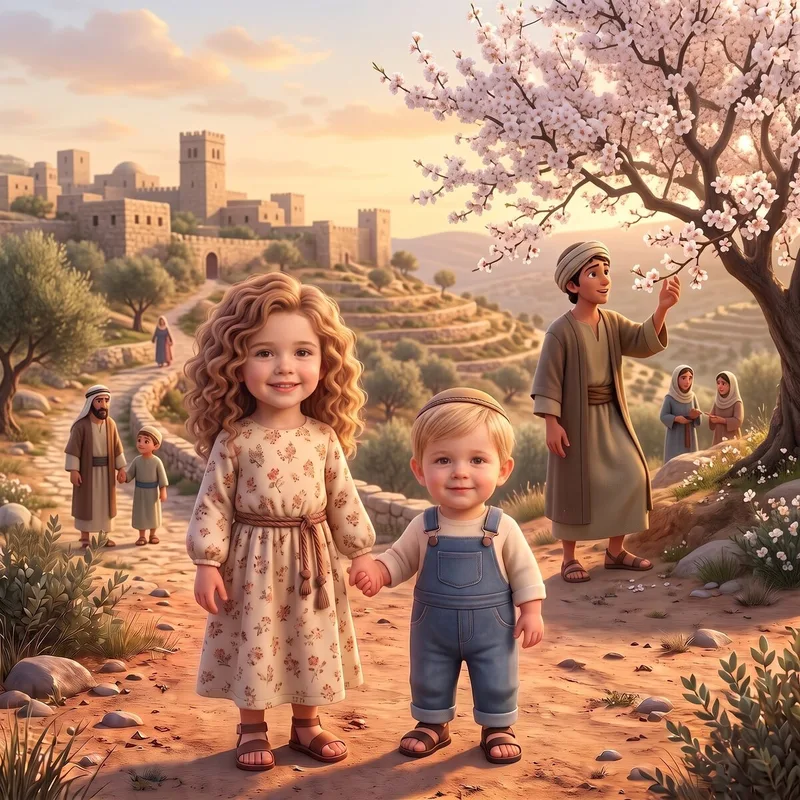
Sefer Yirmiyahu - The Navi's Call is a book in the Nevi'im collection, and in a Torah Tale book your child is in it. Their name is the name on the page, and from one uploaded photo their likeness is illustrated on every page in high-resolution 3D animated-film style, standing in Anasos, looking at the almond branch, hearing the words that a young navi once heard. Up to eight siblings, ages 0 to 18, can appear in the same book.
Every book ends with a discussion page carrying ten questions about the story, mixing comprehension with middos: what happened, and what it asks of the child. That page is what turns the book from something you read to your child into something the table talks about. If you add parents and grandparents with their photos, they appear with the children on a closing family page, in every format. Softcover and hardcover books open with a dedication page.
Formats follow the child's age: the 6x6 board book with rounded safety corners for ages 0-4, the 8x8 softcover for ages 4-8, and the 8x8 hardcover for ages 5-18. Books are available in English, Hebrew and Yiddish, and every book is written with careful rabbinical guidance and strict tznius and reviewed by our team before it goes to print. A storybook like this one is exactly right for a long Shabbos afternoon or for reading at the Shabbos table.

Softcover 8″×8″

Hardcover 8″×8″

Board book 6″×6″

Coloring book 8.5″×11″
Shabbos table questions on Yirmiyahu's call
These are for talking, not writing, so they work at the Shabbos table as they are.
- Yirmiyahu told Hashem he was too young. Was he right? Does it matter?
- Hashem said, "Do not be afraid of them, for I am with you." What is something you would do if you were not afraid of what people would say?
- Why did Hashem show Yirmiyahu a tree branch instead of just telling him the message in words?
- The almond hurries to bring out its fruit. What is something in our house that we say we will do and then take a long time to do?
- Hashem told Yirmiyahu he would be like a wall that people fight against and cannot break. What makes a person like that?
- Has anyone ever told you something true that you did not want to hear? Were you glad later?
A weekday activity and a one-sentence script
The one-sentence version, for the car or the walk home from cheder: Hashem told Yirmiyahu he was chosen before he was born, Yirmiyahu said he was only a na'ar, and Hashem said, do not say that, because I will give you the words.
During the week, take two minutes outside and look at the trees on your block. Ask which one you think wakes up first in the spring. Then tell them that Hashem chose the almond, the tree that hurries, as the picture for a promise that comes true quickly. For a weekday afternoon or erev Shabbos, the optional matching coloring book in black-and-white line art gives younger children the same scenes to color; coloring is melacha, so keep it to weekdays and before Shabbos, never on Shabbos or Yom Tov.
One more idea for older children: ask them to find one thing this week that they know is right and say it out loud to one person, even if it is uncomfortable. Yirmiyahu's whole life was that, forty years long.
How to order this story
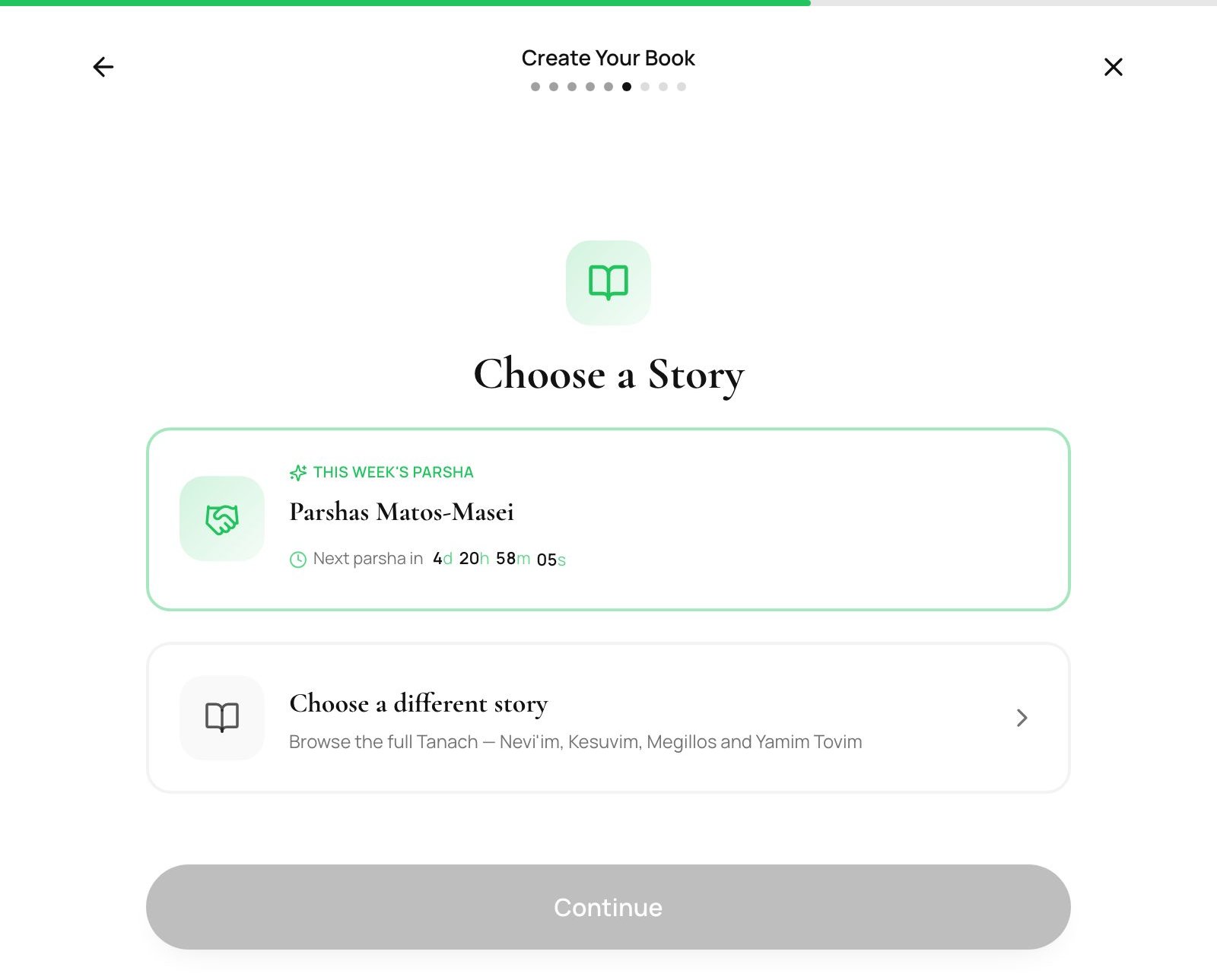
Creating a book takes about five minutes. It needs a free account and a few short questions: each child's name, boy or girl, age and one photo, any siblings, the story, your family's community (asked once), the language and the printed format. You can order Sefer Yirmiyahu - The Navi's Call as a single book, or subscribe to the Nevi'im collection, monthly at four books a month in one delivery, or yearly with the whole collection paid once, $30 off, still four books a month. US standard shipping on a one-time order is $5.99 and arrives in about 12 business days, free on orders of $75 or more; we ship worldwide, with rates shown at checkout.
If this is the story you want your child to carry, create the book and let them hear Hashem's answer with their own name on the page: do not say you are only a na'ar. You can browse the rest of the Nevi'im stories, including Dovid and Golyas, in the same story picker.
Frequently asked questions
What is the story of Yirmiyahu's call?
At the start of Sefer Yirmiyahu, Hashem tells Yirmiyahu that He knew him and set him apart to be a navi before he was even born. Yirmiyahu answers that he does not know how to speak, because he is only a na'ar. Hashem tells him not to say that, promises that He will put His words in Yirmiyahu's mouth, and tells him not to be afraid, because Hashem is with him to save him. Hashem then shows him two pictures, an almond branch and a boiling pot tipping from the north.
How do I explain Yirmiyahu's call to a 5-year-old?
Say it in one sentence first: Hashem picked Yirmiyahu to be His messenger, Yirmiyahu said he was too young, and Hashem said, do not say you are too young, I will give you the words. Then connect it to something your child knows, like being nervous to say a bracha out loud or to tell the truth in front of other children. The point for a five-year-old is not the churban, it is that Hashem chooses people and then helps them do the job.
What does "al tomar na'ar anochi" mean?
It is Hashem's answer to Yirmiyahu in the first perek of Sefer Yirmiyahu, and it means "do not say, I am only a na'ar." Yirmiyahu had just said that he could not speak because he was young. Hashem tells him that the job does not depend on his age, because he will go wherever Hashem sends him and say whatever Hashem commands him.
Why was Yirmiyahu shown an almond branch?
Hashem asked Yirmiyahu what he saw, and he answered that he saw a branch of an almond tree, a makel shaked. Hashem then told him that it is because Hashem is shoked, watchful over His word to carry it out. Rashi explains that the almond brings out its fruit quickly, faster than other trees, so it is a fitting picture for a word of Hashem that will not be delayed.
Where is Yirmiyahu in Tanach, and is he in the Torah?
Yirmiyahu is in Nevi'im, not in the Torah. Sefer Yirmiyahu is one of the later Nevi'im, and Chazal (Bava Basra 15a) say that Yirmiyahu wrote his own sefer, Sefer Melachim and Kinos, which is Megillas Eichah. His nevuah began in the days of Yoshiyahu, king of Yehuda.
Which Torah Tale format should I choose for this story?
Match the format to the child's age: the 6x6 board book with rounded safety corners is for ages 0-4, the 8x8 softcover is for ages 4-8, and the 8x8 hardcover is for ages 5-18. The story text is the same in every format, and every book ends with the discussion page of ten questions and the family page. An optional matching 8.5x11 coloring book in black-and-white line art can be added to a one-time order as a weekday activity.