Wearing Tzitzis (ציצית) for Kids: Explaining the Mitzvah at Home
Tzitzis are the strings a child sees and feels every day. Here is what the Torah says, what to tell a 3-year-old, a 6-year-old and a 10-year-old, and questions for the Shabbos table.
Published by Torah Tale.
Create this book for your child
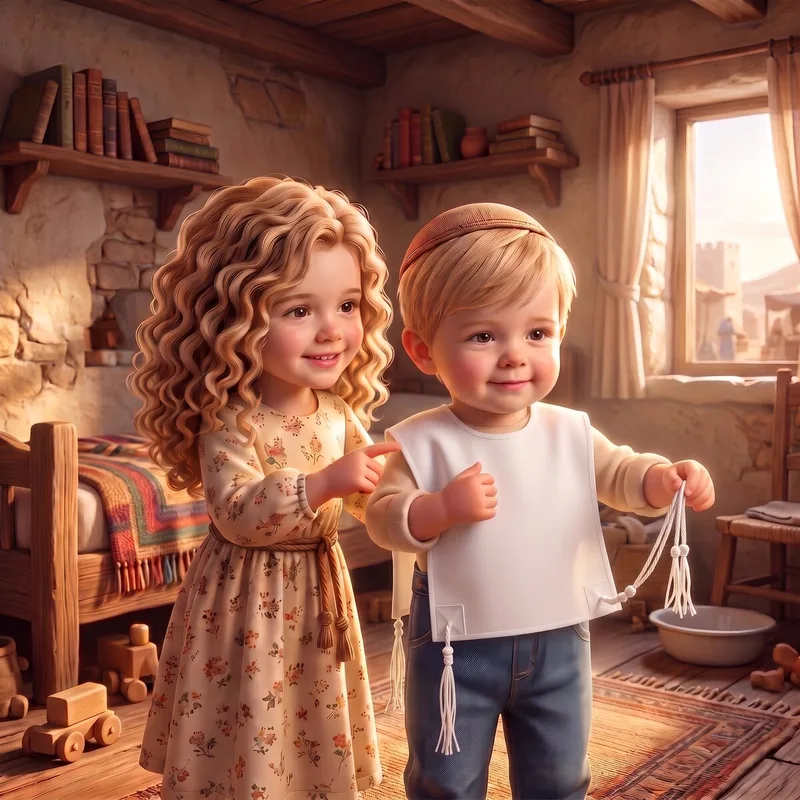
Tzitzis are the strings tied on the corners of a four-cornered garment, and the Torah tells us their purpose in one line: look at them and remember all of Hashem's mitzvos. Children connect with this mitzvah because they can see it, hold it and feel it every single day, which makes it one of the first mitzvos a little boy keeps with his whole body.
What does the Torah say about tzitzis?
The Torah tells us in Parshas Shelach (Bamidbar 15:37-41) that Hashem spoke to Moshe Rabbeinu and told him to instruct Bnei Yisrael to make tzitzis on the corners of their garments, throughout their generations. The pasuk also mentions a thread of techeles on each corner. The details of how tzitzis are made and tied are for your rav and your family minhag, but every child can learn the main words of the pasuk.
Those words are ur'isem oso uzechartem es kol mitzvos Hashem: you shall see it, and you shall remember all the mitzvos of Hashem. The pesukim end by saying that Hashem took Bnei Yisrael out of Mitzrayim to be their Elokim. We say these same pesukim as the third paragraph of Krias Shema, so a child who learns to say Shema is already saying the story of tzitzis. If you are teaching Shema at home, see Saying Shema for Kids.
Why do we wear tzitzis? The lesson for children
The lesson is written right in the pasuk: seeing leads to remembering, and remembering leads to doing. A string on the corner of a shirt is a quiet reminder that a Yid is always standing before Hashem, at home, at school and on the playground.
The pasuk also says not to follow after your heart and your eyes. On this, Rashi explains that the heart and the eyes are like scouts for the body: they see something, want it, and the body follows. The pasuk uses a word from the same root as the touring done by the meraglim, which is not surprising since this parsha begins with them. You can read more about that story in Parshas Shelach for Kids. For a child this becomes a simple idea: before I grab, I stop and remember what Hashem wants.
Rashi also brings a well-known count. The word tzitzis has the numerical value of 600, and with the eight strings and five knots, this comes to 613, the number of mitzvos. Children like this one, because it gives them something to count with their own fingers.
How do I explain tzitzis to a 3-year-old, a 6-year-old and a 10-year-old?
- Ages 3 to 4: Keep it physical and short. Show the strings, let him hold them, and say, "These are Hashem's mitzvah strings. When I see them, I remember Hashem loves me and I do mitzvos." Say it the same way each morning.
- Ages 6 to 7: Add the pasuk. Teach the words ur'isem oso uzechartem, count the knots together, and talk about a time when it was hard to listen and the tzitzis could have reminded him.
- Ages 9 to 12: Talk about the idea behind it. Why does Hashem give us something to look at? What are my eyes and my heart pulling me toward today? Let him learn the pesukim in Parshas Shelach inside, and ask how Rashi's idea of the heart and eyes as scouts fits real situations he knows.
Whatever the age, keep it positive. Tzitzis are a gift of closeness, not a rule to catch him breaking.
When does a boy start wearing tzitzis?
The halacha ties a father's chinuch obligation to the time when a boy is old enough to wear the garment properly. In many homes, boys begin around age three, and for many families this goes together with the upsherin, as described in An Upsherin for Kids. Communities differ on details such as when to teach the bracha, so ask your rav or your son's rebbi.
Tzitzis are worn by boys and men, and girls are not obligated. That does not mean a sister is left out of the story. She can help count the knots, hear the pesukim, and take part in the conversation about what the mitzvah reminds us of.
What is the personalized Torah Tale book about wearing tzitzis like?
Wearing Tzitzis is in the collection of mitzvos a child keeps, set in everyday life today, and you find it in the Mitzvos category of the story picker. Your child is the hero: his name and likeness, from one uploaded photo, appear in the book, illustrated in 3D animated-film style. Up to eight children can appear in the same book, so brothers and sisters can all be in it.

Softcover 8″×8″

Hardcover 8″×8″

Board book 6″×6″

Coloring book 8.5″×11″
The books come in a 6x6 board book with rounded safety corners (ages 0-4), an 8x8 softcover (ages 4-8) and an 8x8 hardcover (ages 5-18). For a three-year-old just starting tzitzis, the board book fits his age. The softcover and hardcover open with a dedication page. If you add parents and grandparents, they appear with the children on a closing family page in every format. A matching coloring book is available as a one-time add-on, and it is a weekday activity, for an afternoon during the week or erev Shabbos, never for Shabbos or Yom Tov itself.
Every book is written with careful rabbinical guidance and strict tznius, and is reviewed by our team before it goes to print. You can order in English, Hebrew or Yiddish, and the creation takes a free account and a few short questions: each child's name, boy or girl, age and one photo, any siblings, the story, your community (asked once), the language and the format.
Questions to ask at the Shabbos table about tzitzis
Reading the book at the Shabbos table is just right, and every book ends with a discussion page of 10 questions that mix comprehension with middos. Here are a few more to add. They are for talking only, so no pencils or crafts are needed.
- What did Hashem tell us to do when we look at our tzitzis?
- What does it mean to remember a mitzvah, and when did you remember one this week?
- The pasuk says not to follow our eyes and our hearts. When is it hard to stop yourself?
- Why do you think Hashem wanted us to wear the reminder on our clothes, where we can see it?
- What mitzvah do you want to remember tomorrow morning when you put on your tzitzis?
If you want a simple activity for a weekday, take a clean pair of tzitzis, sit down with your child, and count the strings and knots together while you tell him Rashi's 613.
When you are ready, create the book for your child. It takes about five minutes, and the story is then ready to read, talk about and keep.
Frequently asked questions
What is the lesson of tzitzis for kids?
The Torah gives the lesson itself: when you see the tzitzis, you remember all of Hashem's mitzvos and keep them. For a child this means the strings are a small, daily reminder of who he belongs to and what Hashem asks of him. The pasuk also asks us not to be led by what our hearts and eyes pull us toward.
Where is tzitzis in the Torah?
Tzitzis is in Parshas Shelach, at the end of the parsha, in Bamidbar 15:37-41. The same pesukim are the third paragraph of Krias Shema, which is why we say them every morning and evening. The mitzvah of gedilim, twisted threads on the four corners of a garment, is also mentioned in Devarim 22:12.
How do I explain tzitzis to a 4-year-old?
Keep it short and concrete: Hashem told us to put strings on the corners of our clothes so that when we look at them, we remember that Hashem is with us and that we do His mitzvos. Let the child touch the strings and count the knots with you. Let him hold them while he hears the words, rather than adding more explanation.
At what age should a boy start wearing tzitzis?
The halacha connects a father's obligation of chinuch to the age when a boy can wear the garment properly, and in many homes boys begin around the age of three, often connected with the upsherin. Families and communities differ in the details, including how and when to teach the bracha. Ask your rav or your child's rebbi what is right for your son.
Is there a Torah Tale book about wearing tzitzis?
Yes. Wearing Tzitzis is a story in the Mitzvos category, in the collection of mitzvos a child keeps, set in everyday life today. Your child's name and likeness, from one uploaded photo, appear in the book, which is illustrated in 3D animated-film style. It ends with a discussion page of 10 questions about the story.