Wearing a Yarmulke (כיפה) for Kids: How to Explain the Mitzvah at Home
A yarmulke is a small, daily reminder that Hashem is above us. Here is where the practice comes from, how to explain it to a 3-4 year old and an older child, and questions to talk about at the Shabbos table.
Published by Torah Tale.
Create this book for your child
A yarmulke (כיפה) is the head covering that Jewish men and boys wear to remember that Hashem is always above us. Children understand it quickly because it is something they can see, touch and put on themselves every morning, and it makes a big idea, yiras shamayim, small enough to hold in a hand.
Why do Yidden wear a yarmulke?
The Torah does not give a pasuk that tells us to wear one, so it is best to explain it the way it is taught: as a practice of Yidden rooted in what Chazal tell us. In Kiddushin 31a we read about Rav Huna son of Rav Yehoshua, who would not walk four amos with his head uncovered. He explained that the Shechinah is above his head.
Chazal also tell us (Shabbos 156b) that the mother of Rav Nachman bar Yitzchak told him to cover his head so that the fear of Heaven would be upon him. The poskim record the practice of Yidden to be careful about covering the head, and it is especially kept while davening, making brachos and learning Torah. For the exact halachos, ask your rav.
What is the lesson of wearing a yarmulke?
The lesson is yiras shamayim: living with the quiet awareness that Hashem is near. A yarmulke does not say anything out loud, but it tells a child, and everyone who sees him, who he belongs to.
It also teaches that a mitzvah can be small and daily. A child who puts on his yarmulke in the morning is practicing something that grows with him, the same way he practices tying his shoes or saying Modeh Ani.
How do I explain a yarmulke to a child?
The simplest approach is one sentence, then a real example. Tell the child that Hashem is above us always, and the yarmulke helps us remember. Then point to a moment he already knows, such as before a bracha, at the Shabbos table or in cheder.
For a 3 or 4 year old
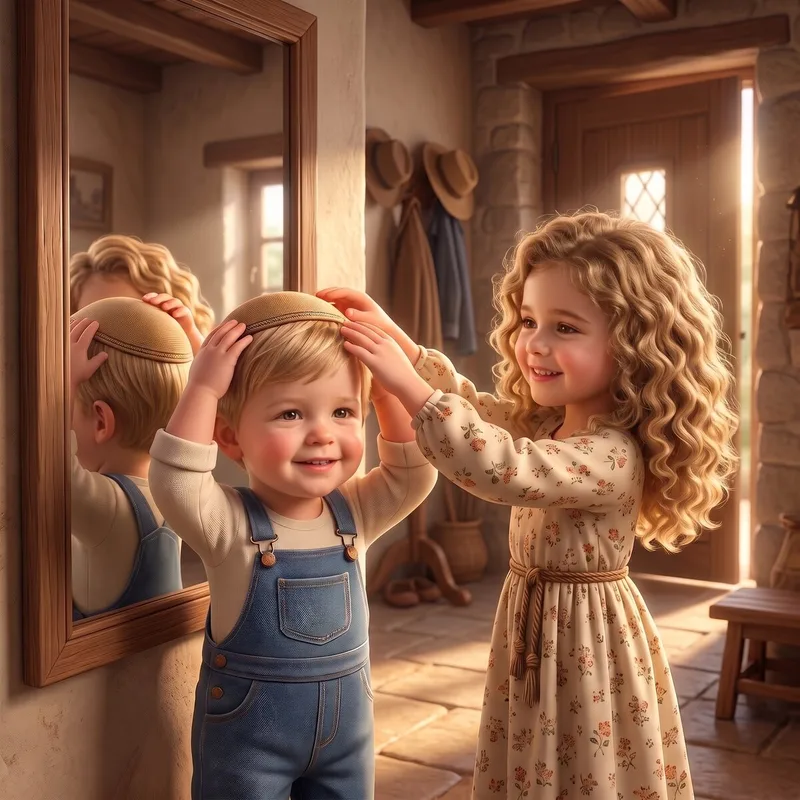
Keep it concrete and happy. Let him pick his own kippah from a few that suit your family, and call it his special hat for Hashem. Praise him when he puts it on without being reminded. Do not turn it into a power struggle if it falls off on the playground. Just smile and help him put it back.
For a 6 or 7 year old
Children this age ask why. Tell him the story of Rav Huna and the Shechinah above his head, and ask what he thinks it feels like to know Hashem is always near. This is also the age when he notices what friends and cousins wear, so explain simply that styles differ by family and community custom while the mitzvah is the same.
For a 10 to 12 year old
An older child can hear that covering the head is connected to how Chazal describe yiras shamayim, and that it carries responsibility. When he is wearing a yarmulke, people see a Yid, so how he speaks and acts reflects on the Torah. Say this as a source of pride and not as pressure.
What about girls and siblings who do not wear one?
Sooner or later a sister or a younger brother will ask why they do not have one. Answer without apology. Boys and girls each have their own mitzvos, and girls and women show yiras shamayim in their own ways, tznius among them. A younger brother can be told that he will get his own when your family's time comes.
Children often feel less left out when they have a job of their own. A sister can help hand out the kippos for a family simcha, or choose the bag for a spare kippah.
What is the Torah Tale book about wearing a yarmulke like?
This story is part of the Mitzvos collection, the books about mitzvos a child keeps, set in everyday life today. Your child is the hero: his name and, from one uploaded photo, his likeness appear on every page, illustrated in a 3D animated-film style. Up to eight children can appear in the same book, so a sibling can share the pages.
Every book ends with a discussion page of ten questions about the story, mixing comprehension with middos, what happened and what it asks of the child. That page is what turns a book you read to your child into something talked about at the table. Every book is written with careful rabbinical guidance and strict tznius, and reviewed by our team before it goes to print.
Which format suits which age?

Softcover 8″×8″

Hardcover 8″×8″

Board book 6″×6″

Coloring book 8.5″×11″
Torah Tale offers a board book (6"x6" with rounded safety corners, ages 0-4), a softcover photo book (8"x8", ages 4-8) and a hardcover photo book (8"x8", ages 5-18). The child's age is one of the short questions when you create the book. Softcover and hardcover open with a dedication page, which is a nice place for a few words from a parent or grandparent about the day he started wearing his kippah.
If you add parents, grandparents and other relatives with their photos, they appear with the children on a closing family page in every format. There is also an optional matching coloring book (8.5"x11", black-and-white line art). Coloring is melacha, so keep it for a weekday, such as a weekday afternoon or erev Shabbos, never for Shabbos or Yom Tov itself.
What can we talk about at the Shabbos table?
Reading is entirely appropriate on Shabbos, so a storybook is a good fit for the table or a quiet afternoon. These questions need only talking:
- When do you notice your yarmulke the most?
- What do you think it means that Hashem is above us?
- How can we act when we know Hashem is near?
- Who do you know who always wears a kippah, and what do you like about the way he does it?
- What can a yarmulke teach someone who sees you wearing it?
Parents can also share a memory of the first kippah they wore. Children love hearing that a grown-up once learned this too.
Practical ways to help a boy keep his yarmulke on
- Keep a spare in the backpack, by the door and in the car.
- Let him choose a style that fits your family's custom.
- Teach him to put it on first thing, before a bracha.
- Use small clips if it slides, and show him how to put it back on by himself.
- Model it: children notice when a father or grandfather puts his on gladly.
For related mitzvos that grow alongside this one, see Wearing Tzitzis for Kids, An Upsherin for Kids and First Day in Cheder for Kids.
If you would like your son to see himself in this mitzvah, you can create the book with a free account and a few short questions: his name, boy or girl, age, one photo, any siblings, the story, your community, the language and the format.
Frequently asked questions
Why do Jewish boys wear a yarmulke?
A yarmulke is a reminder that Hashem is above us and an expression of yiras shamayim. The Gemara in Kiddushin 31a tells of Rav Huna son of Rav Yehoshua, who would not walk four amos bareheaded because the Shechinah is above his head. Covering the head has become the established practice of Yidden, and your rav can explain the details.
At what age should a boy start wearing a yarmulke?
Families begin at different ages. Some start around the upsherin, some when the child starts cheder, and some earlier at home. Ask your rav what is right for your family, and make it something a child is proud of, not a battle.
How do I explain a yarmulke to a 4-year-old?
Keep it to one sentence: Hashem is always above us, and the yarmulke helps us remember that He is watching over us with love. Then link it to something the child already does, like putting it on before a bracha or before Shabbos. Short and warm works better than a long explanation.
Why don't girls wear a yarmulke?
Wearing a head covering in this way is the practice of men and boys. Girls and women have their own mitzvos and their own ways of showing yiras shamayim, such as tznius. If your daughter asks, answer simply and positively, and bring the question to your rav or her teacher if she wants more.
Why are there so many different kinds of yarmulkes?
Styles such as knitted, velvet, suede or black cloth often follow a family's or community's custom, and the child's own taste. What matters is the covering and what it reminds us of, not any one style. Letting a child choose among kippos that fit your family's custom can help him feel it is his own.