First Day in Cheder for Kids: Minhagim, Nerves & How to Explain It
A parent's guide to the first day in cheder: the minhagim, the Midrash about starting with Vayikra, what to say to a nervous child, and a personalized storybook starring your child.
Published by Torah Tale.
Create this book for your child
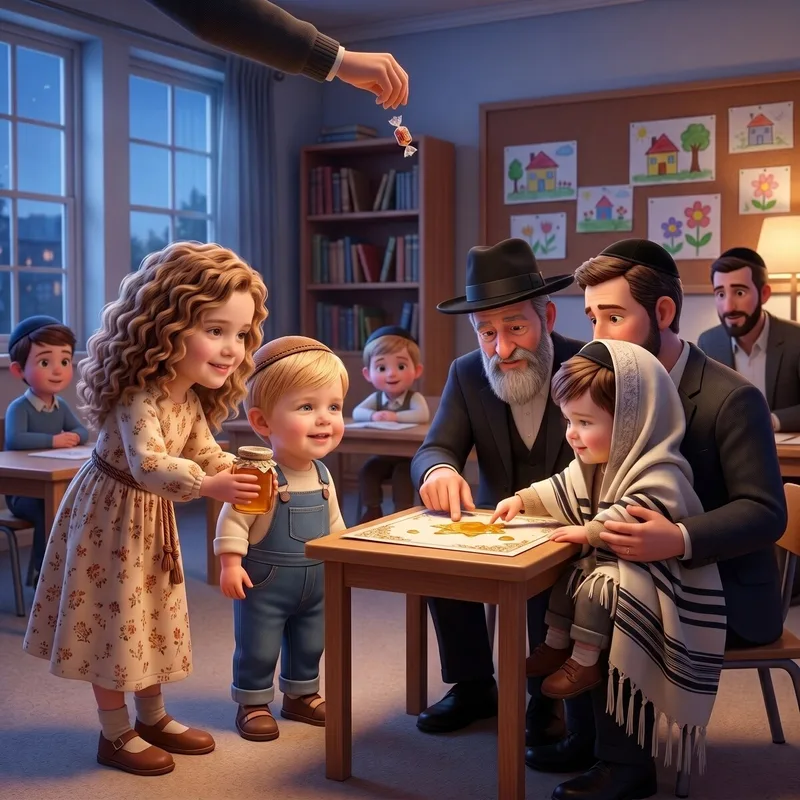
The first day in cheder is the day a child steps into a classroom to begin learning Torah, and it is one of the big moments of a Yiddishe life. It lands with children because it is both exciting and a little scary, and a story helps a child feel that the new place is a happy one. Torah Tale's First Day in Cheder is a story in the Jewish Life collection, with your child as the hero.
What is the first day in cheder all about?
It is the beginning of a child's formal Torah learning. For a parent it is also a moment of nachas, and often a few nerves, because a little person who was at home all day is now walking into a room with a rebbi or morah and a new group of friends.
For the child, the day is made of small, concrete things: a new place, new faces, the aleph-beis and a first taste of what it means to learn. A story that walks through that day in advance gives a nervous child pictures to hold onto.
How does Torah learning begin, according to Chazal?
The Gemara in Maseches Sukkah (42a) teaches that when a child begins to speak, his father teaches him Torah tzivah lanu Moshe, morasha kehillas Yaakov and the first pasuk of Shema. So Torah learning begins at home, with a parent's voice, long before cheder.
That is worth saying to a child: you are not starting from zero. You already know Shema, and you already know that Torah is ours.
Why do children begin with Sefer Vayikra?
The Midrash relates the custom of beginning children's learning with Toras Kohanim, which is Sefer Vayikra. The Midrash gives the reason that children are pure and the korbanos are pure, so let the pure come and learn about the pure.
Many classrooms still follow this custom, though practice varies, so ask your child's rebbi what your cheder does. It can be a lovely thing to tell your child: you are starting where Yidden have long started.
What minhagim go with a child's first day of learning?
Families and communities keep different customs, so treat this as a list to ask about rather than a checklist.
- Honey. In many families a child tastes a little honey, often with the letters of the aleph-beis, so that Torah is remembered as sweet.
- Aleph-beis. The first letters are often learned with a chart or a card and a lot of repetition and singing.
- A bracha from a parent. A parent can say a short tefillah for the child before leaving the house.
If you are unsure how your community does it, ask your rav or your child's rebbi.
A child who is about to turn three may be marking an upsherin around the same time. See our article on the upsherin and the first haircut for that milestone.
What is the lesson of the first day in cheder?
The lessons are simple, and they are things a child can practice on day one.
- Torah is sweet. Learning is something to look forward to, and the honey minhag makes that a taste, not just an idea.
- Being brave about something new. A child can feel nervous and still walk in. The courage is in going anyway.
- Listening to the rebbi. A classroom works when children listen and wait their turn. Our article on waiting patiently goes with this.
- Thanking the people who teach us. A rebbi gives a great deal, and a child can learn to say thank you, as in our article on hakaras hatov.
How do I explain starting cheder to a 3-year-old, a 5-year-old and a 7-year-old?
For a 3-year-old, keep it to a few short sentences: "Tomorrow you are going to cheder. You will learn the aleph-beis and sing. Mommy will bring you, and I will come back to pick you up." Repeat it, and say the same words each time.
For a 5-year-old, add the meaning: "Cheder is where Yidden learn Torah. When you learn, you are doing what Hashem wants from us." Let the child ask what worries them and answer the real question, even if it is about the bathroom or lunch.
For a 7-year-old, talk about the bigger picture. A child this age can understand that learning is a lifelong thing and that every Yid starts somewhere. It also helps to ask which part feels hardest, and to treat it as a normal part of learning something new.
What is the Torah Tale book of this story like?
It is a personalized storybook: your child's name and, from one uploaded photo, your child's likeness appear on every page, illustrated in 3D animated-film style. Up to eight children can appear in the same book, ages 0 to 18, which suits a family where a younger child is about to start and an older sibling already knows the way.
Every book ends with a discussion page of 10 questions about the story, mixing comprehension with middos. That turns the book from something read to a child into something talked about, and it is a good way to follow up after the first week of cheder. Each book is written with careful rabbinical guidance and strict tznius, and reviewed by our team before it goes to print.
Creating one needs a free account and a few short questions: each child's name, boy or girl, age and one photo, any siblings, the story, your community (asked once), the language and the printed format. It takes about five minutes. Languages are English, Hebrew and Yiddish.

Softcover 8″×8″

Hardcover 8″×8″

Board book 6″×6″

Coloring book 8.5″×11″
Which format fits a child starting cheder?
Match the format to your child's age. A child starting at three fits the 6x6 board book with rounded safety corners (ages 0-4). A four-year-old fits the 8x8 softcover photo book (ages 4-8), and a child of five or older fits the 8x8 hardcover photo book (ages 5-18). Softcover and hardcover open with a dedication page, which is a natural place for a message from you.
You can also add a matching 8.5"x11" black-and-white coloring book. Coloring is a weekday activity, so save it for a weekday afternoon or erev Shabbos, and not for Shabbos itself. The storybook is a good fit for the Shabbos table or a quiet Shabbos afternoon: reading it is entirely appropriate.
What can we talk about at the Shabbos table?
These are for talking and singing only, and work well on the Shabbos after a first week of cheder.
- What was the first thing you learned?
- Who is your rebbi, and what do you like about him?
- What felt a little scary, and what helped?
- Can you sing something you learned?
- How can you say thank you to your rebbi?
- What would you tell a child who is starting tomorrow?
If you have the book, its discussion page gives you 10 more questions to choose from.
When you are ready, create the book for your child's first day in cheder. If you want to see how the steps go first, read how to create a personalized Torah storybook.
Frequently asked questions
How do I prepare my child for the first day in cheder?
Talk about it in simple, happy terms for a few weeks beforehand, and tell your child exactly what the day will look like: who will be there, where you will say goodbye and who will pick up. Read a story about a first day in cheder together so the new experience already feels familiar. Many parents also let the child choose a small thing to bring along, if the cheder allows it.
Why do children start learning with Sefer Vayikra?
The Midrash in Vayikra Rabbah relates the custom of beginning children's learning with Toras Kohanim, Sefer Vayikra. The reason given is that children are pure and the korbanos are pure, so let the pure come and learn about the pure. Many classrooms still keep this custom, so ask your child's rebbi what your cheder does.
What is the honey minhag on the first day of learning?
In many families and chadarim, a child is given a little honey, often on or near the letters of the aleph-beis, so that Torah is tasted as something sweet from the very first day. It is a widely known minhag, but communities keep it in different ways. Ask your rav or your child's rebbi how it is done where you live.
What should I say to a child who is scared of cheder?
Start by taking the feeling seriously: say that new places can feel big and that it is normal to feel nervous. Then give one concrete, true thing to look forward to, such as the rebbi, the aleph-beis or a friend, and a clear picture of when you will be back. Avoid promising that there is nothing to be scared of.
Which Torah Tale format is best for a child starting cheder?
It depends on the child's age. A child who is three fits the 6x6 board book with rounded safety corners (ages 0-4), a four-year-old fits the 8x8 softcover (ages 4-8), and a child of five or older fits the 8x8 hardcover (ages 5-18). The child's age is one of the short questions when you create the book.
Can I add the whole family to a First Day in Cheder book?
You can add up to eight children in the same book, and you can add parents, grandparents and other relatives with their photos. The story stars the children, and if you add the grown-ups they appear with the children on a closing family page in every format.