The Wall That Was Never Destroyed (הכותל שלא נחרב) for Kids
Chazal teach that the Shechinah never left the Western Wall. Here is how to tell the Midrash to a 4-year-old, a 7-year-old and a 10-year-old, what lesson it holds, and what to ask at the Shabbos table.
Published by Torah Tale.
Create this book for your child
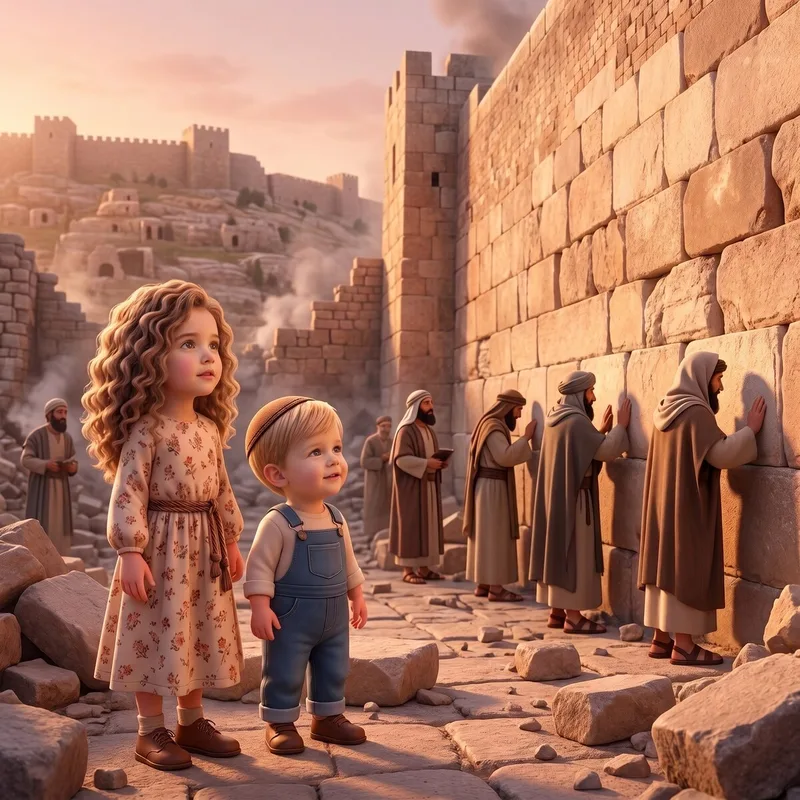
The Wall That Was Never Destroyed is a Midrash about the Kosel Maaravi, the Western Wall. Chazal teach that the Shechinah, Hashem's presence, never left the Western Wall of the Beis HaMikdash. Children usually take from it a simple, steadying idea: even after a very sad time, Hashem stays close to His people.
What does the Midrash say about the Western Wall?
The Midrash relates that the Shechinah never moved from the Kosel Maaravi. Chazal bring this in connection with a pasuk in Shir HaShirim (2:9): הנה זה עומד אחר כתלנו. They explain "our wall" as the western wall of the Beis HaMikdash. The teaching appears in Shemos Rabbah and in the Midrash on Shir HaShirim.
It helps to keep pshat and Midrash apart when you tell this to a child. The pasuk is in Shir HaShirim; reading it as the Western Wall, and saying that Hashem's presence never left it, is what Chazal tell us. The Midrash is short, and a parent does not need to add scenes or details to it.
How do I tell the story of the Kosel to a child?
Start with the Beis HaMikdash, the place where Yidden came close to Hashem. When it was destroyed, Yidden were very sad, and that is part of the story. Then comes the Midrash: Chazal tell us that Hashem's presence never left the Western Wall.
You can finish with the part a child can see for themselves. Yidden have davened near this wall for generations, and we still call it the Kosel. A few sentences are enough. There is no need for graphic detail about the churban, and the Midrash does not ask for it.
What is the lesson of the wall that was never destroyed?
The lesson is closeness, and with it hope. Even when something very precious is lost, Hashem has not gone far from us. That is why a Yid can always daven, and why a sad time is not the end of the story.
It also teaches a child to treat a holy place with respect, and to feel that places connected to Hashem matter to us. If your family is thinking about Eretz Yisrael, our article on teaching what the Land means goes well with this. Another Midrash about Yerushalayim is Rabbi Chanina's gift for Yerushalayim.
How do I explain it to a 4-year-old, a 7-year-old and a 10-year-old?
- Around 4: Keep it to one warm idea. "Hashem is always close to us, and Chazal tell us His presence never left the Kosel." Let the child say it back to you in their own words.
- Around 7: Add that the Beis HaMikdash was destroyed and Yidden were sad, but that the Midrash gives us comfort. Ask what it feels like when something you love is gone, and how it feels to know Hashem is still near.
- Around 10: Show them the pasuk in Shir HaShirim and how Chazal read the word כתלנו. If they ask about the churban itself, our article on Tisha B'Av for kids explains it age-appropriately.
What is a personalized Torah Tale book of this story like?
This story sits in the Midrash & Aggadah collection, which tells the stories Chazal tell behind the pesukim, each from its named source. Your child is the hero: their name and, from one uploaded photo, their likeness appear on every page in 3D animated-film style. Up to eight children can appear in the same book, so siblings can share it.
The formats are a 6"x6" board book with rounded safety corners (ages 0-4), an 8"x8" softcover (ages 4-8) and an 8"x8" hardcover (ages 5-18). The softcover and hardcover open with a dedication page. If you add parents and grandparents, they appear with the children on a closing family page in every format. Every book is written with careful rabbinical guidance and strict tznius, and reviewed by our team before it goes to print.

Softcover 8″×8″

Hardcover 8″×8″

Board book 6″×6″

Coloring book 8.5″×11″
Every book also ends with a discussion page of 10 questions that mix comprehension with middos. That page turns the book from something you read to your child into something you talk about together. An optional matching coloring book is a weekday activity only, for a weekday afternoon or erev Shabbos, never for Shabbos or Yom Tov.
What can we ask at the Shabbos table?
Reading the story at the Shabbos table is just right, and these questions need only talking:
- What did Chazal tell us about the Western Wall?
- Why do you think the Beis HaMikdash was so special to Yidden?
- How can we tell someone who is sad that Hashem is close to them?
- When do you feel closest to Hashem, and what helps you feel that way?
- What is a way we can show respect for a holy place?
Let a young child answer in a single sentence, and let an older child look for the pasuk. The goal is to leave the table with one steady thought: Hashem's presence stays close.
When you are ready, you can create the book for your child. It takes about five minutes, with a free account and a few short questions: each child's name, boy or girl, age and one photo, any siblings, the story, your community (asked once), the language and the format.
Frequently asked questions
What is the story of the wall that was never destroyed?
It is a Midrash that Chazal teach about the Kosel Maaravi, the Western Wall of the Beis HaMikdash. The Midrash relates that the Shechinah, Hashem's presence, never left this wall. Chazal connect the idea to the words הנה זה עומד אחר כתלנו in Shir HaShirim 2:9.
Where does the Midrash about the Western Wall come from?
The teaching appears in Shemos Rabbah and in the Midrash on Shir HaShirim, in connection with Shir HaShirim 2:9. It is a Midrash, which means it is what Chazal tell us, and it is not stated in the pasuk itself. When you retell it, it is best to stay close to what the Midrash says.
How do I explain the Kosel to a 4-year-old?
Keep it to a few warm sentences: the Beis HaMikdash was a very special place, and Chazal tell us that Hashem's presence never left the Western Wall. You can add that Yidden still come to daven there. There is no need to describe the churban in detail at this age.
What is the lesson of the wall that was never destroyed?
The lesson is that Hashem stays close to Yidden even in sad times, so there is always a reason for hope and for tefillah. It also teaches children to treat a holy place with respect. A parent can bring out this middah of bitachon with simple questions at the table.
Is there a Torah Tale book about this Midrash?
Yes, it is in the Midrash & Aggadah collection, which tells the stories Chazal tell behind the pesukim, each from its named source. Your child's name and likeness, from one uploaded photo, appear on every page in 3D animated-film style. The book ends with a discussion page of 10 questions that mix comprehension with middos.
Can I read this book on Shabbos?
Yes, reading a storybook is entirely appropriate on Shabbos and Yom Tov, and the discussion questions at the end suit the Shabbos table. The optional coloring book is different, because coloring is melacha. Keep it for weekdays, such as a weekday afternoon or erev Shabbos.