Rabbi Chanina's Gift for Yerushalayim: A Midrash for Kids
A man who wanted to give Yerushalayim a gift, a heavy stone, and help that arrived when he did his part. How to tell the Midrash to a 3-4 year old, a 6-7 year old and a 9-12 year old, plus Shabbos-table questions.
Published by Torah Tale.
Create this book for your child
Rabbi Chanina's gift for Yerushalayim is a Midrash about a man who wanted to give a stone to Yerushalayim, found it too heavy to bring alone, and was helped when he put his own hand to it. Children take to it because it is concrete: a real stone, a real effort, and a gift that is small in one way and very big in another.
What is the story of Rabbi Chanina's stone?
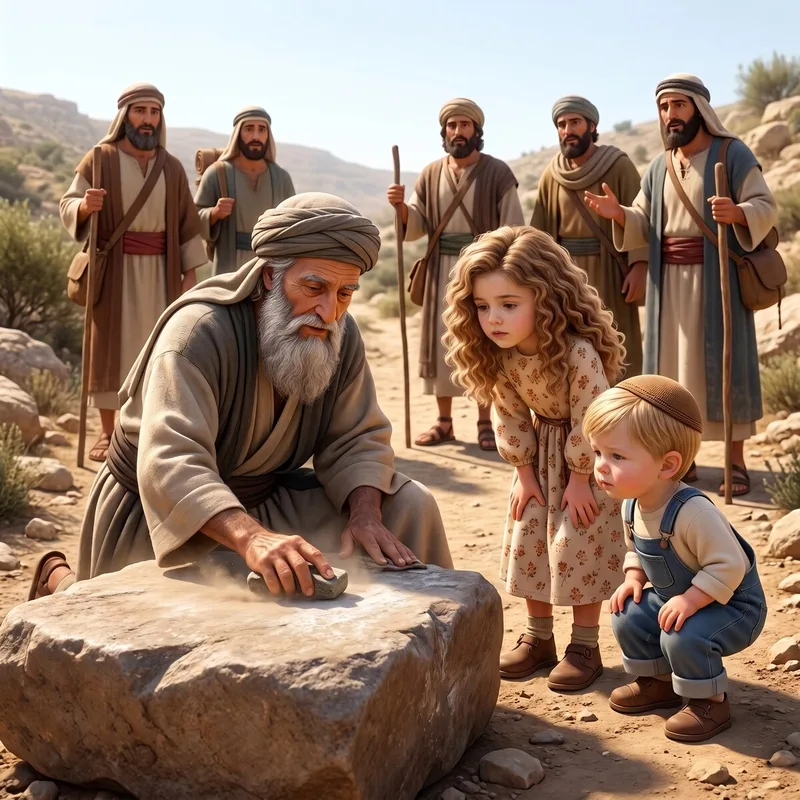
The Midrash relates that Rabbi Chanina wanted to give something to Yerushalayim. He took a stone and worked on it until it was smooth and fit to be given. The stone was his gift, and he had made it ready with his own hands.
Then came the difficulty. Yerushalayim was far, the stone was heavy, and he could not bring it by himself. He looked for workers who could carry it for him.
Workers offered to carry the stone, and they asked him to put his hand on it together with theirs. He did, and the Midrash relates that the stone arrived in Yerushalayim. The workers were not ordinary workers, and the Midrash relates that they were malachim sent to help him.
This article follows the Midrash and adds nothing to it. If you would like to see the original wording, ask your rav or rebbi to show you the makor.
What is the lesson of Rabbi Chanina's gift?
We learn from this that a gift given with what a person has, and with his own effort, is precious to Hashem. Rabbi Chanina did not wait until he could give something grand. He gave a stone he had prepared himself.
We also learn that a person does his part and Hashem helps. Rabbi Chanina could not carry the stone alone, but he did not put it down and walk away. He kept going, and he put his hand on the stone.
These are lessons from the story, and children can hold them simply. Give what you can, and do not stop when something is too big for you alone.
How do I explain it to different ages?
For ages 3-4, tell it as a picture. A man made a stone smooth to give to Yerushalayim. It was too heavy, helpers came, he put his hand on it, and it got there. Then ask, 'What could you give?' and let them answer with whatever they say, a coin for the pushka, a hug, a drawing for Bubby.
For ages 6-7, add the effort. Rabbi Chanina worked on the stone before anyone helped him, and he put his hand on it when help came. This is a good age to talk about the difference between giving something that cost you effort and giving something that came easily.
For ages 9-12, ask about the Midrash itself. Why would Chazal tell us a story where a man who cannot carry a stone is helped? What does it teach about starting something you cannot finish alone? This age can also hear that a Midrash is a teaching of Chazal and not a pasuk, and that is a good moment to look at a Midrash inside a sefer together.
Why is this story in the Midrash & Aggadah collection?
The Midrash & Aggadah collection holds the stories Chazal tell behind the pesukim and in the Gemara and Midrash, each told from its named source. Rabbi Chanina's stone is one of those stories, and it is told as Chazal tell it.
If you want to continue with the same kind of story, Nachshon Jumps into the Sea is another Midrash about a person who acts first and is helped. For a story about Yerushalayim and building, you can read Building the Second Beis HaMikdash.
What is the personalized Torah Tale book of this story like?
The book stars your child. Their name and, from one uploaded photo, their likeness appear on every page, illustrated in 3D animated-film style, and up to eight children can appear in the same book, ages 0 to 18. Softcover and hardcover books open with a dedication page.

Softcover 8″×8″

Hardcover 8″×8″

Board book 6″×6″

Coloring book 8.5″×11″
There are three formats. The board book is 6x6 with rounded safety corners, for ages 0-4. The softcover is 8x8, for ages 4-8. The hardcover is 8x8, for ages 5-18. Every book is written with careful rabbinical guidance and strict tznius, and reviewed by our team before it goes to print.
If you add parents, grandparents and other relatives with their photos, they appear with the children on a closing family page in every format.
What questions can we ask at the Shabbos table?
Every Torah Tale book ends with a discussion page of 10 questions, mixing comprehension with middos. It turns the book from something read to a child into something talked about together. You can also ask your own, and they work at the table because they need only talking:
- What did Rabbi Chanina do to the stone before anyone helped him?
- Why couldn't he bring it to Yerushalayim alone?
- What did he do when the workers came?
- What is something small you could give that is really yours?
- Have you ever started something that was too big to finish alone? Who helped?
For a weekday afternoon, you can add something to do. A child can choose something of their own to put in the pushka, or the family can talk about a mitzvah that is too big for one person, such as a big job at home, and decide who will put a hand to it. The optional matching coloring book (8.5x11, black-and-white line art) is also a weekday activity, for erev Shabbos or a weekday afternoon, never for Shabbos or Yom Tov. For more on giving, see Giving Tzedakah for Kids.
When you are ready, you can create the book. It starts with a free account and a few short questions: each child's name, boy or girl, age and one photo, any siblings, the story, your community (asked once), the language and the printed format. The books come in English, Hebrew and Yiddish, and the whole creation flow takes about five minutes.
Frequently asked questions
What is the story of Rabbi Chanina's stone?
The Midrash relates that Rabbi Chanina wanted to give Yerushalayim a gift. He took a stone and worked it until it was smooth, but he had no way to bring it there. Workers offered to carry it, and when he put his hand to the stone together with theirs, it reached Yerushalayim.
What is the lesson of Rabbi Chanina's stone for children?
We learn from this that Hashem values a gift given with whatever a person has, and that a person is asked to do his part. A child can understand it simply: give what you can, with your own effort, and do not wait until you have something bigger to give.
How do I explain Rabbi Chanina's stone to a 4-year-old?
Keep it to one picture: a man had a stone he wanted to give to Yerushalayim, it was too heavy for him, he put his hand on it, and it got there. Then ask, 'What would you want to give?' Little children enjoy the stone and the helping hands, and the giving part is easy to talk about.
Is Rabbi Chanina's stone a pasuk or a Midrash?
It is a Midrash, a story Chazal tell, and not a pasuk in Tanach. Torah Tale places it in the Midrash & Aggadah collection, where each story is told as its source tells it, without additions. If you would like to see the original wording, ask your rav or rebbi to show you the makor.
Can I read this story on Shabbos?
Yes. Reading a storybook is entirely appropriate on Shabbos, and the Shabbos table is a good place to talk about the questions at the end of the book. Coloring is a weekday activity, so the optional coloring book is for erev Shabbos or a weekday afternoon.
Which Torah Tale format suits this story?
It depends on your child's age. The board book is 6x6 with rounded safety corners for ages 0-4, the softcover is 8x8 for ages 4-8, and the hardcover is 8x8 for ages 5-18. Age is one of the few short questions asked when you create the book.