Giving Tzedakah (נתינת צדקה) for Kids: Teaching the Mitzvah at Home
Tzedakah is a mitzvah a child can do today. Here is what the Torah says, how to explain it at ages 3-4, 5-7 and 8-12, and questions for the Shabbos table.
Published by Torah Tale.
Create this book for your child
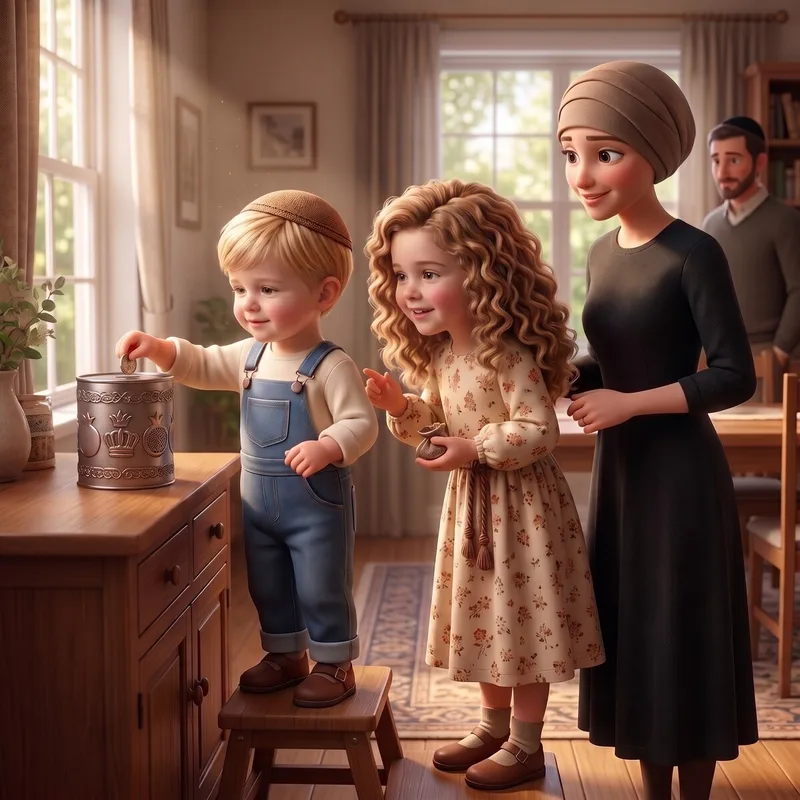
Giving tzedakah is the mitzvah of giving to people in need, and it is one of the easiest middos to teach a child because a child can do it today. The Torah Tale story Giving Tzedakah is set in everyday life today, with your child as the hero. It lands with children because it is concrete: a coin, a pushka, a person who needs help, and a good feeling afterward.
What is the story of giving tzedakah about?
The story belongs to the Middos collection, which is about the good character a child grows, set in the everyday life a child actually lives. Instead of a faraway scene, it takes the mitzvah into ordinary days, where a child can recognize it. Your child's name and likeness appear in the book, so the hero is a child who looks like them.
Like every Torah Tale book, it is written with careful rabbinical guidance and strict tznius, and it is reviewed by our team before it goes to print.
What does the Torah say about giving tzedakah?
The Torah tells us that when there is a poor person among us, we should not harden our heart or close our hand, but open our hand to him (Devarim 15:7-8). It is the clearest place to start, because it speaks about both the hand and the heart. Giving is meant to be generous, not grudging.
We also see giving in the life of the Avos. In Parshas Vayeitzei, Yaakov promises that of all that Hashem gives him, he will give a tenth (Bereishis 28:22). You can read more in our article on Parshas Vayeitzei for kids. Many families keep a custom of setting aside maaser kesafim, a tenth of their income, and your rav can guide you on the details.
The Rambam, in the laws of gifts to the poor, writes that we should give with a cheerful face and with joy. He also writes of eight levels of tzedakah, and the highest is helping a person stand on his own feet, for example by helping him find work. Older children enjoy hearing that giving can be smart as well as kind.
What is the lesson of tzedakah for a child?
The first lesson is that what we have is a gift from Hashem, and that we are partners in caring for others. The word tzedakah is related to tzedek, justice or righteousness, which is why it is not simply called charity. A child learns that giving is the right thing to do, not only a nice extra.
The second lesson is how we give. A coin dropped in a hurry and a coin given with a smile are both tzedakah, but the middah we are growing is the smile. The Midrash relates that the person who gives gains even more than the one who receives, and children are often struck by this idea.
The third lesson is that tzedakah sits next to chesed. If your child is already learning to help at home, our article on A Helping Hand connects naturally, and so does Loving Every Yid.
How do I explain tzedakah to a 4-year-old, a 6-year-old and a 10-year-old?
Ages 3-4: the doing
Keep it to one sentence and an action. Say, 'Some people need help. Hashem asks us to help, so we put a coin in the pushka.' Let your child drop the coin in and listen to the sound. The sound alone is half the fun.
Ages 5-7: the feeling and the choice
At this age children ask why. Tell them that Hashem gave us what we have, and that He asks us to share it. Give them a small amount of their own to put in the pushka, and ask, 'How did it feel to give?' This is also a good age to ask what they would do if a friend forgot his snack.
Ages 8-12: the thinking
Older children can handle real questions. What is better, a big gift once or small gifts each week? Why did the Rambam say to give cheerfully? You can introduce the idea that helping a person become self-sufficient is a very high level of tzedakah. If maaser comes up, ask your rav how it applies to a child's own money.
What is a personalized Torah Tale book about tzedakah like?
It is a printed storybook where your child is the hero, in 3D animated-film style, with their name and likeness from one uploaded photo. Up to eight siblings, ages 0 to 18, can appear in the same book, which suits families who want the tzedakah conversation to include everyone.
There are three formats: a board book (6x6 with rounded safety corners, ages 0-4), a softcover photo book (8x8, ages 4-8) and a hardcover photo book (8x8, ages 5-18). Softcover and hardcover open with a dedication page. If you add parents and grandparents, they appear with the children on a closing family page in every format.

Softcover 8″×8″

Hardcover 8″×8″

Board book 6″×6″

Coloring book 8.5″×11″
Every book ends with a discussion page of 10 questions about the story, mixing comprehension with middos: what happened, and what it asks of the child. That page turns the book from something read to a child into something talked about at the table.
What questions can we ask at the Shabbos table?
Reading is perfect for Shabbos, and so is talking. Money is not handled on Shabbos, so keep the giving itself for before Shabbos and use the table for conversation. Try these:
- Who do you think feels happiest when a coin goes into the pushka, the giver or the one who receives?
- What does it mean to give with a smile?
- Can you give tzedakah without money? What could you give?
- Why do you think Yaakov promised to give a tenth?
- What is one thing we can do before next Shabbos to give tzedakah as a family?
Many families give tzedakah on erev Shabbos before candle lighting, which gives your child a regular time to do it. It is worth asking your child to remind you.
What is an activity we can do during the week?
Make a pushka together on a weekday afternoon or erev Shabbos, and let your child decorate it. Decorating is for weekdays only, never for Shabbos or Yom Tov. Then choose together where the money will go when it is full.
If you order the optional matching coloring book (8.5x11, black-and-white line art), it is also a weekday activity, perfect for a weekday afternoon or Chol HaMoed. The storybook itself is a good one to bring to the Shabbos table.
Ready to make it your child's own? You can create the book in about five minutes: a free account, then a few short questions covering each child's name, age and photo, the story, your community, the language and the format.
Frequently asked questions
What is the lesson of giving tzedakah for kids?
The lesson is that what Hashem gives us is not only for us, and that we are partners in caring for others. The Torah tells us to open our hand to a person in need. A child learns that giving is something they can do themselves, gladly, and not only something grown-ups do.
How do I explain tzedakah to a 4-year-old?
Keep it short and concrete: 'Some people need help, and Hashem asks us to help them. When we put a coin in the pushka, we are doing a mitzvah.' Let your child put the coin in, and say it with a smile. At this age the doing matters more than the explanation.
Should my child give tzedakah from their own money?
It can help to give a child a small amount of their own, from a gift or allowance, to put in the pushka, so that the child feels the giving. It also helps to let a child choose where it goes when they are old enough. For questions about how much to give or how maaser applies to a child, ask your rav.
Can we give tzedakah on Shabbos?
Money is not handled on Shabbos, so the giving itself happens before Shabbos. Many families give tzedakah on erev Shabbos before candle lighting. At the Shabbos table you can talk about tzedakah, read a book about it and share stories, which suits the day well. If you are unsure about a specific situation, ask your rav.
What is the Torah Tale book about giving tzedakah like?
It is a personalized storybook from the Middos collection, set in everyday life today, with your child's name and likeness from one uploaded photo, illustrated in 3D animated-film style. It ends with a discussion page of 10 questions mixing comprehension with middos. Creating it takes a free account and a few short questions, starting at torahtale.com/create.
Which format of the tzedakah book fits my child's age?
The board book (6x6 with rounded safety corners) is for ages 0-4, the softcover (8x8) is for ages 4-8, and the hardcover (8x8) is for ages 5-18. Your child's age is one of the short questions when you create the book.