Building the Second Beis HaMikdash for Kids: Sefer Ezra
The Second Beis HaMikdash is built, interrupted and finished in the first six perakim of Sefer Ezra. Here is the story in order, the lessons for children, and ideas for ages 3-4, 6-7 and 9-12.
Published by Torah Tale.
Create this book for your child
The building of the Second Beis HaMikdash is told in the first six perakim of Sefer Ezra. Yidden return from Bavel, set up the mizbeach, lay a foundation, face opposition and a long pause, and finally finish and dedicate the house with joy. Children connect to it because it is a story about a big job that gets interrupted and then completed, and because it holds happiness and tears in the same moment.
How does the story of building the Second Beis HaMikdash begin?
The sefer opens by telling us that Hashem stirred the spirit of Koresh, king of Persia, in fulfillment of the word of Yirmiyahu. Koresh made a proclamation: Hashem had given him the kingdoms of the earth and charged him to build a house in Yerushalayim, and anyone from Hashem's people who wished could go up. Koresh also brought out the vessels of the Beis HaMikdash so they could be returned.
Those whose spirit Hashem stirred went up, led by Zerubavel and Yeshua ben Yotzadak. For the journey itself and who came along, see our article on Sefer Ezra and the return to Yerushalayim.
What did they build first?
They did not start with the walls. Yeshua and his brothers the kohanim, together with Zerubavel, set up the mizbeach in its place and offered korbanos morning and evening. The pasuk says they did this even though they feared the peoples around them. They kept Sukkos as it is written, and the pasuk tells us they began offering korbanos from the first day of the seventh month, even though the foundation of the Heichal had not yet been laid.
Then they got to work. They gave money to masons and carpenters, and food, drink and oil to bring cedar wood from the Levanon, as Koresh had permitted. In the second year after they came, in the second month, the foundation was laid.
Why did some people cry and some shout for joy?
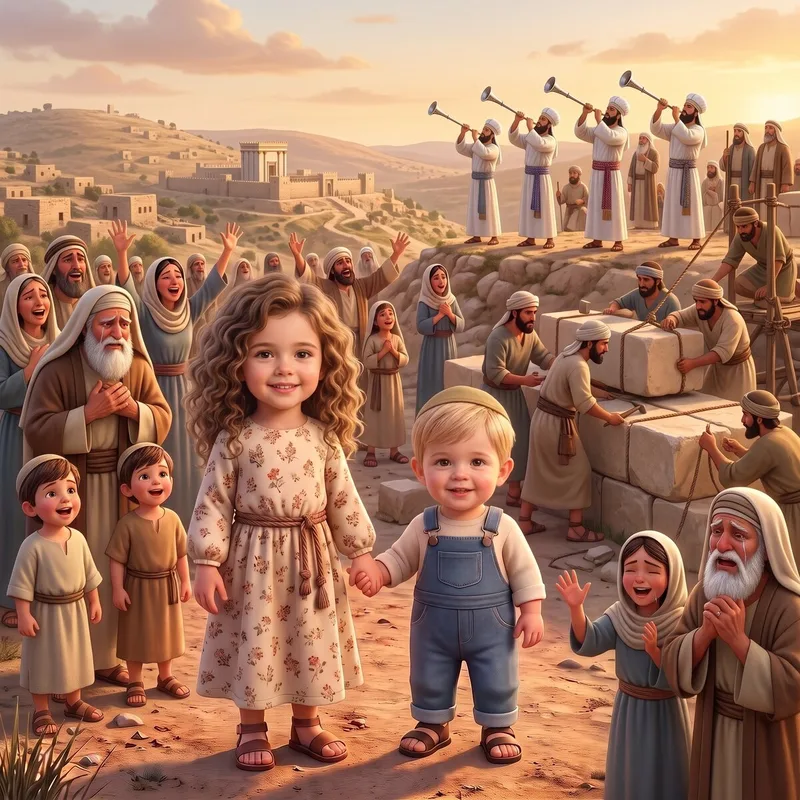
When the foundation was laid, the kohanim stood in their garments with trumpets and the Levi'im with cymbals, and they sang praise to Hashem, "ki tov ki le'olam chasdo al Yisrael." All the people shouted a great shout of praise.
The pasuk then adds something children remember. Many of the older kohanim, Levi'im and heads of families, who had seen the first house, wept aloud, while many others shouted for joy. The people could not tell the sound of the shout of joy from the sound of the weeping.
What happened when the building stopped?
Enemies of Yehuda and Binyamin came and offered to build together with them. Zerubavel, Yeshua and the heads of the families answered that the building was theirs to do, as King Koresh had commanded. After that, the pasuk says the people of the land weakened the hands of the Yidden and frightened them from building, and the work stopped for a long time.
It started again when the nevi'im Chaggai and Zecharia prophesied to the Yidden. Zerubavel and Yeshua rose and began to build, with the nevi'im supporting them. (Zecharia's visions have their own article: Zechariah's Golden Menorah.)
Tatnai, the governor across the river, came and asked who had permitted the building. The pasuk tells us that the eye of their God was on the elders of the Jews, and they were not stopped while the matter went to King Daryavesh. A scroll with Koresh's decree was found in the archives, and Daryavesh ordered that the work continue, with expenses from the royal treasury and what the kohanim needed for korbanos provided each day.
How did the story end?
The house was completed on the third of Adar. The Yidden dedicated it with joy, and the pasuk lists the korbanos: a hundred bulls, two hundred rams, four hundred lambs, and twelve he-goats for a sin offering, according to the number of the tribes of Yisrael. They set the kohanim and Levi'im in their divisions for the avodah.
Then they kept Pesach on the fourteenth of the first month and the seven days of Chag HaMatzos with joy, because Hashem had made them joyful and turned the heart of the king toward them.
What is the lesson for children?
There are several, and each one is rooted in the text:
- First things first. The mizbeach and the korbanos came before the foundation of the Heichal.
- Keep going. The work stopped, and it was picked up again and finished.
- Feelings can be mixed. Tears and joy were heard together at the foundation.
- Hashem guides hearts. He stirred Koresh at the start, and the sefer says He turned the heart of the king at the end.
Pick one lesson for the age of your child rather than all four at once.
How do I explain it at different ages?
Ages 3-4: The Yidden came home to Yerushalayim to build Hashem's house. Some people tried to stop them and it took a long time, but they kept going, and when it was finished everyone was so happy. Ask, "What do you do when something takes a long time?"
Ages 6-7: Tell the order: mizbeach first, then the foundation, then the pause, then the finish. Ask why the mizbeach might have come first, and what the Yidden did when they were afraid. Let them notice that the Yidden put the avodah first, before the building itself.
Ages 9-12: Read the pesukim about the weeping and the shouting together. Ask why the same moment can bring both feelings, and why Zerubavel and Yeshua answered the enemies as they did. Older children can also trace how the story moves through Koresh, Chaggai and Zecharia, Tatnai and Daryavesh.
What is a personalized Torah Tale book of Sefer Ezra like?
Sefer Ezra is a story in our Kesuvim collection. In a personalized Torah Tale book, your child's name and likeness, from one uploaded photo, appear in 3D animated-film style. Up to eight siblings, ages 0 to 18, can be in the same book. Every book is written with careful rabbinical guidance and strict tznius, and reviewed by our team before it goes to print.
Choose by age: a 6x6 board book with rounded safety corners (ages 0-4), an 8x8 softcover (ages 4-8), or an 8x8 hardcover (ages 5-18). Softcover and hardcover open with a dedication page. If you add parents and grandparents, they appear with the children on a closing family page in every format.

Softcover 8″×8″

Hardcover 8″×8″

Board book 6″×6″

Coloring book 8.5″×11″
Every book ends with a discussion page of 10 questions that mix comprehension with middos, what happened and what it asks of your child. That page is what makes it a book talked about at the table, not only read to a child. An optional matching coloring book is a weekday activity, for erev Shabbos or a weekday afternoon, never for Shabbos or Yom Tov.
What can we talk about at the Shabbos table?
Reading is entirely appropriate on Shabbos, and so are these questions, which need only talking:
- Why did the Yidden build the mizbeach before the foundation was laid?
- What do you think the old kohanim and Levi'im were thinking when they wept?
- How did the people feel when the work stopped, and what helped them start again?
- Who helped in the story: Koresh, Chaggai, Zecharia, Daryavesh?
- What is something you started and finished after it took a long time?
For a weekday afterward, give your child a pile of blocks and let them build, then take a break and finish it later, as a way to feel the pause and the finish.
When your child is ready for this story, you can create the book in about five minutes. You will need a free account and a few short questions: each child's name, boy or girl, age and one photo, any siblings, the story, your community (asked once), the language and the format.
Frequently asked questions
What is the story of building the Second Beis HaMikdash in Sefer Ezra?
Koresh, king of Persia, proclaimed that the Yidden could go up to Yerushalayim and build the house of Hashem. Those who went up, led by Zerubavel and Yeshua, set up the mizbeach, laid the foundation, and were then stopped by opposition for a long time. After Chaggai and Zecharia prophesied, the building resumed, Daryavesh confirmed Koresh's decree, and the house was finished and dedicated with great joy.
What is the lesson of building the Second Beis HaMikdash for children?
One lesson is to put first things first, as the Yidden did when they set up the mizbeach before the foundation was laid. Another is to keep going when a job is interrupted, and a third is that joy and tears can both belong to the same moment. Children can also see that the Yidden trusted Hashem to guide the hearts of kings.
How do I explain the Second Beis HaMikdash to a 4-year-old?
Keep it to a few sentences: the Yidden came home to Yerushalayim to build Hashem's house, some people tried to stop them, it took a long time, but they kept going and finished, and everyone was very happy. Ask your child what helps them keep going when something takes a long time. A board book for ages 0-4 can carry the story at that age.
Why did some people cry when the foundation was laid?
The pasuk in Sefer Ezra says that many of the older kohanim, Levi'im and heads of families who had seen the first house wept aloud, while many others shouted for joy. The people could not tell the sound of joy from the sound of weeping. The pasuk does not say more, so it is best to let children notice that people can feel different things at the same moment.
Is there a personalized Torah Tale book about Sefer Ezra?
Yes, Sefer Ezra is a story in the Kesuvim collection, and your child's name and likeness, from one uploaded photo, appear in 3D animated-film style. Creating a book takes a free account and a few short questions, and the book ends with a discussion page of 10 questions about the story. Formats are a 6x6 board book with rounded safety corners (ages 0-4), an 8x8 softcover (ages 4-8) and an 8x8 hardcover (ages 5-18).