Sefer Ezra for Kids: Return to Yerushalayim & the Beis Hamikdash
What happens in Sefer Ezra, why the Yidden wept and sang at the same time, the middos it teaches, and how to explain it to a 4-year-old, a 7-year-old and an older child.
Published by Torah Tale.
Create this book for your child
Sefer Ezra tells how the Yidden came back from Bavel to Yerushalayim and built the Beis Hamikdash again. Children connect with it because it is a story about going home, about starting again when things feel small, and about a day when joy and tears filled the same place. It is a sefer of Kesuvim, and it is a good one for children who already know the story of the Churban and are asking what came next.
What happens in Sefer Ezra?
The sefer opens with Koresh, king of Persia. The pasuk says that Hashem stirred his spirit, and he sent a proclamation through his whole kingdom: Hashem had charged him to build a house for Him in Yerushalayim, and any Yid who wished could go up. The pasuk also says this happened to fulfill the word of Hashem spoken through Yirmiyahu.
Not everyone went. The pasuk says that those who went up were the ones whose spirit Hashem had stirred. Their neighbors helped them with silver, gold and supplies. Koresh also brought out the vessels of the Beis Hamikdash that Nevuchadnetzar had taken from Yerushalayim, and they were counted and handed over: 5,400 gold and silver vessels altogether.
The sefer then lists the families who went up with Zerubavel and Yeshua the Kohen Gadol, 42,360 people in all. When they reached Yerushalayim, they first built the mizbeach and began to bring korbanos. They kept Sukkos as it is written, even though the foundation of the Heichal had not yet been laid.
In the second year after they arrived, the foundation of the Heichal was laid. Then others who lived in the land came and asked to join the building. Zerubavel, Yeshua and the other family heads said no, and the work was weakened and finally stopped. It stayed stopped until the second year of Daryavesh, when the neviim Chaggai and Zecharya spoke in the name of Hashem and the building started again.
A Persian governor, Tattenai, wrote to Daryavesh to ask whether they really had permission. A search was made, and the decree of Koresh was found in a scroll in Achmesa. Daryavesh ordered that the work go on, and the Beis Hamikdash was completed on the third of Adar. The Yidden dedicated it with joy, and later kept Pesach.
Later in the sefer, Ezra HaSofer comes up from Bavel in the seventh year of Artachshasta. He learns that a serious wrong has spread among the people. He davens, confesses and weeps before the house of Hashem, and the pasuk says a very large crowd of men, women and children gathered and wept with him. The people then took it upon themselves to put it right. Parts of Sefer Ezra are written in Aramaic, which is a nice thing to point out to an older child.
Why did the Yidden cry and sing at the same time?
When the foundation of the Heichal was laid, the kohanim stood with trumpets and the Levi'im with cymbals, and they praised Hashem, saying that He is good and His kindness to Yisrael is forever. The whole people shouted with great joy.
The pasuk then says that many of the older kohanim, Levi'im and family heads, who had seen the first Beis Hamikdash, wept in a loud voice, while many others raised their voices in joy. The people could not tell the sound of joy from the sound of weeping, and the sound was heard from far away.
The pasuk does not say why the older ones wept. It is natural to understand it as longing for the first Beis Hamikdash they remembered. This is a good moment to tell a child that feeling happy and feeling sad together is normal, and that neither feeling is a mistake.
What is the lesson of Sefer Ezra for children?
There are a few lessons here, and you can choose the one that fits your child.
- Beginning again. The Yidden did not wait until everything was ready. They built the mizbeach first and started bringing korbanos.
- Not giving up. The work was stopped and they were afraid, but the story says the building began again, and it was finished.
- Loving Yerushalayim. Going up meant leaving a settled life behind, and the pasuk says Hashem stirred the spirit of those who went.
- Learning, doing and teaching. The pasuk says Ezra set his heart to seek out the Torah of Hashem, to do it, and to teach it. Chazal in Sanhedrin 21b say Ezra was worthy of the Torah being given through him, had Moshe Rabbeinu not come before him.
For more about this period, the story of Bavel's fall is in The Writing on the Wall for Kids, and you can read how Yirmiyahu first spoke to the people in Yirmiyahu's Call for Kids.
How do I explain Sefer Ezra to a 4-year-old, a 7-year-old and a 10-year-old?
For a 4-year-old: keep it to a few simple pictures. The Yidden were far from Yerushalayim, Hashem helped them go back, and they built Hashem's house. They sang thank you. You might say: "They came home, and they built the Beis Hamikdash."
For a 7-year-old: add the part where it gets difficult. People tried to stop the building, the work stopped, and then it started again. Ask what helped them keep going. Mention that Hashem stirred Koresh's spirit and that Chaggai and Zecharya encouraged them.
For a 10-year-old: add Ezra. Ask why a sefer about building also has a person who teaches. A house of Hashem needs both walls and Torah. You can also talk about the crying and singing, and about the vessels that came back from Bavel. If your child enjoys sources, show the Gemara in Sanhedrin 21b about Ezra.
What is a personalized Sefer Ezra book like?
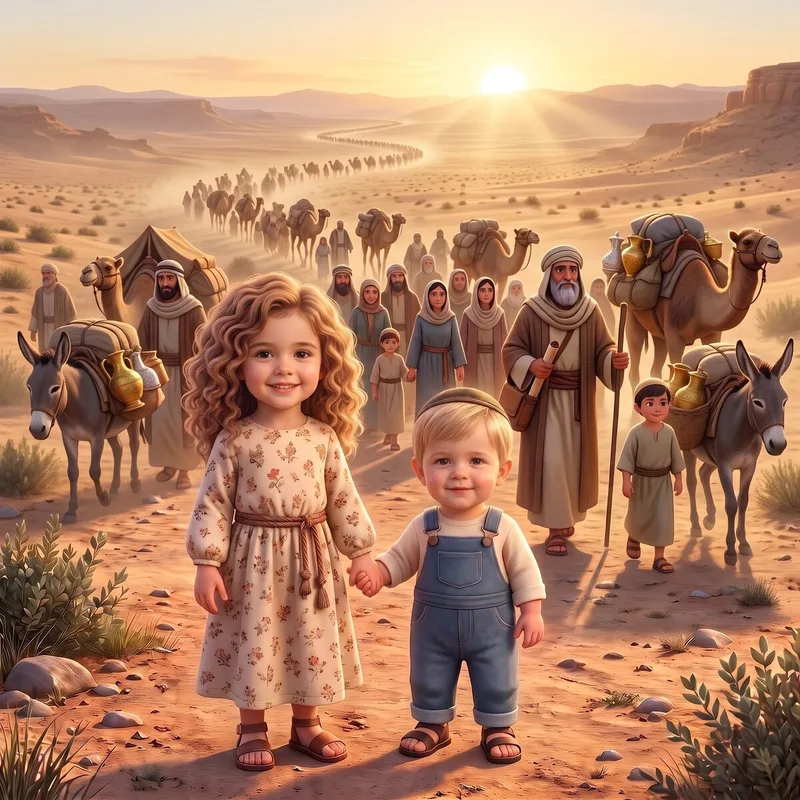
A Torah Tale book of this story is from the Kesuvim collection. Your child's name and likeness, from one uploaded photo, appear on every page, illustrated in 3D animated-film style, so your child is the one walking up to Yerushalayim. You can include up to eight children in one book, ages 0 to 18.
Every book ends with a discussion page of ten questions mixing comprehension with middos: what happened, and what it asks of the child. If you add parents, grandparents and other relatives with their photos, they appear with the children on a closing family page in every format. The softcover and hardcover open with a dedication page. Every book is written with careful rabbinical guidance and strict tznius, and reviewed by our team before it goes to print.

Softcover 8″×8″

Hardcover 8″×8″

Board book 6″×6″

Coloring book 8.5″×11″
There are three formats: a board book 6x6 with rounded safety corners for ages 0-4, a softcover 8x8 for ages 4-8, and a hardcover 8x8 for ages 5-18. The coloring book 8.5x11 in black-and-white line art is an optional one-time add-on. Coloring is a weekday activity, for erev Shabbos or a weekday afternoon, never for Shabbos or Yom Tov. The storybook itself is exactly right for reading at the Shabbos table or on a long Yom Tov afternoon.
What can we ask at the Shabbos table about Sefer Ezra?
These are for talking, not writing. You can read the story first and then ask a few of them, depending on your children's ages.
- Why do you think some Yidden went up to Yerushalayim and others stayed in Bavel?
- What was the first thing they built when they arrived, and why might they have started there?
- What do you do when you are working on something and someone tells you to stop?
- Have you ever felt happy and a little sad at the same time? When?
- What would it mean to set your heart to learn Torah, to do it, and to teach it?
- Who is someone who helped you start something again?
For the sefer's setting, you can also connect it to The Sukkos Story for Kids, since the Yidden kept Sukkos soon after they arrived and before the foundation of the Heichal was laid.
If you would like a Sefer Ezra book with your child in the story, you can create the book. It takes a free account and a few short questions: each child's name, boy or girl, age and one photo, any siblings, the story, your community, the language and the format.
Frequently asked questions
What is Sefer Ezra about, in simple words for kids?
Sefer Ezra is about the Yidden going home to Yerushalayim after the years in Bavel. They built the mizbeach, then the Beis Hamikdash, even when others tried to stop them. Later Ezra HaSofer came to strengthen the people in Torah.
What is the lesson of Sefer Ezra for children?
One lesson is that we can begin again, even when the start looks small. The Yidden began with the mizbeach and kept going when the work was stopped. Another lesson is to love Torah, as the pasuk says of Ezra that he set his heart to seek out the Torah of Hashem, to do it and to teach it.
How do I explain Sefer Ezra to a 4-year-old?
You can say: the Yidden had been far from Yerushalayim, and Hashem helped them go back home to build His house again. They were very happy and they sang thank you to Hashem. Keep it to the going home, the building and the singing.
Why did some of the Yidden cry when the Beis Hamikdash was being built?
The pasuk says that many of the older kohanim, Levi'im and family heads, who had seen the first Beis Hamikdash, wept loudly when the foundation of this one was laid, while many others raised their voices in joy. The pasuk does not say why they wept, but it is natural to understand it as longing for the first Beis Hamikdash they remembered. You can tell children that one heart can hold happiness and sadness together.
Which Torah Tale format suits a Sefer Ezra book?
Torah Tale offers a board book 6x6 with rounded safety corners for ages 0-4, a softcover 8x8 for ages 4-8 and a hardcover 8x8 for ages 5-18. Pick the one that matches your child's age. An optional matching coloring book is a one-time add-on for weekdays.
Is Sefer Ezra part of the Torah?
No. Sefer Ezra is in Kesuvim, the third section of Tanach, not in the Chumash. In the Torah Tale story picker it sits in the Kesuvim category.