The Writing on the Wall for Kids: Sefer Daniel, Belshazzar & the Hand
Belshazzar drinks from the keilim of the Beis HaMikdash, a hand writes four words on the wall, and only Daniel can read them. Here is the story, its lesson and how to tell it to a 4-year-old, a 7-year-old and an older child.
Published by Torah Tale.
Create this book for your child
The writing on the wall is the story in Daniel chapter 5, where a king uses the holy keilim of the Beis HaMikdash for a party and a hand writes a message on his palace wall. Children remember it because it has a mystery in it: strange words, wise men who cannot read them, and one person who can. Underneath the drama is a lesson a child can hold onto, that being proud and careless with holy things does not end well, while Daniel stays humble and honest.
What is the story of the writing on the wall?
Belshazzar was the king of Bavel. He made a great feast for a thousand of his nobles and drank wine with them. As the pasuk tells us, he then commanded that the gold and silver keilim that Nevuchadnetzar had taken from the Heichal in Yerushalayim be brought, so the king and his nobles could drink from them. Chazal relate that Belshazzar had calculated that the seventy years Yirmiyahu spoke of were over and that the Yidden had not been redeemed, which is why he felt so sure of himself.
Right then, the fingers of a hand appeared and wrote on the plaster of the palace wall, opposite the lampstand. The king watched the hand writing. His face changed, he became frightened, and his knees shook.
He called for his astrologers and wise men and promised a royal robe, a gold chain and the position of third ruler in the kingdom to anyone who could read the writing and explain it. None of them could. Then the queen came into the banquet hall and reminded the king about Daniel, a man of wisdom and understanding whom Nevuchadnetzar had once placed over his wise men.
Daniel was brought in. He told the king to keep his gifts for himself, but he would read the writing.
What do Mene, Mene, Tekel, Upharsin mean?
The writing was four words: מנא מנא תקל ופרסין. Before reading it, Daniel reminded Belshazzar of Nevuchadnetzar. Hashem had given him a great kingdom, but his heart grew proud, and he was driven away from people until he learned that the Most High rules over the kingdom of man. Daniel then said, in the words of the pasuk, that Belshazzar had not humbled his heart even though he knew all this.
Then Daniel gave the meaning, and the pesukim explain it in three parts:
- Mene: Hashem has numbered the days of your kingdom and brought it to an end.
- Tekel: you have been weighed on the scales and found lacking.
- Peres: your kingdom is divided and given to Madai and Paras.
Belshazzar kept his word. He had Daniel dressed in royal purple, put a gold chain on him and announced that he would be third ruler. The pasuk then says that on that very night Belshazzar was killed, and Daryavesh the Mede received the kingdom.
What is the lesson of the writing on the wall?
The first lesson is humility. Belshazzar did not need a new warning, because the story of Nevuchadnetzar was already well known to him. A wise person learns from what happened to others, and does not have to learn it the hard way.
The second is kavod for what is holy. The keilim were from the Beis HaMikdash, and Belshazzar used them for a drinking party. Children can understand this in their own world: a siddur, a sefer or a Shabbos candlestick is not an ordinary object, and we handle it with care.
The third lesson comes from Daniel. He spoke the truth to a king who had just been frightened, and he said he did not need the king's rewards before he read the writing. Telling the truth is not something we do to get a reward.
It also helps to know that Nevuchadnetzar's story appears in other places in Sefer Daniel. You can read about Chananya, Mishael and Azarya in The Fiery Furnace for Kids, and the next chapter of Sefer Daniel opens under Daryavesh, which leads into Daniel in the Lion's Den.
How do I explain the writing on the wall to a 4-year-old, a 7-year-old and an older child?
For a 4-year-old, keep it simple and calm. You can say: "A king used the special cups from the Beis HaMikdash for a party. That was not right. Then a hand wrote words on the wall, and Daniel, who loved Hashem, told the king what they meant." You do not need to describe the king being afraid in detail, and you do not need to describe what happened afterward in more than a sentence.
For a 7-year-old, add the connection to Nevuchadnetzar. Ask: "The king knew what happened to the king before him. Why didn't he learn from it?" This age usually enjoys the idea of the wise men who could not read the writing, and then a quiet man who could.
For an 11- or 12-year-old, talk about what it means to be weighed and found lacking. Ask what it looks like to have everything and still be careless with what matters. You can also ask why Daniel said he did not want the gifts but then accepted the honor when the king gave it, and what that shows about how he saw himself.
What questions can we ask at the Shabbos table?
Reading and talking are a good fit for Shabbos, so this story can easily come to the table. These questions work for a mixed-age table:
- What did Belshazzar do with the keilim from the Beis HaMikdash?
- Why could the king's wise men not read the writing?
- Who reminded the king about Daniel?
- What did Daniel remind the king about before he read the words?
- What are some holy things in our home, and how do we treat them?
- Can you think of a time when you learned from someone else's mistake?
If you want to do a craft or draw a picture of the story, save it for a weekday or erev Shabbos, since drawing is not for Shabbos.
What is a personalized Torah Tale book of this story like?
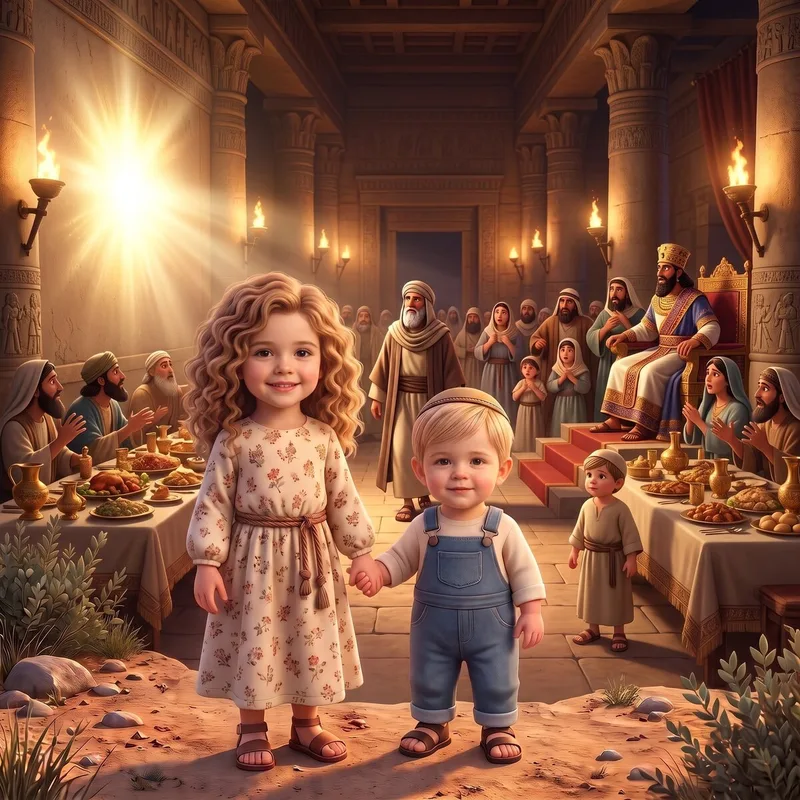
The Torah Tale book of Sefer Daniel, The Writing on the Wall, is in the Kesuvim collection of the story picker. Your child's name and, from one uploaded photo, their likeness appear on every page, illustrated in high-resolution 3D animated-film style. The book is written with careful rabbinical guidance and strict tznius, and is reviewed by our team before it goes to print.

Softcover 8″×8″

Hardcover 8″×8″

Board book 6″×6″

Coloring book 8.5″×11″
Every book ends with a discussion page of ten questions that mix comprehension with middos, so after you read, the book gives you something to talk about with your child. If you add parents and grandparents, they appear with the children on a closing family page in every format. You can also add siblings, up to eight children in the same book, ages 0 to 18.
There are three formats. The softcover photo book is 8"x8" for ages 4-8, and the hardcover photo book is 8"x8" for ages 5-18. The board book is 6"x6" with rounded safety corners for ages 0-4. An optional matching coloring book, 8.5"x11" in black-and-white line art, can be added to a book as a weekday activity, for example on a weekday afternoon or erev Shabbos.
Creating a book needs a free account and a few short questions: each child's name, boy or girl, age and one photo, any siblings, the story, your community (asked once), the language and the format. The languages are English, Hebrew and Yiddish.
When you are ready, you can create the book and let your child be part of the story of Daniel and the writing on the wall.
Frequently asked questions
What is the story of the writing on the wall?
It is the story in Sefer Daniel, chapter 5. King Belshazzar made a great feast and had the gold and silver keilim of the Beis HaMikdash brought out to drink from. Then the fingers of a hand appeared and wrote on the wall of the palace, and only Daniel could read and explain the writing. That same night Belshazzar's kingdom ended.
What do the words Mene, Mene, Tekel, Upharsin mean?
In the pesukim Daniel explains three of them. Mene means that Hashem has numbered the days of the kingdom and brought it to an end, Tekel means it was weighed and found lacking, and Peres means the kingdom would be divided and given to Madai and Paras. The writing itself has four words, because Mene appears twice.
What is the lesson of the writing on the wall for kids?
The main lesson is humility and respect for what is holy. Belshazzar had heard what happened to Nevuchadnetzar when he became proud, and he still treated the keilim of the Beis HaMikdash as party cups. A child can learn to take lessons from what happened before, and to treat holy things with care.
How do I explain the writing on the wall to a 4-year-old?
Keep it short and calm: a king used holy cups from the Beis HaMikdash for a party, which was wrong, and a hand wrote a message on the wall. Daniel, who loved Hashem, could read it, and the message said the king's time as king was over. You can end with how Daniel told the truth and was not afraid.
Is there a personalized book of the writing on the wall?
Yes. Torah Tale has a personalized storybook of Sefer Daniel, The Writing on the Wall, in the Kesuvim collection. The child's name and likeness appear on every page in 3D animated-film style, and the book ends with a discussion page of ten questions mixing comprehension with middos.