The Fiery Furnace for Kids: Sefer Daniel, Chananya, Mishael & Azarya
Three Yidden in Bavel refuse to bow to a golden statue and are saved from a burning furnace. Here is the story, its lesson, and how to explain it to a young child.
Published by Torah Tale.
Create this book for your child
The fiery furnace is the story in Sefer Daniel, perek 3, of three Yidden in Bavel, Chananya, Mishael and Azarya, who would not bow to a golden statue even when the king threatened them with a burning furnace. Children connect with it because it is about something they know well: everyone around you is doing one thing, and you know it is not right.
What happens in the story of the fiery furnace?
King Nevuchadnetzar set up a huge golden statue in the valley of Dura, sixty amos high. He commanded that whenever the music sounded, all the peoples and officials must fall down and bow to it. Anyone who did not would be thrown into a burning furnace.
Chananya, Mishael and Azarya did not bow. Some of the Chaldeans came to the king and told him so. Nevuchadnetzar was furious, but he gave them one more chance to bow when the music played.
Their answer is the most famous part of the perek. They told the king that their G-d whom they serve is able to save them from the furnace, and that He will save them from the king's hand. Then they added that even if He does not, the king should know that they will not serve his gods or bow to the golden statue.
The king ordered the furnace heated seven times hotter than usual. The three were bound and thrown in. Then Nevuchadnetzar jumped up in amazement. He saw four men walking in the fire, unbound and unharmed.
He called the three to come out. The officials gathered around and saw that the fire had no power over them. Their hair was not singed, their clothes were not changed, and there was not even the smell of fire on them. The king himself said, Blessed is the G-d of Chananya, Mishael and Azarya, who sent His malach and saved His servants who trusted in Him.
Who were Chananya, Mishael and Azarya?
Sefer Daniel introduces them in the first perek. They were taken to Bavel as young men together with Daniel, and the king's officer gave them Babylonian names: Shadrach, Meshach and Abed-Nego. In the second perek they are appointed over the affairs of the province of Bavel, which is why they were among the officials expected to bow.
The pasuk does not mention Daniel in this episode. His own test, the lions' den, is a separate story, and you can read about it in Daniel in the Lion's Den for Kids.
What is the lesson of the fiery furnace?
The first lesson is standing firm when everyone else does otherwise. Nobody forced these three to be different. They simply knew who they were, and they answered the king calmly and plainly. Children feel this at school, in the playground and with friends, so it is a very practical middah to talk about.
The second lesson is in the words and even if not. They trusted that Hashem could save them, and they also said they would stay faithful if He did not. That is a mature kind of emunah, and it is worth explaining to older children in simple words: we trust Hashem because He is Hashem, not only because things turn out the way we hope.
The Gemara in Pesachim (53b) tells us that Chananya, Mishael and Azarya learned from the frogs in Mitzrayim, who went into the hot ovens of the Egyptians. If the frogs did so, they reasoned, then people who are commanded to sanctify Hashem's name can surely do so. This is Chazal's teaching and not something the pesukim say, but it is a lovely way to show a child that even small creatures serve Hashem.
Standing alone in front of a crowd appears in other stories too. Compare it with Eliyahu on Har HaCarmel for Kids, where the whole nation was called to say Hashem Hu HaElokim.
How do I explain the fiery furnace to my child by age?
Ages 3 to 4. Keep it short: a king made a big golden statue and told everyone to bow. Three good friends said, we only bow to Hashem. Hashem kept them safe in the fire, and the king saw that Hashem is real. Skip the details of the heating. Add one clear safety line: this was a miracle, and we never play near fire.
Ages 6 to 8. Tell the full story, including their answer to the king. Ask how they might have felt when the music started and everyone else bowed. Children this age understand peer pressure well, so connect it to times when it is hard to say no to something that is not right.
Ages 10 to 12. Talk about the words and even if not. What does it mean to trust Hashem when you do not know the outcome? You can also bring in the Gemara about the frogs, and ask why that kal vachomer would give them courage.
What can we ask at the Shabbos table?
These are good for talking, with no writing or crafts needed. Pick a few that fit your children.
- What did the king command, and what did the three friends do?
- Why do you think they were calm when they answered the king?
- What do the words and even if not mean?
- Who saw the miracle, and what did the king say afterward?
- Has there been a time when it was hard to do the right thing because others were not?
- What can we do this week to be a little braver about being Yidden?

Softcover 8″×8″

Hardcover 8″×8″

Board book 6″×6″

Coloring book 8.5″×11″
What is a personalized Torah Tale book of the fiery furnace like?
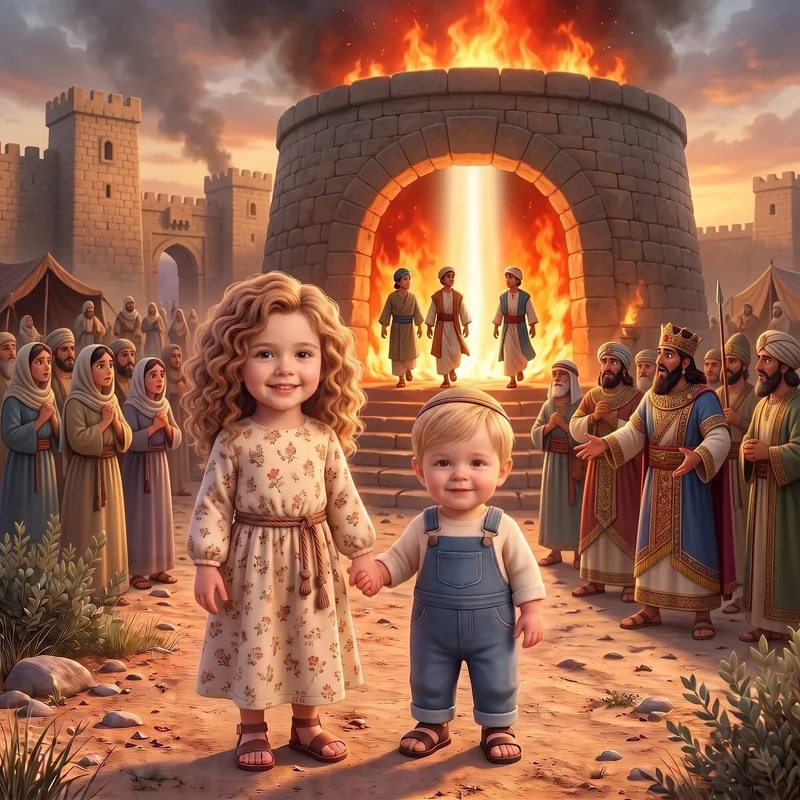
Torah Tale makes a personalized storybook of this story from its Kesuvim collection. Your child's name and, from one uploaded photo, their likeness appear on every page, illustrated in 3D animated-film style. You can include up to eight siblings in the same book, ages 0 to 18. Every book is written with careful rabbinical guidance and strict tznius, and reviewed by our team before it goes to print.
Every book ends with a discussion page of 10 questions about the story, mixing comprehension with middos. That is what turns it from a book you read to your child into one you talk about together. And since reading is entirely appropriate on Shabbos, this is a good book for the Shabbos table.
There are three formats. The board book is 6"x6" with rounded safety corners, for ages 0-4. The softcover photo book is 8"x8", for ages 4-8, and the hardcover photo book is 8"x8", for ages 5-18. Softcover and hardcover books open with a dedication page. If you add parents, grandparents and other relatives with their photos, they appear with the children on a closing family page in every format.
You can also add a matching coloring book, 8.5"x11" in black-and-white line art. Coloring is melacha, so keep it for a weekday afternoon or erev Shabbos, never for Shabbos or Yom Tov itself.

Creating a book needs a free account and a few short questions: each child's name, boy or girl, age and one photo, any siblings, the story, your community (asked once), the language and the printed format. Languages are English, Hebrew and Yiddish. The whole flow takes about five minutes.
Ready to make it? Choose Sefer Daniel in the Kesuvim collection and create the book that puts your child at the center of a story about courage and emunah.
Frequently asked questions
What is the story of the fiery furnace in Sefer Daniel?
King Nevuchadnetzar set up a golden statue and commanded everyone to bow to it when the music sounded. Chananya, Mishael and Azarya refused, so the king had them thrown into a furnace. The pasuk tells us that the fire did not harm them, and the king himself then blessed their G-d.
What is the lesson of the fiery furnace for kids?
The lesson is to stay faithful to Hashem and to what is right even when everyone else is doing something different, and even when it is hard. Chananya, Mishael and Azarya also teach that we trust Hashem whether or not we can see how He will help. Children can understand this as being brave and honest about who we are.
How do I explain the fiery furnace to a young child without scaring them?
Tell it as a story about three good friends who would only bow to Hashem, and keep the focus on the miracle and on their courage. For a three or four year old you can leave out the details of the furnace being heated, and say clearly that Hashem protected them. It is also a good moment to remind children that real fire is never something to play with.
Was Daniel in the fiery furnace?
No. The furnace was for Chananya, Mishael and Azarya, and the pasuk does not mention Daniel in this episode. Daniel's own test, being thrown to the lions, is a different story in Sefer Daniel.
Is there a personalized children's book about the fiery furnace?
Yes. Torah Tale has a book of this story in its Kesuvim collection, with your child's name and likeness from one uploaded photo illustrated in 3D animated-film style. Every book ends with a discussion page of 10 questions mixing comprehension with middos.