Zechariah's Golden Menorah for Kids: Not by Might & the Olive Trees
Zechariah sees a menorah of gold, two olive trees and a message for Zerubavel: 'Not by might and not by power, but by My spirit.' Here is the story, the lesson, and how to tell it to your children.
Published by Torah Tale.
Create this book for your child
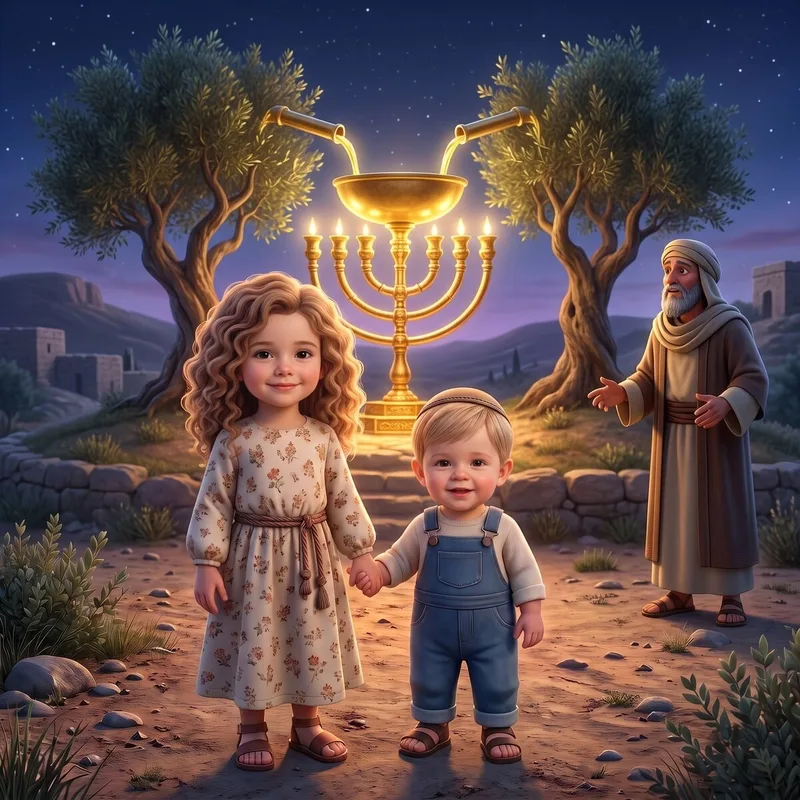
The golden menorah in Sefer Zechariah is a vision the Navi sees in chapter 4: a menorah all of gold, two olive trees beside it, and a message for Zerubavel, who had begun rebuilding the Bayis. The message is 'Not by might and not by power, but by My spirit.' Children connect to it because the picture is easy to hold in the mind and the lesson is one every child needs, that a small beginning still matters.
Who was Zechariah, and what is Sefer Zechariah?
Zechariah ben Berechyah is one of the Nevi'im whose words are gathered in Trei Asar, the twelve shorter books of Nevi'im. He prophesied among the Yidden who had returned from Bavel and were working to rebuild the Bayis. His book is full of visions, and the golden menorah is one of them.
For a child, it helps to say it simply: Hashem showed Zechariah a picture, and the picture came with a message for the leader of the building, a man named Zerubavel.
What does Zechariah see in the vision of the menorah?
The pasuk says that the malach who spoke with him woke him, like a person woken from sleep. Zechariah then sees a menorah all of gold, with a bowl on top and seven lamps on it, with pipes leading to the lamps. Beside it stand two olive trees, one on the right of the bowl and one on the left.
Zechariah asks, 'What are these, my lord?' The malach answers by asking if he does not know, and Zechariah says that he does not. Then the malach gives the answer, and it is not about the menorah's shape at all. It is a word of Hashem to Zerubavel.
What is the message to Zerubavel?
The pasuk gives us the words exactly: Lo v'chayil v'lo v'koach, ki im b'ruchi, amar Hashem Tzevakos (Zechariah 4:6). 'Not by might and not by power, but by My spirit.' The building will not succeed because of strength or an army, but because of Hashem's help.
The Navi goes on. Any 'great mountain' standing in front of Zerubavel will become a plain. He will bring out the head stone with shouts of 'chein chein lah.' The pasuk also says that Zerubavel's hands laid the foundation of this house and his hands will finish it (4:9).
Then comes a line that children remember: 'For who has despised the day of small things?' (4:10). A beginning may look small, and the Navi says it should not be looked down on.
Who are the two olive trees?
The Navi asks about the two olive trees and the oil, and the pasuk answers that they are 'the two sons of oil who stand by the Master of the whole earth' (4:14). The meforshim explain this as a reference to Zerubavel and Yehoshua the Kohen Gadol, the two leaders of the people at that time. That is an explanation of the meforshim, and the pasuk itself does not name them.
For younger children you do not need to go into this. It is enough to say that the oil and the olive trees remind us that Hashem sends help to those who are serving Him.
How do I explain it to a 4-year-old, and to an older child?
For a 4-year-old: show the picture and tell it in two sentences. 'Zechariah saw a golden menorah with olive trees. Hashem told Zerubavel, I will help you build the Bayis.' Then ask, 'Who helps us finish good things?' A younger child may be happiest just counting the lamps. The Torah Tale board book (6x6 with rounded safety corners, ages 0-4) is made for the youngest listeners.
For a 7 or 8-year-old: tell the story with the words of the pasuk, and let your child say 'Lo v'chayil v'lo v'koach' with you. Ask what a big job looks like when you feel small. The softcover (8x8, ages 4-8) fits this age.
For a 10 to 12-year-old: talk about 'the day of small things.' Why would someone look down on a small beginning? What is the difference between strength and hishtadlus, doing our part, and trusting that Hashem is the one who brings the success? The hardcover (8x8, ages 5-18) has room to grow with an older reader.
Why do we read this on Chanukah?
The vision and the words 'Not by might and not by power' are part of the haftarah read on Shabbos Chanukah, and also in Parshas Beha'aloscha, the parsha that speaks of lighting the menorah. Many children therefore meet the story around Chanukah. You can read more about the menorah in Parshas Beha'aloscha for kids, about the original menorah in Parshas Terumah for kids, and about the Yom Tov in the Chanukah story for kids.
Chanukah is also a good time to hear the lesson: a small flask, a small group of Yidden, and Hashem's help. The words 'not by might' fit well beside it.
What can we talk about at the Shabbos table?
Reading is entirely appropriate on Shabbos, and a story like this is a good one to read together. These questions need nothing but talking:
- What did Zechariah see, and who woke him?
- What did the malach say the message was for Zerubavel?
- What is a 'day of small things'? Can you think of one in your own life?
- Is it hard to keep going when a job is big? What helps?
- How is 'by My spirit' different from 'by strength'?
For a weekday activity, ask each child to tell you about one small thing they started this week, such as a bracha said carefully or a page of learning. Any coloring or drawing of the menorah is for a weekday afternoon or erev Shabbos, never for Shabbos itself.

Softcover 8″×8″

Hardcover 8″×8″

Board book 6″×6″

Coloring book 8.5″×11″
What is a personalized Torah Tale book of this story like?
The Torah Tale book of Sefer Zechariah comes from the Nevi'im collection. Your child's name and, from one uploaded photo, their likeness appear on every page, illustrated in 3D animated-film style. Up to eight children, ages 0 to 18, can appear in the same book.
Every book ends with a discussion page of 10 questions that mix comprehension with middos: what happened, and what it asks of your child. Softcover and hardcover books open with a dedication page. If you add parents, grandparents or other relatives, they appear with the children on a closing family page in every format. The book is written with careful rabbinical guidance and strict tznius, and our team reviews it before it goes to print. An optional matching coloring book (8.5x11, black-and-white line art) can be added, for weekdays.
Creating a book takes a free account and a few short questions about your child, the story, your community, the language and the format. It is available in English, Hebrew and Yiddish.
Ready to make it? Here you can create the book and let your child be the one who hears 'Not by might, but by My spirit.'
Frequently asked questions
What is the story of the golden menorah in Sefer Zechariah?
Zechariah is woken by a malach and shown a menorah all of gold, with a bowl on top, seven lamps, and two olive trees beside it. The malach explains that the vision carries a message to Zerubavel, who had laid the foundation of the Bayis: 'Not by might and not by power, but by My spirit.' The message is that Zerubavel will finish the building with Hashem's help.
What is the lesson of 'Not by might and not by power'?
The lesson is that the work of Hashem succeeds because of His help, not because of armies or strength. For children it also means that a small, hard beginning is worth continuing, since the pasuk asks 'Who has despised the day of small things?' It is a good lesson for a child who feels too small or too slow to finish something.
How do I explain Zechariah's menorah to a 4-year-old?
Keep it to a picture and one sentence: Zechariah saw a golden menorah with olive trees next to it, and Hashem told Zerubavel that He would help him build the Bayis. Ask your child to point out the lamps in the picture and say that Hashem helps us finish good things. Leave the harder ideas for when your child is older.
When do we read this story in the Jewish year?
The vision of the menorah and the words 'Not by might and not by power' are part of the haftarah read on Shabbos Chanukah and in Parshas Beha'aloscha. That is why many children first meet it around Chanukah, even though it is a story in its own right from Sefer Zechariah.
Is the menorah in Zechariah's vision the same as the menorah in the Mishkan?
Zechariah describes a vision he was shown, with a bowl, seven lamps, pipes and two olive trees, and it is not an instruction for building. The menorah of the Mishkan is commanded in Parshas Terumah. If your child asks about the details that differ, it is a good question to bring to your rav or teacher.