Tisha B'Av for Kids: The Churban, the Fast & How to Explain It
Tisha B'Av is the ninth of Av, when we remember the churban and hope for Mashiach. Here is how to explain it to a 4-year-old, an 8-year-old and an 11-year-old, with questions for the Shabbos table.
Published by Torah Tale.
Create this book for your child
Tisha B'Av is the ninth of Av, a day of fasting and mourning when we remember the destruction of both Batei HaMikdash, and it is also a day of hope. Children can understand it because it is about something they know well: missing a home that was taken away, and longing to have it back. This guide explains the story simply, with ideas for talking about it at home.
What is Tisha B'Av, in simple words?
The Beis HaMikdash was the holy place in Yerushalayim where the kohanim brought korbanos and where Yidden came to be close to Hashem. It was destroyed twice. We spend one day a year remembering that it is gone, and we ask Hashem to bring it back.
The day comes at the end of the Three Weeks, which begin on 17 Tammuz. If you want the first half of the story, we cover it in Shiva Asar B'Tammuz for Kids.
What happened on the ninth of Av?
The Mishnah in Maseches Taanis (4:6) says five things happened to our ancestors on the ninth of Av. It was decreed that the generation of the midbar would not enter Eretz Yisrael. The first Beis HaMikdash was destroyed, and so was the second. Beitar was captured, and the city was plowed up.
The first of these goes back to Parshas Shelach. Ten of the meraglim brought back a frightening report, and the Torah tells us the people wept that night. Kalev and Yehoshua said that with Hashem's help they could go up. You can read that story in Parshas Shelach for Kids.
The Gemara (Taanis 29a) says that night was the ninth of Av, and that Hashem said, in effect, that because the people wept for no reason, He would give them a reason to weep for all the generations. That is why Chazal tie the day to the meraglim.
How do we keep Tisha B'Av, and what do children see?
Adults fast from eating and drinking, and there are other restrictions as well, such as washing for pleasure and wearing leather shoes. Many people sit on the floor or on low chairs at the start of the day, Eicha is read at night, and kinos are said in the morning. In many shuls the lights are low and the atmosphere is quiet.
When Tisha B'Av falls on Shabbos, the fast is pushed off to Sunday. Children below bar or bas mitzvah age do not have an obligation to fast. For older children, and for questions about what is appropriate for children to do or read that day, ask your rav.
What is the lesson of Tisha B'Av for kids?
The first lesson is ahavas Yisrael. Chazal say in Yoma 9b that the second Beis HaMikdash was destroyed because of sinas chinam, hatred without a reason. For a child that means everyday things: not leaving a classmate out, not speaking badly about someone, making peace after an argument. We discuss this further in Loving Every Yid for Kids.
The second lesson is hope. The Gemara (Taanis 30b) teaches that whoever mourns for Yerushalayim will merit to see its joy. The Midrash relates that Mashiach is born on Tisha B'Av. The Shabbos after Tisha B'Av has the haftarah that begins with the words "Nachamu, nachamu ami."
How do I explain Tisha B'Av to a 4-year-old, an 8-year-old and an 11-year-old?
Age 4: Keep it to a few sentences. "A long time ago there was a very special house in Yerushalayim where Yidden came close to Hashem. It was taken away, so today we are sad. We daven that Hashem will bring it back." Then let your child ask questions, and answer only what they ask.
Age 8: Tell the five things the Mishnah lists and connect the first one to the meraglim they may have learned in school. Ask what the people could have done differently when they were afraid. Explain that the sad part of the day is real, and so is the hope.
Age 11: Talk about sinas chinam and what it looks like in real life, such as being quick to judge or to hold a grudge. Look together at the idea that mourning is a way of caring about what is missing. Ask how that caring should change how we act on an ordinary day.
Questions to ask at the Shabbos table
The Shabbos before Tisha B'Av is called Shabbos Chazon, and the Three Weeks are a good time to talk. These are for talking only, and they work well around the Shabbos table:
- Why do you think the Beis HaMikdash was so special to Yidden?
- What makes it hard to be happy when something important is missing?
- What does it mean to be kind to someone for no reason, the opposite of baseless hatred?
- When was a time someone made peace with you, or you made peace with someone?
- What do we hope for when we daven for Mashiach?

Softcover 8″×8″

Hardcover 8″×8″

Board book 6″×6″

Coloring book 8.5″×11″
What is a personalized Tisha B'Av book like?
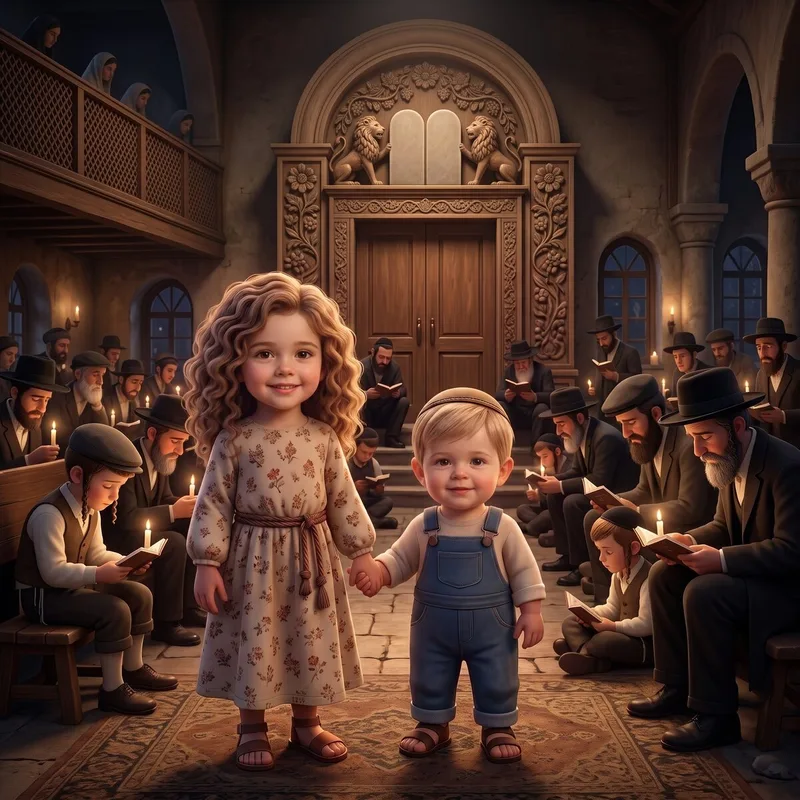
Torah Tale's Tisha B'Av story is in the Holidays collection. Your child's name and, from one uploaded photo, their likeness appear on every page, illustrated in 3D animated-film style. Every book is written with careful rabbinical guidance and strict tznius, and reviewed by our team before it goes to print.
Every book ends with a discussion page of 10 questions that mix comprehension with middos: what happened, and what it asks of the child. If you add parents and grandparents, they appear with the children on a closing family page in every format. Softcover and hardcover books open with a dedication page.
The board book is 6x6 with rounded safety corners, for ages 0-4. The softcover is 8x8, for ages 4-8, and the hardcover is 8x8, for ages 5-18. You can order in English, Hebrew or Yiddish. Up to eight children can appear in one book, so siblings can read the same story together.
A good time to read it is during the Three Weeks, including at the Shabbos table. Reading is entirely appropriate on Shabbos. On Tisha B'Av itself, Torah learning is restricted, so ask your rav what children may read that day.
How do I order a Tisha B'Av book?
You need a free account and a few short questions: each child's name, boy or girl, age and one photo, any siblings, the story, your community (asked once), the language and the format. The whole flow takes about five minutes. One-time orders come with US standard shipping that arrives in about 12 business days from the order, so it is worth ordering with some time to spare. We also ship worldwide, with rates shown at checkout.
Tisha B'Av is the kind of day children understand best when they hear the story ahead of time, in a calm moment, from someone who loves them. When you are ready, you can create the book and make your child part of the story.
Frequently asked questions
What is Tisha B'Av in simple words for a child?
Tisha B'Av is the day each year when we remember that the Beis HaMikdash, the special place in Yerushalayim where Yidden came close to Hashem, was destroyed. We are sad, we fast (if we are old enough), and we daven for the day Hashem brings Mashiach and the Beis HaMikdash is rebuilt. It is a sad day with a hopeful ending.
Do children fast on Tisha B'Av?
Children below bar or bas mitzvah age do not have an obligation to fast. How much, if anything, older children should do to prepare for fasting is a question for your rav. Younger children can still feel the day through the quiet atmosphere, the low seats and the stories they hear.
What happened on Tisha B'Av?
The Mishnah in Maseches Taanis lists five events: the decree after the meraglim that our ancestors would not enter Eretz Yisrael, the destruction of the first Beis HaMikdash, the destruction of the second, the capture of Beitar, and the plowing of the city. Chazal connect the night the people wept over the meraglim's report to the ninth of Av.
What is the lesson of Tisha B'Av for kids?
One lesson is ahavas Yisrael: Chazal tell us the second Beis HaMikdash was destroyed because of baseless hatred, so the way to repair it is to treat every Yid with kindness. A second lesson is hope, because Chazal say that whoever mourns for Yerushalayim will merit to see its joy.
Is there a personalized Tisha B'Av book for children?
Yes. Torah Tale has a Tisha B'Av story in its Holidays collection, starring your child with their name and, from one uploaded photo, their likeness in 3D animated-film style. Every book ends with a discussion page of 10 questions, and it comes as a board book (ages 0-4), a softcover (ages 4-8) or a hardcover (ages 5-18).