The Rema (הרמ״א) for Kids: Rabbi Moshe Isserles, the Mapah & Krakow
The Rema is Rabbi Moshe Isserles of Krakow, who added his notes to the Shulchan Aruch. Here is how to tell his story to a 4-year-old and to an older child, and what a personalized book about him is like.
Published by Torah Tale.
Create this book for your child
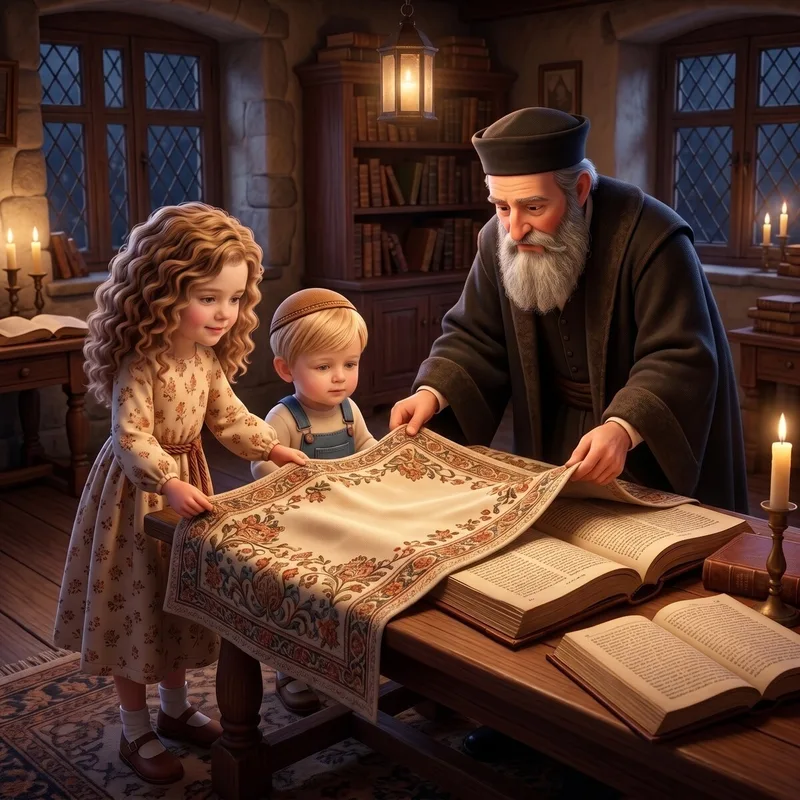
The Rema is Rabbi Moshe Isserles of Krakow, a Torah leader of the 1500s who added his notes to Rav Yosef Karo's Shulchan Aruch so that it also reflected the customs and rulings of Ashkenazi communities. Children connect with his story because the picture is so simple: a table was set, and then a tablecloth was spread over it so that more families could sit down.
Who was the Rema, Rabbi Moshe Isserles?
The name Rema (הרמ״א) is made from the letters of Rabbi Moshe Isserles. He lived in Krakow, Poland, in the 1500s. He learned Torah from Rav Shalom Shachna in Lublin, and in Krakow he taught Torah and led a yeshiva.
Yidden brought him halachic questions, and his answers were collected in a sefer of teshuvos. He was also known for writing, and the best known of his works is a set of notes on the Shulchan Aruch. His yahrzeit is on Lag BaOmer, 18 Iyar.
What is the Mapah, the tablecloth on the Shulchan Aruch?
Rav Yosef Karo, who lived in Eretz Yisrael, wrote the Shulchan Aruch, whose name means a set table. It lays out the halachos clearly, topic by topic, so a Yid can find what he needs. You can read more in our article on Rabbi Yosef Karo and the Shulchan Aruch.
The Rema added his own notes, known as the Mapah, which means a tablecloth. They record the customs and rulings of Ashkenazi communities where these differed from what Rav Yosef Karo wrote. In standard editions the Rema's comments are printed alongside the main text and are usually marked with the word Hagah.
Today Ashkenazi communities generally follow the Rema where he differs from Rav Yosef Karo, and Sephardi communities generally follow Rav Yosef Karo. For what your own family does, ask your rav.
What else did the Rema write?
The Rema wrote Darkei Moshe, a work on the Tur. Our article on the Baal HaTurim and the four Turim explains what the Tur is. He also wrote Toras HaOlah, a sefer about the Beis HaMikdash, and Mechir Yayin, a commentary on Megillas Esther. If your family is learning about the Megillah, our article on Megillas Esther for kids is a good place to start.
You do not need to tell a young child all of this. For most children one sentence about the tablecloth is enough, and the sefer names can wait until they are older.
What does the Rema teach children?
These are lessons we draw from his work, not a quotation from Chazal. They are easy to name at home:
- Add to a great work with respect. The Rema did not replace the Shulchan Aruch. He spread a tablecloth over the table that was already set.
- Every community's minhag matters. Yidden in different places have different customs, and Torah makes room for them.
- Make Torah something a family can use. A halacha is only useful if a Yid can find it and keep it.
- Keep learning and teaching. He learned from his rebbe and then taught talmidim of his own in Krakow.
A child might say it this way: 'Different families have different customs, and a good Yid respects both the table and the tablecloth.'
How do I explain the Rema to a 4-year-old and to an older child?
Ages 3 to 4: Point to the tablecloth on your Shabbos table. Say: 'A great rav set the table with halachos. Then Rabbi Moshe Isserles, the Rema, added a tablecloth so more families could sit at the table.' Keep it to that.
Ages 6 to 7: Name the two Yidden: Rav Yosef Karo, who wrote the Shulchan Aruch in Eretz Yisrael, and the Rema, who lived in Krakow. Explain that families in different places have different customs, and that both rabbanim wanted every Yid to be able to keep the halachos.
Ages 9 to 12: Explain the words Shulchan Aruch and Mapah, and show a page of a Shulchan Aruch where the Rema's Hagah is printed. Talk about why Ashkenazi and Sephardi families sometimes keep different minhagim. Remind them that for questions about what their own family does, they ask a rav and do not decide for themselves.
What is a personalized Torah Tale book about the Rema like?
The Rema is part of the Stories of Tzaddikim collection, which tells about tzaddikim and Torah leaders. In the book, your child is the hero. Their name and likeness, from one uploaded photo, appear on every page, illustrated in 3D animated-film style. You can read about the story's pshat and background in this article, and the book is written with careful rabbinical guidance and strict tznius.
Every book ends with a discussion page of 10 questions that mix comprehension with middos. That turns the book from something read to a child into something talked about at the table. Softcover and hardcover books open with a dedication page. If you add parents, grandparents and other relatives with their photos, they appear with the children on a closing family page in every format.

Softcover 8″×8″

Hardcover 8″×8″

Board book 6″×6″

Coloring book 8.5″×11″
There are three formats. The board book is 6"x6" with rounded safety corners, for ages 0-4. The softcover photo book is 8"x8", for ages 4-8, and the hardcover photo book is 8"x8", for ages 5-18. An optional matching coloring book, 8.5"x11" in black-and-white line art, can be added. It is a weekday activity for erev Shabbos, an afternoon during the week, or Chol HaMoed, never for Shabbos or Yom Tov. The storybook itself is perfect for reading at the Shabbos table.
What can we ask at the Shabbos table about the Rema?
These are for talking only. Choose the ones that fit the ages at your table:
- What did the Shulchan Aruch do for Yidden, and why is it called a set table?
- Why is the Rema's work called a tablecloth?
- Where did the Rema live, and who was his rebbe?
- Why might two families keep different minhagim and both be right?
- When have you added something to a friend's idea instead of changing it?
- Who do we ask when we are not sure what our family does?
You can end with the one-sentence version: 'The Rema spread a tablecloth over the set table so that more Yidden could sit down and keep the Torah together.'
When you are ready for a book on the Rema or another tzaddik, you can create the book in about five minutes. You will need a free account, then a few short questions: each child's name, boy or girl, age and one photo, any siblings, the story, your community (asked once), the language and the format. Torah Tale books are available in English, Hebrew and Yiddish.
Frequently asked questions
Who was the Rema?
The Rema was Rabbi Moshe Isserles, a Torah leader who lived in Krakow, Poland, in the 1500s. The name Rema is made from the letters of his title and name. He taught Torah, answered halachic questions, and wrote notes on the Shulchan Aruch that Ashkenazi communities still use.
What is the Mapah?
The Mapah, which means tablecloth, is the name of the Rema's notes on Rav Yosef Karo's Shulchan Aruch. The Shulchan Aruch is the set table, and the Rema's additions record the customs and rulings of Ashkenazi communities. In standard editions his comments are printed alongside the main text and are usually marked with the word Hagah.
How do I explain the Rema to a 4-year-old?
Use the table and the tablecloth. Tell your child that one great rav set the table with the halachos, and then Rabbi Moshe Isserles added a tablecloth so that families in his part of the world could sit at it too. Keep it to one sentence and let your child point to the tablecloth on your own Shabbos table.
Do I follow the Rema or Rav Yosef Karo?
Sephardi communities generally follow Rav Yosef Karo, and Ashkenazi communities generally follow the Rema where the two differ. Because details vary between families and communities, it is best to ask your own rav what your family does.
What else did the Rema write?
Besides the Mapah, the Rema wrote Darkei Moshe, a work on the Tur, and Toras HaOlah, a sefer about the Beis HaMikdash. He also wrote Mechir Yayin on Megillas Esther, and his teshuvos were collected.
Is there a personalized book about the Rema for children?
Yes. Torah Tale has a personalized storybook about the Rema in its Stories of Tzaddikim collection, with your child's name and likeness illustrated in 3D animated-film style. Every book ends with a discussion page of 10 questions mixing comprehension with middos, so the story can be talked about at the table.