Rabbi Yosef Karo (רבי יוסף קארו) for Kids: Shulchan Aruch & Beis Yosef
Rabbi Yosef Karo lost his home as a small child, kept learning, and spent his life making halacha clear for every Yid. Here is how to tell it to a 4-year-old, a 6-year-old and a 10-year-old.
Published by Torah Tale.
Create this book for your child
Rabbi Yosef Karo (רבי יוסף קארו, 1488-1575) was the great Torah scholar who wrote the Beis Yosef and the Shulchan Aruch, the work that tells Yidden what to do in everyday life: when to daven, how to keep Shabbos, what is kosher. Children connect with him because his story begins with a family that lost its home, and it goes on to a man who spent his life making Torah clear for everyone else.
Who was Rabbi Yosef Karo?
Rabbi Yosef Karo was born in Toledo, Spain, in 1488. In 1492, when he was a small child, the Jews were expelled from Spain and his family had to leave. They made their way, over time, to Turkey, where he grew up learning Torah.
Later he settled in Tzfas in Eretz Yisrael, where he became one of the leading rabbanim of his generation. He lived there until his passing in 1575. Some details of his early wanderings are told in different ways, so a parent can keep to the simple outline above, which is widely taught.
What are the Beis Yosef and the Shulchan Aruch?
Before Rabbi Yosef Karo, many Yidden used the Tur, written by Rabbi Yaakov ben HaRosh, which arranges the halachos by topic. You can read about its author in our article on Rabbi Yaakov, Baal HaTurim. Rabbi Yosef Karo wrote a long commentary on it called the Beis Yosef, tracing each halacha back to the Gemara and to the earlier Rishonim such as the Rif, the Rambam and the Rosh. It is usually said that this took him about twenty years.
He then wrote the Shulchan Aruch, which means a set table. It is a short version of the same halachos, without the long discussions, so a Yid can find the answer quickly. In the Beis Yosef he generally followed the Rif, the Rambam and the Rosh, and when they disagreed he usually went with the majority of the three. You can meet one of them in our article on the Rambam, on whose Mishneh Torah he also wrote the commentary called Kesef Mishneh.
The Shulchan Aruch has four sections. Here is how to describe them to a child:
- Orach Chaim: the daily life of a Yid, such as tefillah, brachos, Shabbos and Yom Tov.
- Yoreh Deah: kashrus and many other halachos a family lives with.
- Even HaEzer: marriage and family matters.
- Choshen Mishpat: honesty in business and the laws of monetary matters.
Sephardic communities generally follow Rabbi Yosef Karo's rulings. Rabbi Moshe Isserles, known as the Rema, added his glosses, called the Mapah (the tablecloth), on the customs of Ashkenazic Yidden. That is how the Shulchan Aruch came to be used by Yidden from many communities. A child can understand the picture: a table was set, and then a cloth was spread over it.
What does the story of Rabbi Yosef Karo teach children?
The first lesson is that Torah goes with a Yid wherever he goes. A child who has lost a home, a school or a familiar place still has Torah. This can be a quiet comfort for a child who has moved or is about to move.
The second lesson is patience. A work like the Beis Yosef took many years of steady effort. For a child, that translates to something small and real: finishing a little each day, whether it is learning a parsha, a perek of Mishnayos or a page of a project.
The third is that making things clear for others is a kindness. Rabbi Yosef Karo could have kept his learning to himself. Instead he wrote so that others could know what to do. We can ask a child how they help a younger sibling or a friend understand something.
One more detail is for older children. In his sefer Maggid Meisharim, Rabbi Yosef Karo recorded that a heavenly teacher spoke to him and encouraged his learning. If your child asks about it, you can say it is told in his own sefer, and that a rav can explain more when the child is older.
How do I explain Rabbi Yosef Karo to a 4-year-old, a 6-year-old and a 10-year-old?
To a 4-year-old: "Rabbi Yosef Karo wrote a big book that tells us what Hashem wants us to do, like saying brachos and keeping Shabbos. He wrote it so every Yid could find the answer." Then point to the Shulchan Aruch on the shelf and say it is a holy sefer that we hold with care.
To a 6-year-old: add that he was a little boy when his family had to leave Spain, and that he kept learning wherever they went. You can add that he first wrote a long book, the Beis Yosef, and then a short one, the Shulchan Aruch. Ask which one is easier to carry and why he might have wanted a short one too.
To a 10-year-old: explain the four sections, the connection to the Tur, and that he looked to the Rif, the Rambam and the Rosh. Then talk about the Rema and the Mapah, and why Yidden from different communities have different customs and still use the same Shulchan Aruch. Older children like to hear the structure, so you might ask which section they think they use most at home.
On a weekday, you can take down the volumes of the Shulchan Aruch from your shelf and show your child the four sections. Teach the child to kiss the sefer and return it to its place, as in our article on respecting holy seforim.
Questions to ask at the Shabbos table about Rabbi Yosef Karo
Reading and talking are just right for Shabbos. These questions need no screens and no paper:
- What do you think it felt like for a small child to leave his home in Spain?
- Why do you think Rabbi Yosef Karo wrote a short book after writing a long one?
- Which halacha did we keep today that is written in the Shulchan Aruch?
- What takes you a long time but is worth finishing?
- How can you help someone understand something that is hard for them?
- Why do you think Yidden from different communities have different customs?
Let the youngest answer first, and let the older children add what they know. For a child who gives a short answer, ask, "And what would you do?"
What is a personalized Torah Tale book about Rabbi Yosef Karo like?
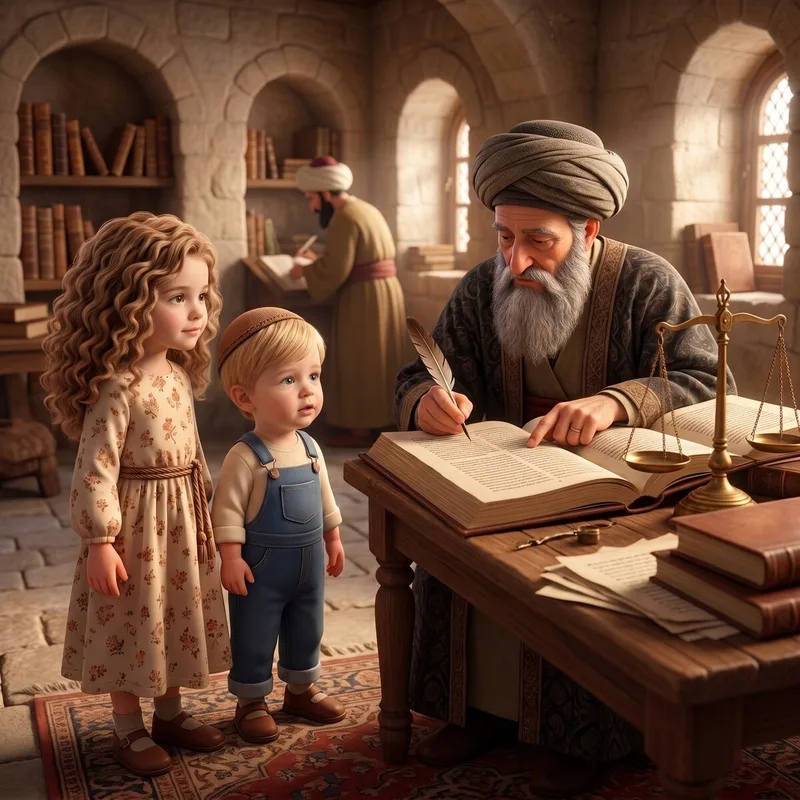
The story is in the Stories of Tzaddikim collection, among the Jewish leaders of the last two thousand years. Your child's name, and from one uploaded photo their likeness, appear in 3D animated-film style, so the child is the hero alongside the tzaddik. Up to eight children can appear in the same book, ages 0 to 18.
Every book ends with a discussion page of 10 questions about the story, mixing comprehension with middos: what happened, and what it asks of the child. If you add parents, grandparents and other relatives, they appear with the children on a closing family page in every format. Each book is written with careful rabbinical guidance and strict tznius, and reviewed by our team before it goes to print.

Softcover 8″×8″

Hardcover 8″×8″

Board book 6″×6″

Coloring book 8.5″×11″
Choose the format by the child's age. The 6x6 board book with rounded safety corners is for ages 0-4, the 8x8 softcover is for ages 4-8, and the 8x8 hardcover is for ages 5-18. Softcover and hardcover open with a dedication page. An optional matching coloring book can be added to a one-time order, and it is a weekday activity, for erev Shabbos or a weekday afternoon, never for Shabbos or Yom Tov. The book itself is perfect to read at the Shabbos table. The language can be English, Hebrew or Yiddish.
You can also see how the whole process works in our guide to creating a personalized Torah storybook.
Ready to make it? You can create the book in about five minutes. It takes a free account and a few short questions: each child's name, boy or girl, age and one photo, any siblings, the story, your community (asked once), the language and the format.
Frequently asked questions
Who was Rabbi Yosef Karo, in simple words for a child?
Rabbi Yosef Karo was a great Torah scholar who lived about five hundred years ago. He wrote a book called the Shulchan Aruch that tells Yidden what to do in daily life, such as how to keep Shabbos and what is kosher. He was born in Spain, left as a small child, and lived most of his adult life in Tzfas.
What is the difference between the Beis Yosef and the Shulchan Aruch?
The Beis Yosef is a long commentary on the Tur, which follows each halacha back to the Gemara and the earlier Rishonim. The Shulchan Aruch is a much shorter book that gives the conclusions without the long discussion, so that a Yid can find the halacha quickly. Rabbi Yosef Karo wrote both.
What is the lesson of the story of Rabbi Yosef Karo?
We learn that Torah can be carried anywhere, even after a family loses its home. We learn that important work takes years of steady effort, and that making Torah clear for others is a real act of chesed. A parent can choose whichever of these fits the child's age.
How do I explain the Shulchan Aruch to a 4-year-old?
You can say that the Shulchan Aruch means a set table, and that Rabbi Yosef Karo set out the Torah's instructions so every Yid can find what to do. Show the child the volumes on the shelf and say that Abba and Mommy look in them when they have a question about Shabbos or kashrus. Keep it short and let the child touch the sefer gently, with kavod.
Does Torah Tale have a book about Rabbi Yosef Karo?
Yes, it is in the Stories of Tzaddikim collection. The child's name and, from one uploaded photo, their likeness appear in the illustrations in 3D animated-film style. Creating a book takes a free account and a few short questions, and every book ends with a discussion page of 10 questions mixing comprehension with middos.
Which format suits a book about Rabbi Yosef Karo?
It depends on the child's age. Torah Tale offers a 6x6 board book with rounded safety corners for ages 0-4, an 8x8 softcover for ages 4-8, and an 8x8 hardcover for ages 5-18. An optional matching coloring book can be added to a one-time order.