Rabbi Yaakov, Baal HaTurim for Kids: the Four Turim & Toledo
Rabbi Yaakov, the Baal HaTurim, was the son of the Rosh and the author of the Arba'ah Turim. Here is his story, the lesson for children, and how to explain him to a 3-4 year old, a 6-7 year old and a 9-12 year old.
Published by Torah Tale.
Create this book for your child
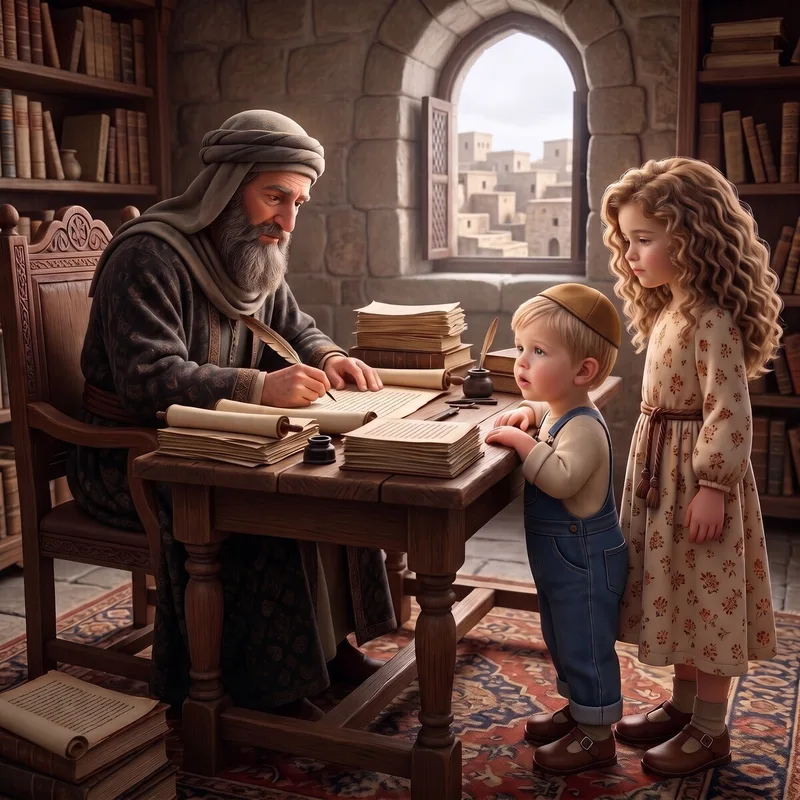
Rabbi Yaakov ben HaRosh, known as the Baal HaTurim, was a Rishon who lived in Toledo, Spain, in the 1300s. He wrote the Arba'ah Turim, a sefer that arranged the halachos of Jewish life into four sections so a Yid could find the way to keep them. Children connect with him because the idea is easy to picture: he took a huge amount of Torah and set it in order.
Who was Rabbi Yaakov, the Baal HaTurim?
Rabbi Yaakov was the son of Rabbeinu Asher, the Rosh, and he was born in Germany, around the year 1270. The Rosh was a talmid of the Maharam of Rothenburg. The family later left Germany and settled in Toledo, Spain, where the Rosh served as rav.
Rabbi Yaakov learned Torah from his father, and in Toledo he grew into a talmid chacham in his own right. He is called the Baal HaTurim, meaning the author of the Turim, after his great sefer. You can read more about his father in our article on the Rosh.
It is told that Rabbi Yaakov lived simply, without wealth, and spent his life on Torah. That is how the account has been passed down, and it is worth telling that way, without adding scenes that nobody recorded.
What are the Arba'ah Turim, in words a child can understand?
Arba'ah Turim means four rows, and the name is often connected to the four rows of stones on the choshen. Rabbi Yaakov gathered the halachos of Jewish life and arranged them into four sections:
- Orach Chaim: the Yid's day and year, including tefillah, brachos, Shabbos and Yom Tov.
- Yoreh Deah: kashrus and other halachos a Jewish home needs to know.
- Even HaEzer: the halachos of marriage and family.
- Choshen Mishpat: the halachos between people, such as honest dealing and beis din.
He drew on the teachings of the Rishonim before him, including the Rif, the Rambam and his own father, the Rosh. Some two centuries later, Rav Yosef Karo wrote the Beis Yosef on the Tur, and then the Shulchan Aruch, which follows the same four-section order. When a child learns the four names, they are learning the map that frum Yidden still use today.
What did the Baal HaTurim write on the Chumash?
Rabbi Yaakov also wrote a short commentary on the Chumash, and it appears in many Chumashim today. It is not a long explanation of the story. It is a collection of brief notes that make us look closely at the words of the Torah, such as the numerical value of a word (gematria) and the way a word is written.
This gives a child an easy way in. When your child finds a note of the Baal HaTurim in the Chumash at home, they can see that one man wrote both the Tur and this commentary.
What is the lesson of the Baal HaTurim for children?
There are three things a child can take from Rabbi Yaakov, and they fit together.
- Torah is meant to be found and used. Putting halacha in order helps every Yid know what to do. Organizing something so that others can learn from it is a real kind of chesed.
- Respect for teachers. Rabbi Yaakov learned from his father and built on the Rishonim before him, and he did not try to start from nothing.
- Steady effort. A simple life lived for Torah, one day of learning after another, is how a large sefer gets written.
For more on the last point, see Learning Torah Every Day.
How do I explain the Baal HaTurim to a 3-4 year old, a 6-7 year old and a 9-12 year old?
- Ages 3 to 4: Use one picture. Rabbi Yaakov loved Torah, and he put the Torah's rules in order, like putting books on a shelf so you can find the one you want. His father, the Rosh, was a great Rav who taught him.
- Ages 6 to 7: Teach the four sections and ask which one would tell us about a bracha before eating (Orach Chaim) or about returning something that is not ours (Choshen Mishpat). Children this age like sorting, so give them the names to sort with.
- Ages 9 to 12: Explain that the Tur gathered the teachings of the Rishonim into one order, and that Rav Yosef Karo later built on it with the Beis Yosef and the Shulchan Aruch. Ask why the order of a sefer matters, and show them a Chumash with the Baal HaTurim's notes if you have one.
What can we talk about at the Shabbos table?
Reading about Rabbi Yaakov is a fine thing to do on Shabbos, and so is talking about him. These are talking questions only, so nobody needs a pencil or paper.
- Why do you think Rabbi Yaakov put the halachos into four sections?
- Which section would we look in to learn about Shabbos? (Orach Chaim.)
- Who taught you something that you now do on your own?
- Why is it a kindness to make Torah easy to find?
- How do we show respect when we take a sefer off the shelf?
- What is one thing you would like to learn well this month?
For a weekday activity, such as on an erev Shabbos afternoon, you could straighten the family's seforim shelf together and put like with like. Tell your child that this is a small version of what Rabbi Yaakov did with halacha, and read Respecting Holy Seforim for how to handle seforim with care.

Softcover 8″×8″

Hardcover 8″×8″

Board book 6″×6″

Coloring book 8.5″×11″
What is the personalized Torah Tale book about the Baal HaTurim like?
Torah Tale's book about Rabbi Yaakov, the Baal HaTurim, is in the Stories of Tzaddikim category, in the Sefer Rishonim collection. Your child's name and likeness, from one uploaded photo, appear in high-resolution 3D animated-film style. Up to eight children, ages 0 to 18, can appear in the same book, so brothers and sisters can share one story.
Every book ends with a discussion page of 10 questions that mix comprehension with middos, which is what makes it something to talk about at the table and not only to read. If you add parents, grandparents and other relatives, they appear with the children on a closing family page in every format. Softcover and hardcover books open with a dedication page.
The formats are a 6"x6" board book with rounded safety corners (ages 0-4), an 8"x8" softcover (ages 4-8) and an 8"x8" hardcover (ages 5-18). A matching 8.5"x11" black-and-white coloring book can be added to a book, and it is a weekday activity, never for Shabbos or Yom Tov. The book can be ordered in English, Hebrew or Yiddish. It is written with careful rabbinical guidance and strict tznius and reviewed by our team before it goes to print.
To make one, you open a free account and answer a few short questions: each child's name, boy or girl, age and one photo, any siblings, the story, your community (asked once), the language and the format. It takes about five minutes. Other tzaddikim in the same spirit include the Rosh and the Rambam.
If you would like your child to meet the man who put Torah in order, you can create the book in about five minutes.
Frequently asked questions
Who was the Baal HaTurim?
The Baal HaTurim was Rabbi Yaakov, the son of Rabbeinu Asher, the Rosh. He is called the Baal HaTurim, the author of the Turim, because of his great sefer the Arba'ah Turim. He lived in Toledo, Spain, in the 1300s and also wrote a short commentary on the Chumash.
What is the Arba'ah Turim in simple words for a child?
It is a sefer that puts the halachos of Jewish life in order, in four sections. Orach Chaim covers things like tefillah, brachos, Shabbos and Yom Tov. Yoreh Deah covers kashrus and other halachos, Even HaEzer covers marriage and family, and Choshen Mishpat covers halachos between people such as honest dealing and beis din.
What is the lesson of the Baal HaTurim for children?
One lesson is that Torah is meant to be learned and found, so putting it in order is a real act of giving. Another is respect for teachers, since Rabbi Yaakov learned from his father and built on the Rishonim before him. A third is steady effort in learning, with a simple life lived for Torah.
How do I explain the Baal HaTurim to a 4-year-old?
Keep it to one picture: Rabbi Yaakov loved Torah, and he put all the Torah's rules in order, like putting your books and toys on shelves so you can find them. Add that his father, the Rosh, was a great Rav who taught him. That is enough for this age.
What is the difference between the Tur and the Shulchan Aruch?
The Tur was written by Rabbi Yaakov, the Baal HaTurim, and the Shulchan Aruch was written by Rav Yosef Karo some two centuries later. Rav Yosef Karo first wrote the Beis Yosef, a commentary on the Tur, and his Shulchan Aruch follows the same four-section order. For children, it is enough to say that the Shulchan Aruch builds on the Tur.
Is there a personalized book about the Baal HaTurim?
Yes. Torah Tale has a book about Rabbi Yaakov, the Baal HaTurim, in its Stories of Tzaddikim category. Your child's name and likeness, from one uploaded photo, appear in 3D animated-film style, and the book ends with a discussion page of 10 questions about the story.