Learning Torah Every Day (תלמוד תורה) for Kids: Teaching It at Home
Learning Torah every day is a mitzvah a child can keep at any age. Here is what the Torah says, how to explain it to a 4-year-old, a 7-year-old and an 11-year-old, and what to ask at the Shabbos table.
Published by Torah Tale.
Create this book for your child
Learning Torah every day (talmud Torah, תלמוד תורה) is the mitzvah to set aside time each day to learn Torah, and it works for children because they can start at their own level and keep it going daily. A child does not need to understand a whole sugya to keep it. A few minutes of a parsha story, a pasuk or a halacha, repeated every day, is already the mitzvah taking root.
What does the Torah say about learning Torah every day?
The clearest source for parents is in Shema. The Torah says "ושננתם לבניך ודברת בם בשבתך בביתך ובלכתך בדרך ובשכבך ובקומך" (Devarim 6:7), that we teach these words to our children and speak of them at home, on the way, when we lie down and when we rise. The pasuk does not describe a special occasion. It describes ordinary parts of the day.
The Gemara in Kiddushin (30a) explains the word "ושננתם" to mean that the words of Torah should be sharp in our mouths, so that if someone asks us, we can answer without hesitating. That is a goal worth telling a child: we learn something so well that it becomes ours.
Sefer Yehoshua (1:8) says "לא ימוש ספר התורה הזה מפיך והגית בו יומם ולילה," that the Torah should not leave your mouth, and that you should think in it by day and by night. And the Mishnah in Peah (1:1) says "ותלמוד תורה כנגד כולם," that talmud Torah is equal to all of those mitzvos together.
What is the lesson for a child?
The lesson is steadiness. Shammai says in Pirkei Avos (1:15) "עשה תורתך קבע," make your Torah something fixed. A child who learns a little every day, at a known time, is learning something bigger than any one pasuk: that Torah is part of who we are, not a hobby for when there is nothing else to do.
This is also a gentle lesson for a child who feels they are not "good at learning." The mitzvah is not to finish quickly or to know the most. It is to come back tomorrow. Children understand that very well, because they already know what it is to practice something every day.
How do I explain it to a 4-year-old, a 7-year-old and an 11-year-old?
For a 4-year-old: say it in one sentence. "Hashem gave us the Torah, and every day we learn a little bit of it." Then attach it to a moment that already exists, like a parsha story before bed or a pasuk after the brachos at breakfast. At this age the routine is the lesson.
For a 7-year-old: add the reason for keeping it daily. You can say that when we learn every day, the Torah becomes something we know well, not something we only hear about. Let them show you what they learned in cheder or school that day and listen to it properly. Being the one who teaches is a strong motivator at this age, and it echoes the pasuk about teaching our children.
For an 11-year-old: bring in the sources. Show them the pasuk in Shema, then Shammai's "עשה תורתך קבע," and ask what it means to make something fixed. Older children can choose their own time and a small goal, such as a set time each day, and see it through. This is also a good age to talk about the joy of finishing something, and you can read Making a Siyum for Kids together.
What is the Torah Tale book Learning Torah Every Day like?
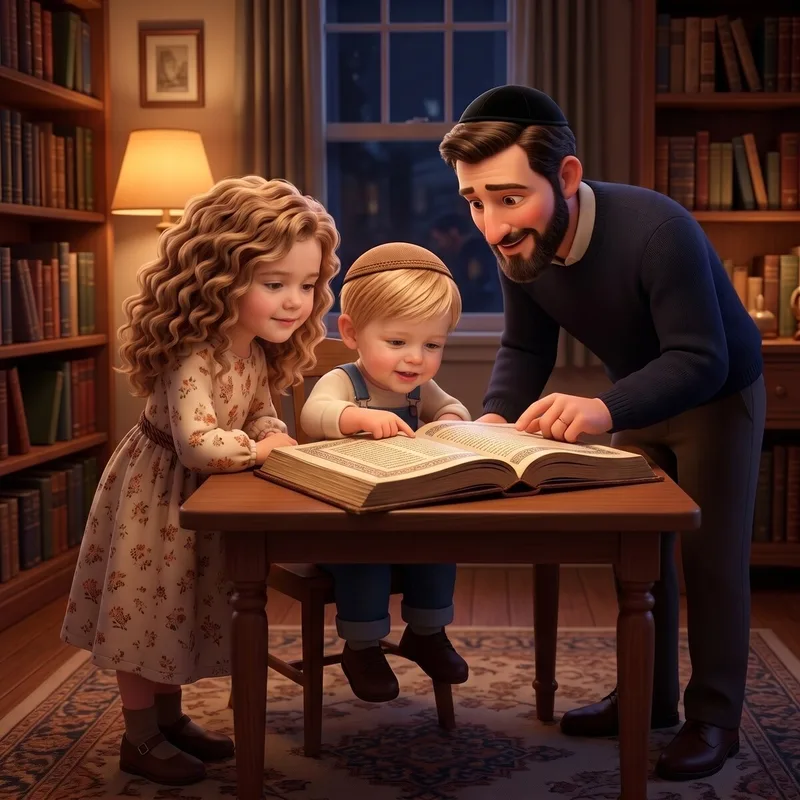
Learning Torah Every Day is a book in Torah Tale's Mitzvos collection, which is set in everyday life today. Your child is the hero: their name appears throughout, and from the one photo you upload their likeness is illustrated on every page in 3D animated-film style. Up to eight children can appear in the same book, ages 0 to 18, which suits a family with several children learning at different levels.
Every book ends with a discussion page of 10 questions about the story, mixing comprehension with middos: what happened, and what it asks of the child. This turns the book from something read to a child into something talked about at the table. Softcover and hardcover books open with a dedication page. If you add parents, grandparents or other relatives with their photos, they appear with the children on a closing family page in every format.

Softcover 8″×8″

Hardcover 8″×8″

Board book 6″×6″

Coloring book 8.5″×11″
Which format fits which age?
There are three formats. The board book is 6x6 with rounded safety corners, for ages 0-4. The softcover photo book is 8x8, for ages 4-8, and the hardcover photo book is 8x8, for ages 5-18. Your child's age is one of the short questions asked when you create the book.
There is also an optional matching coloring book, 8.5x11 in black-and-white line art. It is a weekday activity: use it on erev Shabbos, on a weekday afternoon or on Chol HaMoed, never on Shabbos or Yom Tov. The storybook itself is exactly right for reading on Shabbos and Yom Tov.
What can we ask at the Shabbos table?
Shabbos is a natural time to talk about Torah, and these questions need only talking, no writing or drawing. Try a few:
- What did you learn this week that you could tell us in one minute?
- What time of day is easiest for you to learn, and why?
- Why do you think the Torah says to speak of its words at home, on the way, when we lie down and when we rise?
- Shammai says to make your Torah fixed. What is something you do every day that you would like to make fixed?
- Who taught you something in Torah that you still remember?
Let the youngest answer first, even if the answer is one sentence. If your child has just read the book, the ten questions on its last page give you a ready-made way to begin. For a related mitzvah that is said every day, see Saying Shema for Kids, and for a child who has just started school, First Day in Cheder for Kids.
How can we start a small daily routine this week?
Choose one fixed time that your family already has, and attach a short piece of learning to it. It might be one pasuk at dinner, a parsha story at bedtime or a few minutes with Abba or Mommy after supper. Keep it short enough that it will still happen on a tired Tuesday.
During the week, you can make a simple chart and mark each day your child learned. This is a weekday activity only, since writing is not for Shabbos or Yom Tov. On Shabbos, simply learn together by talking and reading, and let the routine carry on without the chart.
Ask your rav or your child's rebbi or morah what is right for your child, especially about how much and what to learn at each age. A small commitment that is kept every day is the idea behind "עשה תורתך קבע."
When you are ready, you can create the book for your child. It takes about five minutes: a free account and a few short questions, including each child's name, boy or girl, age and one photo, the story, your community (asked once), the language and the format.
Frequently asked questions
How do I explain learning Torah every day to a 4-year-old?
Keep it short and concrete: Hashem gave us the Torah, and every day we spend a little time learning what it says. Tie it to something your child already does, such as a parsha story at bedtime or a pasuk at the table. A four-year-old understands a small daily routine far better than a big explanation.
What does the Torah say about learning Torah every day?
In the first parsha of Shema the Torah says "ושננתם לבניך ודברת בם בשבתך בביתך ובלכתך בדרך ובשכבך ובקומך" (Devarim 6:7). Sefer Yehoshua (1:8) says "לא ימוש ספר התורה הזה מפיך והגית בו יומם ולילה." Shammai in Pirkei Avos (1:15) teaches "עשה תורתך קבע," make your Torah fixed.
How long should my child learn Torah each day?
There is no single number for every child, so ask your rav or your child's rebbi what suits your child's age and school day. What the pesukim and Chazal stress is that learning is steady and part of the day. A short time that happens every day is a good start for a young child.
Can we read a Torah storybook on Shabbos?
Yes. Reading a book is entirely appropriate on Shabbos and Yom Tov, and a Torah storybook is a good thing to read at the Shabbos table or on a long Shabbos afternoon. Writing, drawing and coloring are not, so a coloring book belongs to the weekdays.
What is the Torah Tale book about learning Torah every day?
It is a personalized storybook from the Mitzvos collection, set in everyday life today, with your child's name and likeness on every page in 3D animated-film style. Like every Torah Tale book it ends with a discussion page of 10 questions that mix comprehension with middos. It comes as a 6x6 board book with rounded safety corners (ages 0-4), an 8x8 softcover (ages 4-8) or an 8x8 hardcover (ages 5-18).