Megillas Esther for Kids: The Story, Esther's Courage & the Lesson
Megillas Esther tells how Esther and Mordechai saved Klal Yisrael from Haman's decree. Here is the story told for children, the lesson, how to explain it to a 4-year-old, a 7-year-old and a 10-year-old, and questions for the table.
Published by Torah Tale.
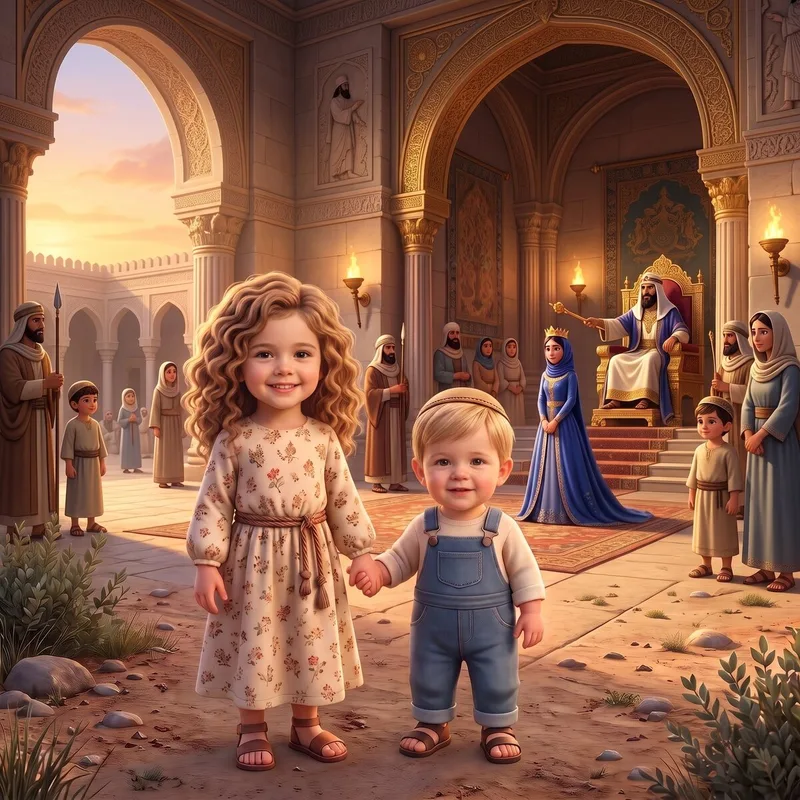
Create this book for your child
Megillas Esther tells how Queen Esther and Mordechai, together with Yidden everywhere, were saved from Haman's decree, and it is why we celebrate Purim. Children connect to it because it has a clear sequence, a brave heroine, a villain whose plan backfires, and a surprising turnaround. It is one of the five Megillos in Sefer Megillos, in Kesuvim.
What happens in Megillas Esther, step by step?
The story takes place in Shushan, in the days of King Achashveirosh, who ruled over 127 provinces. After Vashti did not come when the king called her, she was no longer queen, and Esther was brought to the palace and became queen in her place. Esther was Mordechai's cousin, and he had raised her. The pasuk tells us that Mordechai instructed her not to reveal her nation or her family (2:10).
Mordechai sat at the king's gate. There he heard that two of the king's guards, Bigsan and Seresh, were plotting against the king, and he passed the news to Esther. She told the king in Mordechai's name, and the matter was written down in the king's book of chronicles (2:21-23).
Then Achashveirosh promoted Haman and ordered everyone to bow to him. The Megillah tells us that Mordechai did not bow or stand. Haman was furious and decided to destroy all the Yidden in the kingdom. He cast a pur, a lottery, to choose the day, and letters were sent out naming the 13th of Adar.
Mordechai put on sackcloth and ashes, and the Yidden in Shushan were in great distress. Mordechai sent word to Esther to go to the king. She answered that no one may enter the king's inner court unsummoned. Mordechai replied that if she stayed silent, help would come to the Yidden from elsewhere, and that perhaps she had come to her royal position for a time like this (4:14).
Esther asked Mordechai to gather all the Yidden in Shushan to fast for three days, and she and her maidens would do the same. Then she said, "If I am lost, I am lost" (4:16). On the third day she entered the inner court, and the king held out his golden scepter to her (5:2).
How did the story turn around?
Esther invited the king and Haman to a feast, and then to a second one. That night, the king could not sleep. The Megillah says his sleep was disturbed (6:1), and Chazal tell us this was Hashem's doing. He asked for the book of chronicles to be read to him, and it was read to him that Mordechai had once saved his life. The king asked what had been done to honor Mordechai, and the answer was nothing.
When Haman came in, the king asked him what should be done for a man the king wishes to honor. Haman thought the king meant him, and he described royal clothing and a ride on the king's horse. The king told Haman to do all of that for Mordechai. Haman had to lead him through the streets of Shushan himself.
At the second feast, Esther told the king that she and her people had been sold to be destroyed. The king turned against Haman, and the gallows Haman had prepared for Mordechai were used for Haman himself. A second set of letters allowed the Yidden to defend themselves, and on the 13th of Adar they did. The Megillah calls this a day that was turned around: v'nahafoch hu (9:1).
Mordechai and Esther then wrote to establish the days of Purim for all generations, as days of feasting and joy, sending portions to friends and gifts to the poor (9:22, 9:29).
Why is Hashem's name not in Megillas Esther?
This is a question many children ask once they have heard the story a few times. The Megillah never mentions Hashem's name, yet Chazal teach that the whole story shows Hashem guiding events from behind the scenes. The Gemara in Chullin (139b) finds a hint to Esther in the Torah itself, in the words "v'anochi haster astir panai," meaning that Hashem hides His face.
For a child, a simple way to say it is that nobody in Shushan saw a big miracle, but when everything fit together at the end, Hashem's hand was clear. The king's sleepless night, the book that was read and Haman arriving at just that moment are all things children can point to. Related reading is The Purim Story for Kids.
What is the lesson of Megillas Esther for children?
There are several, and you can choose the one that suits your child.
- Tefillah and togetherness. Esther did not go to the king alone. She asked all the Yidden to fast and daven for her first. See also Taanis Esther for Kids.
- Courage. Esther knew it was dangerous to enter unsummoned, and she went anyway.
- Being in the right place. Mordechai asked whether Esther had come to her position for a time like this. Children can ask the same about themselves: what can I do for someone right now?
- Hakaras hatov. The king's chronicle recorded Mordechai's good deed, and that is what led to his honor.
How do I explain Megillas Esther to a 4-year-old, a 7-year-old and a 10-year-old?
Around age 4: "Esther was a queen. A bad man wanted to hurt the Yidden. Esther asked everyone to daven and she went to the king. Hashem helped, and the Yidden were safe. That's why we have Purim." Then point to what your child sees: the Megillah, the gragers, mishloach manos.
Around age 7: Add the order of events: Mordechai at the gate, Haman's decree, the three-day fast, the two feasts and the king's sleepless night. Ask your child to retell it back to you in order. Seven-year-olds often love the moment when Haman has to honor Mordechai.
Around age 10: Talk about hester panim and v'nahafoch hu. Ask why the Megillah never mentions Hashem's name, and what it means that things look natural but are guided. This is also the age to talk about Esther's choice and Mordechai's words in 4:14.
What questions can we ask at the Shabbos table?
Shabbos-table questions are talking only, so they work well even months before Purim. Here are some to try:
- Why did Esther ask the Yidden to fast and daven before she went to the king?
- What do you think Esther felt when she walked into the inner court?
- What happened on the night the king could not sleep?
- What did Haman think the king would do for him, and what really happened?
- When could you be "in the right place at the right time" to help someone?
On a weekday in the weeks before Purim, children can also help prepare mishloach manos for friends and neighbors. It gives them a real part in the mitzvah.
What is a personalized Megillas Esther book like?
In a Torah Tale book of Megillas Esther, the child is the hero. Their name and, from one uploaded photo, their likeness appear on every page, illustrated in 3D animated-film style. Up to eight children can appear in the same book, ages 0 to 18. The book is written with careful rabbinical guidance and strict tznius, and it is reviewed by our team before it goes to print. Megillas Esther is found in the Kesuvim collection.

Softcover 8″×8″

Hardcover 8″×8″

Board book 6″×6″

Coloring book 8.5″×11″
There are three formats: a board book (6x6 with rounded safety corners, ages 0-4), an 8x8 softcover (ages 4-8) and an 8x8 hardcover (ages 5-18). Softcover and hardcover open with a dedication page. If you add parents and grandparents, they appear with the children on a closing family page in every format.
Every book ends with a discussion page of 10 questions mixing comprehension with middos. That turns the book from something read to a child into something talked about at the table. A storybook is perfectly suited to Shabbos, while the optional matching coloring book is a weekday activity, for an afternoon during the week or the days before Purim.
Torah Tale also offers a collection subscription in two plans, Monthly (4 books a month in one delivery) or Yearly (the whole collection, paid once, $30 off). Shipping details are shown at checkout, and the pricing page has the rest. For related reading, see Shushan Purim for Kids.
Ready to make it? You can create the book in about five minutes: a free account and a few short questions, and Megillas Esther is waiting in the story picker.
Frequently asked questions
What is Megillas Esther about, in simple words for a child?
Megillas Esther is about a queen named Esther and her cousin Mordechai. A man named Haman wanted to harm the Yidden, so Esther davened, asked the Yidden to fast, and went to the king. Hashem helped, the Yidden were saved, and that is why we celebrate Purim.
Why is Hashem's name not written in Megillas Esther?
The Megillah never mentions Hashem's name, and Chazal explain that this teaches us how Hashem guides events from behind the scenes. The Gemara in Chullin 139b hints at Esther's name in the words 'v'anochi haster astir panai.' Children can understand it as Hashem being hidden but always there.
What is the lesson of Megillas Esther for kids?
One lesson is that a person may be placed in a certain spot for a reason, and should use it to help others. Mordechai told Esther that perhaps she had come to her position for a time like this. Children can also learn from Esther to daven, to ask others to join her, and to act with courage.
How do I explain Megillas Esther to a 4-year-old?
Keep it to a few sentences: Esther was a queen, a bad man wanted to hurt the Yidden, Esther asked everyone to daven, and she went to the king. Hashem helped and the Yidden were safe. Then connect it to what your child sees at Purim, such as the Megillah, mishloach manos and the seudah.
Can we read a Megillas Esther storybook on Shabbos?
Yes, reading a storybook is entirely appropriate on Shabbos, and it can be a good book for the Shabbos table. Coloring is a different matter, since it is melacha. A coloring book is a weekday activity, for an afternoon during the week or the days before Purim.
Can I order a personalized Megillas Esther book with several children?
Yes. Up to eight children can appear in the same book, ages 0 to 18, and each child's name and photo are added in the book creator. If you add parents and grandparents, they appear with the children on a closing family page in every format.