The Mann That Fell Every Morning for Kids: Midrash, Bitachon & Daily Trust
The mann fell every morning in the Midbar, enough for one day at a time. Here is the story as the Torah tells it, what Chazal add, how to explain it to ages 3-4, 5-7 and 9-12, and questions for the Shabbos table.
Published by Torah Tale.
Create this book for your child
The mann was the food Hashem gave Bnei Yisrael in the Midbar every morning for forty years, and young children connect to it easily because it is so concrete: you wake up, you go outside, and what you need for the day is there. The Torah tells the story in Shemos 16, and Chazal teach what the mann asks of us, which is to trust Hashem one day at a time.
What was the mann, according to the Torah?
The Torah tells us that Bnei Yisrael were hungry in the Midbar, and Hashem said to Moshe that He was about to rain down bread from the heavens (Shemos 16:4). The people were to go out and gather it, each day's portion on its day. The pasuk itself gives the purpose: so that Hashem would see whether they would walk in His Torah.
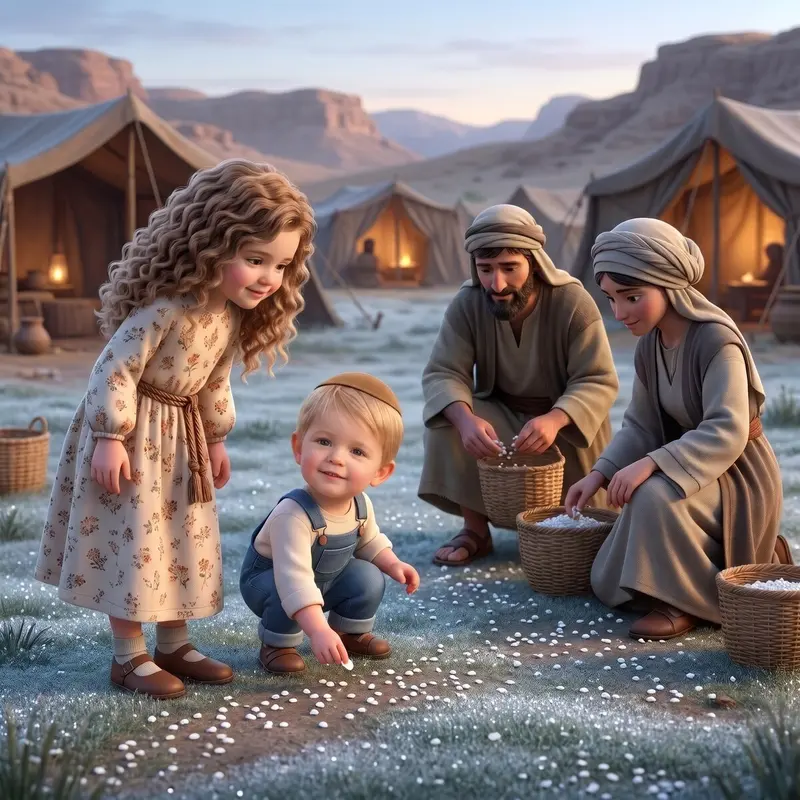
In the morning there was a layer of dew around the camp, and when the dew lifted there was something fine and flaky on the ground, as fine as frost. Bnei Yisrael asked 'Man hu?' because they did not know what it was (16:15), and the name mann stayed with it. The Torah describes it as white like coriander seed, with a taste like wafers made with honey (16:31).
What happened with the mann every morning in the Midbar?
Here is the story as the pesukim tell it, in the order a child can follow:
- Each person gathered an omer, and the Torah says that whoever gathered more had no extra and whoever gathered less did not lack (16:16-18).
- Moshe told them not to leave any until morning. Some did not listen, and the mann they left had worms and spoiled, and Moshe was angry with them (16:19-20).
- They gathered it every morning, and when the sun grew hot it melted (16:21).
- On the sixth day they gathered a double portion, lechem mishneh. The Torah tells us that what was set aside for Shabbos did not spoil, and on the seventh day none fell, even though some people went out to look for it (16:22-27).
- Moshe told Aharon to put an omer of mann in a jar and place it before Hashem to be kept for the generations, so that they would see the bread Hashem fed their ancestors in the Midbar (16:32-34).
- The Torah says the mann continued for forty years, until Bnei Yisrael reached inhabited land (16:35).
What do Chazal tell us about the mann?
These details come from Chazal, not from the pesukim, so it is worth keeping them separate when you tell the story. Rashi on the layer of dew (16:14) brings from Chazal that dew lay beneath the mann and also above it, so the mann lay protected, like something in a closed box.
Maseches Yoma (75a-76a) discusses the mann at length. Chazal tell us there that the mann tasted to each person like whatever he wished to eat. The Gemara also says that for tzaddikim it fell right at the door of their houses, while others had to go out and gather it. Those details are good for a child who asks 'but what did it taste like?'
The Gemara in Yoma 76a also asks why the mann did not fall once a year. It brings Rabbi Shimon bar Yochai's mashal of a king with a son. If the king gave his son his support once a year, the son would only turn to his father once a year. So the king gave it daily, and the son looked to his father every day. Likewise Yidden turned their hearts to their Father in Heaven each morning.
What is the lesson of the mann for children?
The main lesson is bitachon: Hashem gives what we need, and we do our part by going out and gathering. Children can hold this in a simple way. We say thank you in the morning, we do what is ours to do, and we do not need to worry about everything that might happen tomorrow. Devarim 8:3 also recalls the mann as a lesson that a person does not live by bread alone.
There are quieter middos in the story as well. Nobody ended up with too much or too little, which is a good way to talk about sharing and being content with what you have. And the double portion on Friday shows a child that Shabbos is something Bnei Yisrael prepared for, even with the food on the ground each day. For more on this middah, see Trusting in Hashem (ביטחון) for Kids.
How do I explain the mann to a 3-year-old, a 6-year-old and an 11-year-old?
Ages 3-4: Tell it in three short sentences. Bnei Yisrael were in the Midbar and had no food. Hashem sent special bread, and every morning it was on the ground. They gathered just what they needed for that day. Then let your child pretend to gather it, with a pretend basket, and say 'Thank you, Hashem.'
Ages 5-7: Add the part that children find fascinating: if you saved extra, it spoiled, but on Friday there was enough for two days. Ask what that would feel like, waking up each day not knowing, but knowing Hashem would send it. You can also connect the two challos at the Shabbos meals, which Chazal connect to the double portion of mann.
Ages 9-12: Older children can handle the question underneath: why did Hashem make it so that no one could stock up? Bring Rabbi Shimon bar Yochai's mashal of the king and his son from Yoma 76a, and let them say it back in their own words. They can also ask how we turn to Hashem each day in our own lives, in Modeh Ani, tefillah and brachos. See Modeh Ani (מודה אני) for Kids for a first step.
What are good questions to ask at the Shabbos table?
Talking about the mann fits a Shabbos meal well, since Shabbos was part of the story from the start. These are questions for talking only, and they need no props:
- What did Bnei Yisrael find on the ground each morning?
- What happened to the mann some people tried to keep until the next day?
- Why do you think there was a double portion on Friday?
- What is something Hashem gave you today that you did not have to ask for?
- Is it hard to trust that there will be enough? When is it hardest?
- What can we do to thank Hashem for what we ate today?
On a weekday, a simple activity is to stop at breakfast and name three things on the table that you did not make yourself. If your child has a coloring book, a weekday afternoon or erev Shabbos is the time for coloring, never Shabbos or Yom Tov itself.
What is a personalized Torah Tale book of the mann story like?
The Torah Tale book of this story is in the Midrash & Aggadah collection, the stories Chazal tell behind the pesukim. Your child's name and likeness, from one uploaded photo, appear on every page, illustrated in 3D animated-film style. Up to eight siblings can appear in the same book, ages 0 to 18, and if you add parents and grandparents, they appear with the children on a closing family page in every format.

Softcover 8″×8″

Hardcover 8″×8″

Board book 6″×6″

Coloring book 8.5″×11″
Every book ends with a discussion page of 10 questions about the story, mixing comprehension with middos: what happened, and what it asks of the child. That page is what lets the book become something the family talks about together. Each book is written with careful rabbinical guidance and strict tznius, and reviewed by our team before it goes to print.
Which format and language suit my child?
Torah Tale offers three formats: a board book 6x6 with rounded safety corners for ages 0-4, a softcover photo book 8x8 for ages 4-8, and a hardcover photo book 8x8 for ages 5-18. Softcover and hardcover open with a dedication page. An optional matching coloring book 8.5x11 in black-and-white line art can be added, and that is a weekday activity only.
Books are available in English, Hebrew and Yiddish. Creating one takes a free account and a few short questions: each child's name, boy or girl, age and one photo, any siblings, the story, your community (asked once), the language and the format. Ordering is a single book or a collection subscription. For help choosing a book, see Parshas Beshalach for Kids, where the mann appears in the parsha.
If you would like your child to hear about the mann starring themselves, you can create the book in about five minutes.
Frequently asked questions
What is the story of the mann for kids?
After Bnei Yisrael left Mitzrayim, Hashem told Moshe that He would rain down bread from the heavens. Each morning, after the layer of dew lifted, there was a fine, white, flaky food on the ground, and each person gathered an omer. This went on for forty years, as the Torah tells us in Shemos 16.
What is the lesson of the mann?
The mann teaches bitachon, trusting Hashem for today's needs without worrying about tomorrow. The Gemara in Yoma 76a brings a mashal of a king and his son to explain that the mann fell daily so that people would look to their Father in Heaven every single day. It also teaches sharing, since the Torah says that whoever gathered more had no extra and whoever gathered less lacked nothing.
Why couldn't Bnei Yisrael save the mann until the next day?
The Torah tells us that Moshe said not to leave any of it until morning, and those who did found that it had worms and spoiled. The exception was erev Shabbos, when they gathered a double portion and it did not spoil. Children can learn from this that Hashem gives what we need, one day at a time, and that Shabbos was special from the start.
How do I explain the mann to a 4-year-old?
Keep it simple: Hashem took care of Bnei Yisrael in the Midbar, and every morning there was food on the ground, just enough for that day. You can add that on Friday there was food for two days, so they could rest on Shabbos. A young child does not need more than that, and you can say the Modeh Ani together in the morning to connect it to their own day.
Is it all right to read this book at the Shabbos table?
Yes, reading a storybook is entirely appropriate on Shabbos and Yom Tov, and the mann story connects well to Shabbos because of the double portion on Friday. Any coloring or drawing activity, including the optional coloring book that can be added to a Torah Tale order, is a weekday activity only. Do that on erev Shabbos or another weekday.
What ages is a Torah Tale book of this story for?
Torah Tale books come in a board book 6x6 with rounded safety corners for ages 0-4, a softcover 8x8 for ages 4-8, and a hardcover 8x8 for ages 5-18. The child's age is one of the short questions when you create the book, along with their name, a photo and the language: English, Hebrew or Yiddish. Up to eight siblings can appear in the same book.