Trusting in Hashem (ביטחון) for Kids: Teaching Bitachon at Home
What bitachon means for a child, where it comes from in the Torah, how to explain it at ages 3 to 4, 6 to 7 and 9 to 12, and the personalized Torah Tale book about it.
Published by Torah Tale.
Create this book for your child
Bitachon, trusting in Hashem, means that a child does what he can and then settles his heart, knowing that Hashem is looking after him. Torah Tale's Trusting in Hashem (ביטחון) story is in the Mitzvos collection and is set in everyday life today, with your own child as the hero. Children connect to it quickly because they meet the feeling every day: waiting to be picked up, a test, a new classroom, a night with the lights off.
What is bitachon, in words a child understands?
Bitachon is the quiet feeling that Hashem is taking care of me. It is not the same as being sure everything will go exactly the way I want. It is knowing that Hashem is good, that He is with me, and that I do not have to carry every worry alone.
For a child, the simplest version is two steps: I do my part, and then I trust Hashem. The child packs the bag, and then trusts. The child studies the words, and then trusts.
What does the Trusting in Hashem story show a child?
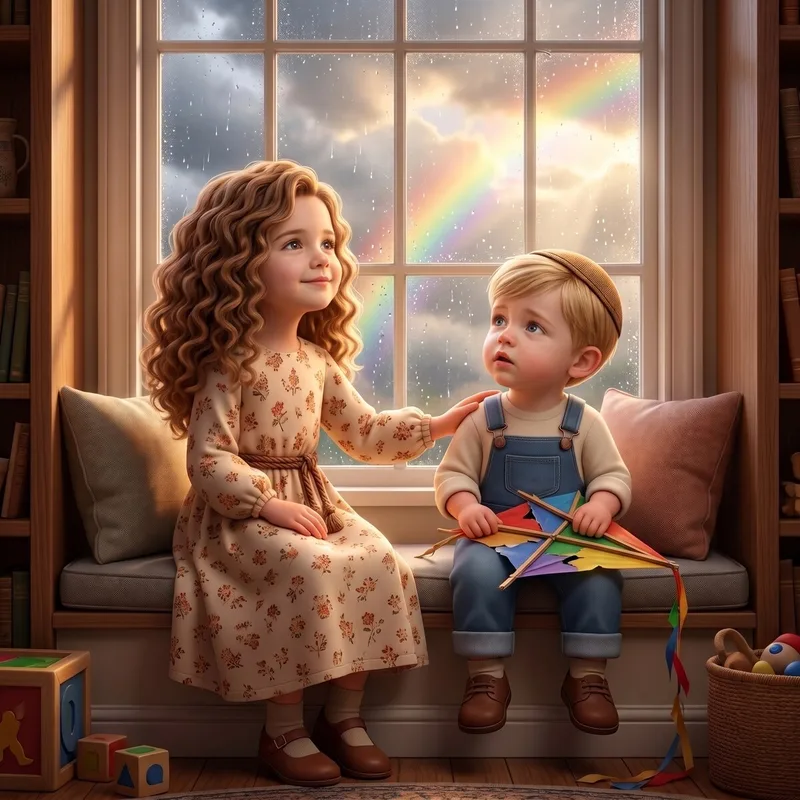
The story is set in the child's own world today, not in a faraway time. That is the point of the Mitzvos collection: a mitzvah or a core part of avodas Hashem is shown inside an ordinary day, with the child at the center, so it feels like something that belongs to him or her. Your child's name and likeness appear on every page, illustrated in 3D animated-film style.
The book carries the discussion page that ends every Torah Tale book. Its 10 questions mix comprehension, what happened, with middos, what the story asks of the child. That page is where the idea moves from the book into your home.
Where do we learn about trusting in Hashem in the Torah?
The clearest picture is the mann in Parshas Beshalach. The pesukim tell us that the Yidden went out and gathered each day's portion for that day. Some left part of it until morning, and it spoiled. On the sixth day they gathered a double portion, and on Shabbos it did not spoil.
Chazal draw a lesson from this way of living. The Gemara in Sotah (48b) says that a person who has bread in his basket and asks what he will eat tomorrow is among those of little emunah. A child does not need that quote, but he can understand the idea: Hashem gave them what they needed, one day at a time.
Other places help too:
- In Tehillim (56:4) Dovid HaMelech says that on the day he is afraid, he trusts in Hashem. Fear and trust can sit in the same heart.
- Hashem promised Yaakov, as he left home, to be with him and guard him wherever he went. You can read that story in Parshas Vayeitzei for Kids.
- In Parshas Behar the Torah speaks directly to the worry of what will be eaten in the seventh year, and Hashem answers it with a brachah. See The Shmita Year for Kids.
Does bitachon mean we do not have to try?
No, and children should hear this early. Bitachon goes together with doing our part. A child who trusts Hashem still studies, still puts on a coat, still asks a grown-up for help when he needs it.
It is also not a promise that things will always go the way we hope. When something is hard, we can tell a child: We do not always understand why, but Hashem is good and He is with us. That is a gentler and more truthful message than 'everything will be fine.'
How do I explain bitachon at different ages?
Ages 3 to 4. One picture, one sentence. At bedtime or while waiting for a ride, say quietly: 'Hashem is taking care of you right now.' Let your child say it back. No explanation is needed.
Ages 6 to 7. Give them the two steps: 'I do my part, then I trust Hashem.' Choose a real moment, such as a spelling test or the first day of a new activity. Ask, 'What is your part? What is Hashem's part?' Children this age enjoy sorting it out.
Ages 9 to 12. Talk about feelings. Dovid HaMelech was afraid and still trusted. Ask when it is hardest to trust, and what helps: tefillah, remembering times Hashem helped, or talking to a parent. You can mention that this is how the mann taught the Yidden to rely on Hashem a day at a time. For more on tefillah at home, see Davening to Hashem for Kids.
What can we ask at the Shabbos table?
Reading is welcome on Shabbos, and these questions need only talking. Pick one or two, and let a quiet answer be enough.
- What did you do yourself this week, and what was up to Hashem?
- Why do you think the Yidden were taught to gather the mann one day at a time?
- Is it okay to feel scared and still trust Hashem? What did Dovid HaMelech say?
- When did you feel worried this week? What could you say to yourself next time?
- How can we help a friend who is worried?
A parent can also go first and share a small moment when he or she felt worried and trusted Hashem. Children listen to that closely.
Which Torah Tale format suits my child?
Torah Tale offers three formats. The board book is 6"x6" with rounded safety corners, for ages 0-4. The softcover photo book is 8"x8", for ages 4-8, and the hardcover photo book is 8"x8", for ages 5-18. Softcover and hardcover books open with a dedication page. An optional matching coloring book, 8.5"x11" in black-and-white line art, can be added for a weekday afternoon or erev Shabbos, never for Shabbos or Yom Tov itself.

Softcover 8″×8″

Hardcover 8″×8″

Board book 6″×6″

Coloring book 8.5″×11″
Up to eight siblings can appear in the same book, ages 0 to 18. If you add parents and grandparents, they appear with the children on a closing family page in every format. The book can be ordered in English, Hebrew or Yiddish.
How do I order the book?
Creating a book takes about five minutes. You open a free account and answer a few short questions: each child's name, boy or girl, age and one photo, any siblings, the story, your community (asked once), the language and the printed format. Every book is written with careful rabbinical guidance and strict tznius, and is reviewed by our team before it goes to print.
You can order a single book, or a collection subscription in the Mitzvos collection, which delivers four books a month. Details are on the pricing page.
When you are ready, you can create the book and give your child a story about trusting Hashem that has his or her own name on it.
Frequently asked questions
What is bitachon in simple words for a child?
Bitachon means trusting that Hashem takes care of us. We do what we can, like studying for a test or packing a bag, and then we remember that Hashem is with us and knows what is good for us. It helps a child feel calm instead of worried.
How do I explain trusting in Hashem to a 4-year-old?
Keep it to one picture and one sentence, such as 'Hashem is always taking care of you, even when Mommy and Totty are not in the room.' Use a moment from your child's own day, like waiting for a ride or going to sleep, and say it quietly there. Short and repeated works better than a long explanation at this age.
Does bitachon mean we do not have to try?
No. Bitachon goes together with doing our part, and a child can learn to say 'I did my part, now I trust Hashem.' It is also not a promise that every outcome will be the one we hoped for. It means knowing that Hashem is good and cares for us.
Where do we learn about trusting in Hashem in the Torah?
A clear example is the mann in Parshas Beshalach, where the Yidden gathered each day's portion for that day, and what was left over until morning spoiled. In Tehillim 56:4 Dovid HaMelech says that on the day he is afraid, he trusts in Hashem. The Torah also asks Yidden to trust Hashem in the laws of shemittah in Parshas Behar.
What is the Trusting in Hashem story from Torah Tale?
It is a personalized storybook in the Mitzvos collection, set in everyday life today, with your child's name and likeness on every page in 3D animated-film style. It ends with a discussion page of 10 questions mixing comprehension with middos. You can order it in English, Hebrew or Yiddish, in a board book, softcover or hardcover.
Can I read the book on Shabbos?
Yes. Reading a storybook is entirely appropriate on Shabbos and Yom Tov, and the discussion questions work well at the Shabbos table. The optional coloring book is different, because coloring is melacha, so keep it for weekdays or erev Shabbos.