Tehillim for Kids: Praising Creation in Dovid HaMelech's Words
Dovid HaMelech looked at the sun, the mountains, the rain and the birds and turned what he saw into praise. Here is how to retell the creation perakim of Tehillim for children ages 3 to 12, with Shabbos-table questions and a weekday noticing walk.
Published by Torah Tale.
Create this book for your child
Tehillim: Praising Creation is the part of Sefer Tehillim where Dovid HaMelech looks at the world Hashem made and turns what he sees into praise. The heavens, the sun and moon, the springs that run between the mountains, the grass that grows for the animals, the birds that sing in the branches: in Dovid HaMelech's words, every one of them is telling Hashem's praise. Children connect to it immediately, because it does not ask them to picture somewhere far away. It asks them to look out the window.
What happens in Tehillim - Praising Creation?
This is not a story with a beginning, a problem and an ending. It is a song, and it is worth telling a child that straight out: Dovid HaMelech, who spent years as a shepherd in the fields and nights alone under the sky, became the king who gave Klal Yisrael the words we still daven with. Sefer Tehillim is part of Kesuvim. The Gemara in Bava Basra 14b teaches that Dovid said Sefer Tehillim together with ten elders, among them Adam HaRishon, Malki-Tzedek, Avraham Avinu, Moshe Rabbeinu, Heiman, Yedusun, Asaf and the three sons of Korach.
Perek 19 opens the theme: Hashamayim mesaprim kevod Kel umaaseh yadav magid harakia, the heavens tell the glory of Hashem and the sky tells of His handiwork. Perek 104 walks through the whole world one piece at a time. The pesukim describe springs sent into the valleys, birds that dwell by the water and give their voice among the branches, grass that grows for the animals, the moon made for the appointed times and the sun that knows when to set. In the middle of it comes the line most children can learn in a minute: Mah rabu maasecha Hashem, kulam b'chochmah asisa, how many are Your works, Hashem, You made them all with wisdom.
Perek 148 turns it into a roll call. Sun and moon, stars, mountains and hills, fruit trees and cedars, wild animals, cattle, creeping things and birds, kings and officers, young men and young girls, all of them are called to praise Hashem. And the last perek of the sefer ends it: Kol haneshamah tehallel Kah, Halleluka, everything that has a soul praises Hashem.
Which perakim praise creation, and when does a child already say them?
This is the detail that makes the story feel close rather than ancient. Perakim 145 through 150 are said every morning in Pesukei D'Zimra, which means a child who davens has already said a good part of this story today.
- Tehillim 19 - the heavens and the sky telling Hashem's glory without a word.
- Tehillim 104 - "Barchi nafshi", the long tour of the world, said on Rosh Chodesh in many shuls.
- Tehillim 147 - Hashem covers the sky with clouds, prepares rain for the earth, and gives the animal its food and the young ravens that call.
- Tehillim 148 - the roll call of sun, moon, stars, mountains, trees, animals and people.
- Tehillim 150 - the closing perek of the sefer.
The Mishnah in Maseches Tamid lists the shir shel yom, the mizmor the Levi'im sang in the Beis HaMikdash on each day of the week, and the Gemara (Rosh Hashanah 31a) connects each one to that day of creation. Sunday's is LaHashem ha'aretz um'lo'ah, the earth and everything in it belongs to Hashem. If your child says the shir shel yom at the end of davening, that is one more place this story lives.
What is the lesson for children?
The middah here is noticing. A child who learns to notice says thank you without being reminded, and a child who notices Hashem's world has an easier time noticing the people in it. That is the same muscle we work on when we teach hakaras hatov: seeing what you have been given instead of walking past it.
There is a second idea, and it is the one that usually lands with an older child. The sun does not daven. The mountain does not say a bracha. They praise Hashem by doing exactly what He made them to do, perfectly, every day, without being asked. A person is different. A person can choose to notice, and a person can say it out loud. That is why the sefer ends with kol haneshamah and not with the stars.
Practically, this is where brachos come from. A fruit, the first blossom of the season, thunder, the ocean, the new moon at Kiddush Levana: the halachos of brachos are Dovid HaMelech's habit turned into everyday life for the rest of us.
How do I explain this at different ages?
Ages 3 to 4. One sentence at a time, pointing at something real. "Who made the sun? Hashem. Who made the bird? Hashem. Thank You, Hashem." At this age the whole idea is that the beautiful things around us did not just happen.
Ages 6 to 7. Tell them about Dovid HaMelech the shepherd who watched the sky at night and the grass growing for his sheep, and who wrote down what he saw as praise. Teach them one line by heart, Mah rabu maasecha Hashem, and use it as a family phrase when something is beautiful.
Ages 9 to 12. Open with the question rather than the answer: if the heavens have no mouth, how can they be "telling" Hashem's glory? Let your child try. Many children land on it themselves, that something built with that much wisdom says something about its Maker without a word. From there you can ask the harder one: if the sun praises Hashem just by doing its job, what is a person's job?
What is the Torah Tale book of this story like?
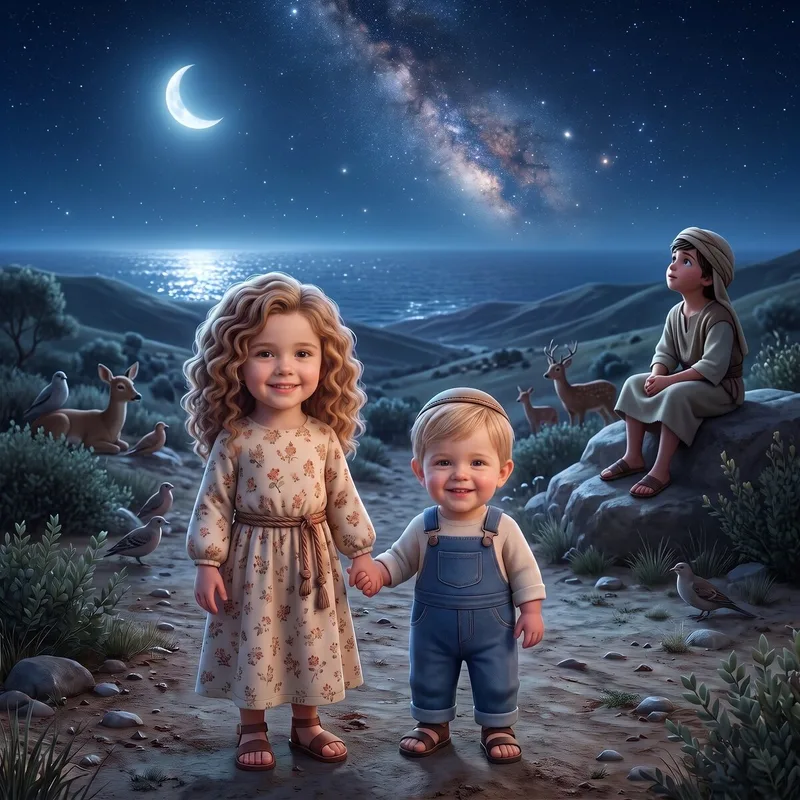
Torah Tale prints Tehillim - Praising Creation as a personalized storybook from the Kesuvim collection, which covers Kesuvim, Sefer Tehillim and the Megillos included. Your child's name and, from one uploaded photo, their likeness appear on every page, illustrated in high-resolution 3D animated-film style, so it is your child standing under the stars of perek 19 and among the mountains and fruit trees of perek 148. Up to eight siblings, ages 0 to 18, can appear in the same book.

Softcover 8″×8″

Hardcover 8″×8″

Board book 6″×6″

Coloring book 8.5″×11″
There are three formats: a 6x6 board book with rounded safety corners for ages 0-4, an 8x8 softcover for ages 4-8, and an 8x8 hardcover for ages 5-18. The softcover and hardcover open with a dedication page. If you add parents, grandparents and other relatives with their photos, they appear with the children on a closing family page, in every format. Books come in English, Hebrew or Yiddish, and a matching 8.5x11 black-and-white coloring book can be added as a one-time add-on, for coloring on a weekday afternoon or erev Shabbos, never on Shabbos or Yom Tov.
Every book ends with a discussion page of ten questions about the story, mixing comprehension with middos. Every book is written with careful rabbinical guidance and strict tznius and reviewed by our team before it goes to print. If this story goes over well, the companion book Hashem Is My Shepherd is Dovid HaMelech from the other direction, not the world he saw but the One he trusted.
Five questions for the Shabbos table
These need nothing but talking, which makes them right for Friday night or a long Shabbos afternoon.
- Name one thing Hashem made that you saw today and almost did not notice.
- The sun has no mouth. So how does it tell Hashem's praise?
- Dovid HaMelech was a shepherd before he was a king. Why would a shepherd be the one to write about mountains, rain and animals?
- Perek 148 calls on big things like stars and small things like little creeping creatures. Why does it include both?
- The sefer ends with "everything that has a soul praises Hashem". What is one way you praised Hashem this week with words?
A weekday activity: the noticing walk
On a weekday afternoon or erev Shabbos, take a ten-minute walk around the block with one rule: everyone has to find five things Hashem made and name them out loud. A tree, a cloud, an ant, a puddle, the moon if it is already up. When someone finds something really beautiful, the whole family says Mah rabu maasecha Hashem. Do it twice and it becomes the way your children walk home. If you ordered the matching coloring book, that is the weekday project to pair with it: color the creation pages during the week, before Shabbos comes in.
Say it in one sentence
If you have thirty seconds in the car: "Dovid HaMelech looked at the sky, the mountains, the rain and the birds, and instead of just enjoying them he said thank You to Hashem out loud, and that is what Sefer Tehillim is."

Creating the book takes about five minutes at torahtale.com/create. You open a free account and answer a few short questions: each child's name, boy or girl, age and one photo, any siblings, the story, your community (asked once), the language and the printed format. Pick Tehillim - Praising Creation from the Kesuvim collection and create the book, and the next time your child sees a sunset, you will both know what to say.
Frequently asked questions
What is the Tehillim story "Praising Creation" about?
It is about the way Sefer Tehillim looks at the world Hashem made and answers with praise. Dovid HaMelech describes the heavens telling Hashem's glory, springs running between the mountains, grass growing for the animals, birds singing in the branches, the moon marking the months and the sun that knows when to set. The message for a child is that every single thing Hashem made has a part in His praise, and so does the child.
Which perek of Tehillim talks about creation?
Several do. Perek 19 begins "Hashamayim mesaprim kevod Kel", the heavens tell the glory of Hashem. Perek 104 is the long description of the world, with the famous line "Mah rabu maasecha Hashem, kulam b'chochmah asisa", how many are Your works, Hashem, You made them all with wisdom. Perek 148 calls on the sun, moon, stars, mountains, fruit trees, animals and people to praise Hashem, and perek 150 closes the whole sefer with "Kol haneshamah tehallel Kah".
Who wrote Sefer Tehillim?
Sefer Tehillim is Dovid HaMelech's. The Gemara in Bava Basra 14b teaches that Dovid said Sefer Tehillim together with ten elders, including Adam HaRishon, Malki-Tzedek, Avraham Avinu, Moshe Rabbeinu, Heiman, Yedusun, Asaf and the three sons of Korach. Sefer Tehillim is part of Kesuvim, not part of the Chumash.
How do I explain "the heavens tell Hashem's glory" to a young child?
Ask the child how a star can talk if it has no mouth. Then explain that when something works perfectly every single day, it tells you about the One who made it, the same way a beautiful drawing tells you there was an artist. For a three- or four-year-old, shorten it to one sentence: the sun does not talk, but when we see it we think of Hashem.
Is there a personalized book of this Tehillim story for children?
Yes. Torah Tale prints Tehillim - Praising Creation as a personalized book from the Kesuvim collection, where the child's name and, from one uploaded photo, their likeness appear on every page in high-resolution 3D animated-film style. Up to eight siblings, ages 0 to 18, can appear in the same book. It comes as a 6x6 board book with rounded safety corners for ages 0-4, an 8x8 softcover for ages 4-8 or an 8x8 hardcover for ages 5-18, in English, Hebrew or Yiddish.
Is this a good book to read on Shabbos?
Yes. Reading a storybook to a child is entirely appropriate on Shabbos and Yom Tov, and the creation perakim of Tehillim suit a Shabbos afternoon particularly well. Every Torah Tale book ends with a discussion page of ten questions mixing comprehension with middos, which gives the family something to talk about at the Shabbos table. The optional coloring book is a weekday or erev Shabbos activity only, since coloring is melacha.