Tehillim 23 for Kids: Hashem Is My Shepherd (Mizmor LeDovid)
Mizmor LeDovid, Hashem Ro'i, is a short chapter of Tehillim with a picture children grasp right away: a shepherd who cares for his flock. Here is what the pesukim say, what they teach, and how to talk about them with ages 3 to 12.
Published by Torah Tale.
Create this book for your child
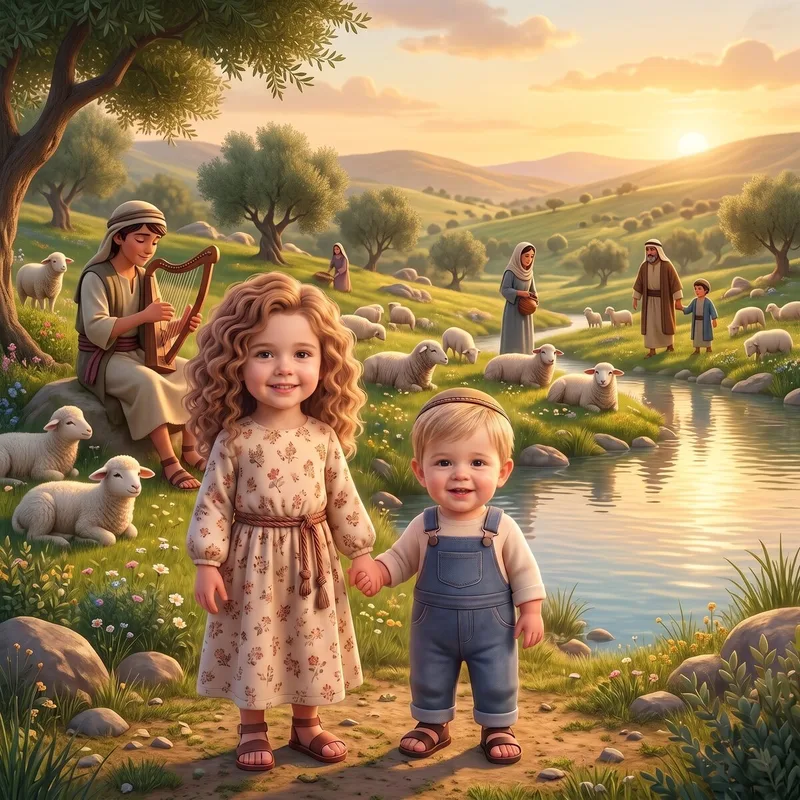
Mizmor LeDovid, Hashem Ro'i, is chapter 23 of Sefer Tehillim, a short psalm in which Dovid HaMelech describes Hashem caring for him the way a shepherd cares for his flock. Children connect to it because the picture is simple and clear: green grass, quiet water, a dark valley, and a lamb that is never alone. It also gives them a few words to hold onto when they feel afraid: 'ki Atah imadi,' You are with me.
What is Mizmor LeDovid, Hashem Ro'i?
It is a chapter of Tehillim with six pesukim, and it opens with the words 'ה' רעי לא אחסר,' Hashem is my shepherd, I shall not lack. The heading calls it a mizmor of Dovid. Many people know it by heart, and in many communities it is sung at Shalosh Seudos on Shabbos.
Dovid was a shepherd as a young man. In Shmuel I, the pesukim describe him tending his father's flock, and he later tells Shaul how he had struck a lion and a bear that took a lamb from it. It is easy to hear a shepherd's care in his words, even though the chapter itself does not say when he spoke them.
What do the pesukim say, in words a child can follow?
The first pesukim describe rest and care. A shepherd leads his flock to green pastures and beside still waters, and the mizmor says Hashem does the same for us: 'בנאות דשא ירביצני, על מי מנוחות ינהלני.' It continues that Hashem restores my soul and guides me on paths of tzedek.
Then the mizmor turns to a hard place. 'גם כי אלך בגיא צלמות לא אירא רע, כי אתה עמדי.' Even if I walk in a valley of deep darkness, I will not fear, because You are with me. The shepherd's rod and staff are a comfort to me, because he guards and guides his sheep with them.
The last pesukim speak of a table set before me and oil on my head, and of a cup that is full. They end with the hope that goodness and kindness will follow me all the days of my life, and that I will sit in the house of Hashem for many days.
What is the lesson of Hashem Is My Shepherd for kids?
The lesson is bitachon: Hashem is with me, so I do not have to be afraid. The mizmor does not say that no hard moments will come. It says that when a person walks through one, he is not walking alone.
There is also hakaras hatov in it. Dovid lists what he has been given: rest, water, guidance, food, and a full cup. A child who learns to notice those things at the table or at bedtime is practicing what Dovid does here.
One word is worth pointing out to older children. In the last pasuk, goodness and kindness 'yirdefuni,' they chase me. Instead of me running after good things, the picture is of Hashem's goodness coming after me.
When you teach this, keep one point clear. The shepherd is a mashal, a picture to help us understand Hashem's care. We do not picture Hashem Himself, and children can hear that said plainly and calmly.
How do I explain it to a 4-year-old, a 7-year-old and a 10-year-old?
Around 3 or 4: Keep it to the first line and one picture. 'A shepherd takes care of his sheep, and Hashem takes care of us.' Say 'Hashem ro'i lo echsar' together, and add 'ki Atah imadi' for when the room is dark or they are missing you. This age wants to say the words again and again, so let them.
Around 6 or 7: Go through the story of the mizmor in order. Ask what a shepherd gives his sheep: food, water, a safe path, and company in the dark places. Then ask what Hashem gives us, and let your child name real examples from their own day.
Around 9 to 12: Ask about the hard part. What is a 'gei tzalmaves' in a child's life, such as a test, a move, or a friend who is no longer friendly? Why does Dovid say 'I will not fear' before he says why? Talk about how bitachon is a skill that grows, and that it goes together with doing what we can and davening.
The same story can also be seen in Dovid's own life. Before he faced Golyas he said that Hashem, who had saved him from the lion and the bear, would save him again. You can read that story with older children in Dovid & Golyas for Kids.
What is the personalized Torah Tale book of this story like?
The book for Tehillim - Hashem Is My Shepherd is in the Kesuvim collection. Your child's name, and their likeness from one uploaded photo, appear on every page, illustrated in 3D animated-film style. Up to eight siblings, ages 0 to 18, can appear in the same book, and it can be ordered in English, Hebrew or Yiddish.

Softcover 8″×8″

Hardcover 8″×8″

Board book 6″×6″

Coloring book 8.5″×11″
The formats go by age: a 6x6 board book with rounded safety corners for ages 0-4, an 8x8 softcover for ages 4-8, and an 8x8 hardcover for ages 5-18. Softcover and hardcover open with a dedication page. If you add parents and grandparents with their photos, they appear with the children on a closing family page in every format.
Every book is written with careful rabbinical guidance and strict tznius, and our team reviews it before it goes to print. It ends with a discussion page of 10 questions that mix comprehension with middos: what happened in the story, and what it asks of your child. That page is what turns the book from something read to a child into something talked about at the table.
What can we ask at the Shabbos table or at Shalosh Seudos?
Reading a book at the Shabbos table or on a long Shabbos afternoon is exactly right, and so is singing the mizmor. Here are questions that need only talking:
- What does a shepherd do for his sheep, and how does Hashem take care of us in a similar way?
- What is something good you got this week that you did not ask for?
- What does 'ki Atah imadi' mean, and when would you want to say it?
- Dovid says he will not be afraid in a dark valley. What helps you when you feel afraid?
- Which part of the mizmor is your favorite, and why?
Yaakov Avinu also went into an unfamiliar place and was told, 'והנה אנכי עמך ושמרתיך בכל אשר תלך,' I am with you and will guard you wherever you go. You can read that story in Parshas Vayeitzei for Kids and ask your children what the two have in common.
Is there a weekday activity to go with the book?
Yes. The optional matching coloring book (8.5x11, black-and-white line art) is a weekday activity only, because coloring is melacha. It fits a weekday afternoon, the hours of erev Shabbos before Shabbos begins, the days before a Yom Tov, or Chol HaMoed. A child can color the shepherd scenes while you say the first words, 'Hashem ro'i lo echsar,' together.
The storybook itself is a different matter: reading it is appropriate on Shabbos and Yom Tov, so it can be read and talked about at the table on those days.
When you are ready, you can create the book. It takes a free account and a few short questions, and your child will be the hero of the story.
Frequently asked questions
What is the lesson of Hashem Ro'i Lo Echsar for children?
The main lesson is bitachon, trusting that Hashem is with us and takes care of what we need. The pasuk 'ה' רעי לא אחסר' says that with Hashem as my shepherd, I will lack nothing. For a child this can be put simply: Hashem looks after me, in the good times and in the hard ones.
How do I explain Hashem Is My Shepherd to a 4-year-old?
Talk about a shepherd and his sheep: he finds them grass and water, and he stays close so they are not alone. Then say that Hashem takes care of us in that way, and that we do not need to picture Hashem to know this. Teach the first words, 'Hashem ro'i lo echsar,' and say them together at bedtime or at the Shabbos table.
Who wrote Mizmor LeDovid Hashem Ro'i?
The heading of the chapter says 'Mizmor LeDovid,' a psalm of Dovid HaMelech. Dovid was a shepherd as a young man, and he spoke to Shaul about guarding his father's flock from a lion and a bear. It is natural to hear that background in his words, though the chapter itself does not tell us when he said it.
What does 'gei tzalmaves' mean in Tehillim 23?
The phrase is often translated as a valley of deep darkness or a very dark place. In the pasuk Dovid says that even if he walks there, he will not fear evil, because Hashem is with him. For children it can mean any frightening or lonely moment, such as a dark room or a hard day, and the answer is the same: 'ki Atah imadi.'
Is there a personalized book for Tehillim - Hashem Is My Shepherd?
Yes. Torah Tale has a personalized book for this story in the Kesuvim collection, with your child's name and likeness illustrated in 3D animated-film style. Creating it takes a free account and a few short questions, and every book ends with a discussion page of 10 questions about the story. You can choose English, Hebrew or Yiddish, and a format by your child's age.