Shmuel Yarchinai for Kids: Rebbi's Eye & the Star He Didn't Know
Shmuel of Nehardea was a great Amora, a doctor and a student of the heavens. Here is his story for children, the middos it teaches, and questions to talk about at home.
Published by Torah Tale.
Create this book for your child
Shmuel of Nehardea, known as Shmuel Yarchinai, was one of the great Amoraim of Bavel. He was a talmid chacham, a doctor and a student of the heavens. Children connect with him because his greatness had many parts: he learned Torah, he helped people, and he was honest about what he did not know. This is Shmuel the Amora, not Shmuel HaNavi, whose story is told in Sefer Shmuel.
Who was Shmuel Yarchinai?
Shmuel lived in Bavel in the time of the Amoraim and taught in the city of Nehardea. He was a contemporary of Rav, who taught in Sura, and the Gemara often records their words side by side. If your child has heard about Rav, you can read more in our article on Rav (Abba Aricha).
The name Yarchinai is often connected to the word yerach, the moon, and to his knowledge of the calendar and the heavens. The Gemara also shows him as a physician.
A quick note so the names do not get mixed up: Shmuel HaNavi, who was born after Chana's tefillah, lived many centuries earlier. His story is in our article on the birth of Shmuel.
What does the Gemara tell us about Shmuel and Rebbi's eye?
In Bava Metzia 85b the Gemara tells that Rebbi, Rabbi Yehuda HaNasi, suffered with his eyes. Shmuel offered to treat him with medicine. Rebbi could not bear having the treatment applied directly.
Shmuel did not insist, and he did not give up. As the Gemara relates, he placed the medicine under Rebbi's pillow, and Rebbi was healed. You can read about Rebbi himself in our article on Rabbi Yehuda HaNasi.
For a child, the point is easy to hold on to: Shmuel had the knowledge to help, and he also paid attention to how Rebbi could actually accept help.
What did Shmuel say about the stars?
In Berachos 58b Shmuel says that the paths of the heavens are as clear to him as the streets of Nehardea. It is a remarkable thing to say about what he knew.
The Gemara then continues that there is one star, called kokhva dishavit, that he said he did not know. A person who knows this much could have kept quiet about the one gap. Shmuel named it.
What is the lesson of Shmuel for children?
There are three middos children can take from Shmuel, and each one comes from the Gemara sources above.
- Using what you know to help. Shmuel's medical knowledge was a way to do chesed for Rebbi.
- Helping in a way the other person can receive. When the first way of helping did not work, he found a second.
- Honesty about your limits. Being an expert did not stop him from saying what he did not know.
There is also a quiet lesson in the way the Gemara places Shmuel next to Rav. Torah has room for different strengths. As a general rule, the halacha follows Shmuel in monetary law and Rav in issurim (Bechoros 49b).
How do I explain Shmuel to a 4-year-old, a 7-year-old and an 11-year-old?
For a 4-year-old, keep it to one picture: "Shmuel was a doctor and a very learned Yid. Rebbi's eye hurt and he could not stand the medicine, so Shmuel found a gentle way to help, and Rebbi got better." Then ask, "How can you help someone in a way that is easy for them?"
For a 7-year-old, add the stars. Shmuel knew the heavens so well, and still said, "This one I do not know." Ask your child when it feels hard to say "I don't know," and why it is a sign of strength.
For an 11-year-old, you can bring in dina d'malchusa dina, a statement of Shmuel in Nedarim 28a and Bava Kamma 113a. Explain that in certain matters the law of the government binds us, and that the limits of this rule are a question for a rav. It opens a good conversation about honest dealings.
What can we ask at the Shabbos table about Shmuel?
These are talking-only questions, so they suit a Shabbos meal or a long Yom Tov afternoon.
- Why do you think Rebbi could not bear the treatment, and what did Shmuel do about it?
- When did someone help you in a way that was just right for you?
- Why might Shmuel have told everyone about the one star he did not know?
- What is something you know well that you could use to help someone in our family?
- Rav and Shmuel are both in the Gemara. Why does Torah need people with different strengths?
For a weekday activity, step outside on a clear evening during the week and look at the sky together. Ask what we know about it and what we still wonder about. On a weekday afternoon, a coloring page of the stars is also a nice way to keep the story fresh. Coloring is for weekdays only, not for Shabbos or Yom Tov.
What is a personalized Torah Tale book of Shmuel like?
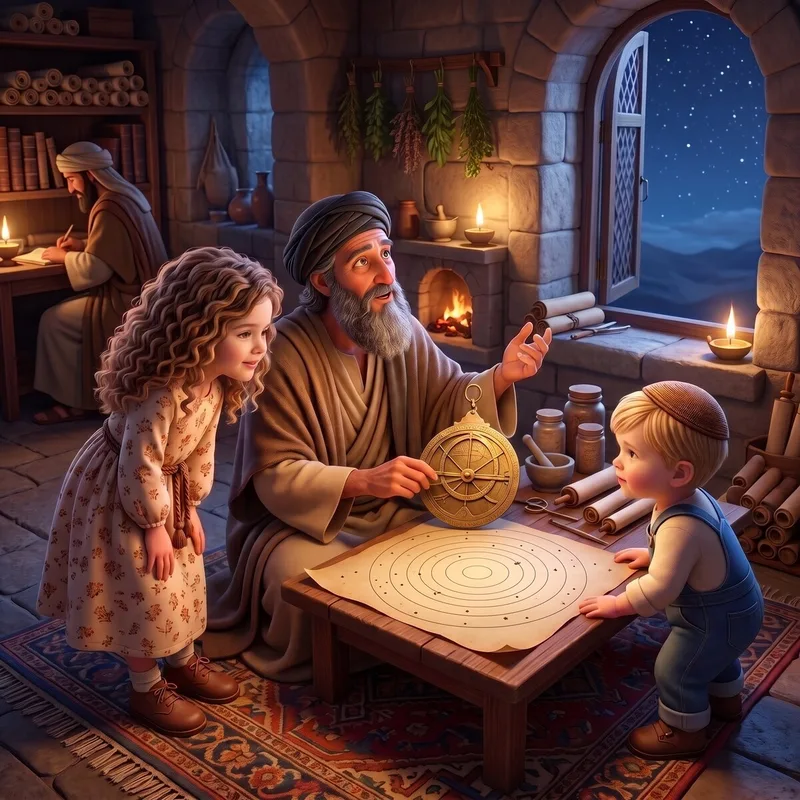
Torah Tale makes personalized Torah storybooks starring your child. Their name and, from one uploaded photo, their likeness appear on every page, illustrated in 3D animated-film style. You can find Shmuel in the story picker under Stories of Tzaddikim, in the Sefer Amoraim collection. Up to eight siblings can appear in the same book.

Softcover 8″×8″

Hardcover 8″×8″

Board book 6″×6″

Coloring book 8.5″×11″
The formats are a 6x6 board book with rounded safety corners (ages 0-4), an 8x8 softcover (ages 4-8) and an 8x8 hardcover (ages 5-18). An optional matching coloring book is a one-time add-on for weekday use. If you add parents and grandparents, they appear with the children on a closing family page in every format.
Every book ends with a discussion page of ten questions that mix comprehension with middos. That page is what turns a book you read to your child into one you talk about together. Every book is written with careful rabbinical guidance and strict tznius, and is reviewed by our team before it goes to print.
Reading is entirely appropriate on Shabbos and Yom Tov, so the book fits well at the Shabbos table or on a long Yom Tov afternoon.
If your child has met Rebbi and Rav, Shmuel is a natural next step. When you are ready, you can create the book in about five minutes with a free account and a few short questions about your child, the story, your community, the language and the format.
Frequently asked questions
Who was Shmuel Yarchinai?
Shmuel Yarchinai, also called Shmuel of Nehardea, was one of the great Amoraim in Bavel. He taught in Nehardea at the same time that Rav taught in Sura. The Gemara knows him as a talmid chacham, a doctor and someone with deep knowledge of the heavens and the calendar.
Is Shmuel the Amora the same as Shmuel HaNavi?
No. Shmuel HaNavi lived many centuries earlier and his story is told in Sefer Shmuel in Nevi'im, beginning with Chana's tefillah. Shmuel Yarchinai lived in the time of the Amoraim, and his words and deeds are found in the Gemara.
What is the lesson of Shmuel's story for children?
Shmuel teaches that whatever Hashem gave you to know can be used to help another person, and that real greatness includes honesty about what you do not know. When Rebbi could not bear the treatment, Shmuel found another way to help him. When he spoke about the stars, he admitted the one he did not understand.
How do I explain Shmuel to a 4-year-old?
You can say that Shmuel was a very learned Yid who was also a doctor. Rebbi's eye hurt and he could not stand the medicine, so Shmuel found a gentle way to help, and Rebbi got better. Then ask your child how they can help someone in a way that is easy for them to accept.
What does dina d'malchusa dina mean?
It is a statement of Shmuel, found in Nedarim 28a and Bava Kamma 113a, that the law of the government is binding in certain matters. How far it applies, and where it does not, is a question for a rav. With older children it is a good way to talk about honest dealings in the country where we live.
Does Torah Tale have a personalized book about Shmuel?
Yes. The story picker lists it under Stories of Tzaddikim in the Sefer Amoraim collection, and your child's name and likeness appear on every page. It comes as a 6x6 board book with rounded safety corners (ages 0-4), an 8x8 softcover (ages 4-8) or an 8x8 hardcover (ages 5-18), in English, Hebrew or Yiddish.