Shlomo HaMelech's Wisdom for Kids: A Listening Heart & the Famous Judgment
Hashem told Shlomo HaMelech to ask for anything he wanted, and he asked for a listening heart. Here is the story from Melachim I, retold for children, with how to explain the famous judgment to a 4-year-old and to a 10-year-old.
Published by Torah Tale.
Create this book for your child
The story of Shlomo's wisdom is in Nevi'im, in Sefer Melachim (Melachim I, chapter 3). Hashem appeared to Shlomo HaMelech in a dream at Givon and told him to ask for whatever he wanted, and Shlomo asked for a lev shomea, a listening heart, to judge the people and to understand between good and bad. Soon afterward, two women came before him arguing over one living baby, and the way Shlomo settled it showed all of Yisrael what that listening heart could do. Children love this story because the hero wins with his head and his ears, not with a sword.
What happens in the story of Shlomo's wisdom?
Shlomo was the son of Dovid HaMelech, and he became king while he was still young. The pasuk records his own words about himself: he was like a small child who did not know how to go out and come in. He went to Givon and brought a thousand olos there.
That night Hashem appeared to him in a dream and said, ask what I should give you. Shlomo did not ask for a long life. He did not ask for wealth. He did not ask that his enemies be defeated. He asked for a heart that listens, so that he could judge Hashem's people properly.
Hashem was pleased with the request. He gave Shlomo a wise and understanding heart, and told him that He was also giving him what he had not asked for, riches and honor, and that if he would walk in Hashem's ways, he would also be given length of days. Then Shlomo woke up, and the pasuk says plainly: and behold, it was a dream. He came to Yerushalayim, stood before the Aron, brought olos and shelamim, and made a feast for all his servants.
Then came the test. Two women came before the king. Each one had had a baby, and one of the babies was niftar during the night. Now each woman stood there saying that the living baby was hers. There were no witnesses and no proof, only two voices saying opposite things.
Shlomo said to bring a sword, and said that the living child should be divided in two, half to each woman. One woman cried out immediately: give her the baby, only do not kill him. The other said, let it be neither mine nor yours, divide him. Shlomo said at once: give the living child to the first woman, she is his mother. He was never planning to harm the baby. His words were the test itself, because only a real mother would rather lose the argument than let her child be hurt.
The pasuk tells us that all Yisrael heard the judgment the king had judged, and they held the king in awe, because they saw that the wisdom of Hashem was within him to do justice.
Why did Shlomo ask for a listening heart and not for riches?
This is the part worth slowing down on with children, because it is the part they can copy. Shlomo was offered anything, and he thought about the job he had been given rather than about himself. He was responsible for a whole nation, so he asked for the tool that job needs.
Notice the exact words he chose. He did not ask for a clever heart or a quick heart. He asked for a heart that listens. A judge who does not listen all the way to the end of what a person is saying cannot judge correctly, no matter how smart he is. The same is true of a parent, a rebbi, a morah and a nine-year-old settling an argument over whose turn it is.
Later, in Melachim I chapter 5, we are told that Shlomo's wisdom was greater than that of all the people of his time, that he spoke three thousand mishalim, and that people came from the kings of the earth to hear him. All of it grew from one request made in a dream.
How to explain this story at different ages
Ages 3 to 4. Keep it to one scene and keep it safe. "Two mommies both said the same baby was theirs. The king said something that sounded very scary, and right away one of them said, don't hurt him, give him to her. The king said, that one is the real mommy. The baby was fine the whole time." Say the last sentence out loud. A small child needs to hear that the baby was never in danger.
Ages 6 to 7. Now add the dream. Hashem told Shlomo to ask for anything, and he asked for a heart that listens. Ask your child what he would have asked for. Then show how the two halves of the story fit together: the thing he asked for in chapter 3 is the exact thing that saved the baby a few pesukim later.
Ages 9 to 12. Go into the mechanics. Shlomo had no witnesses and no evidence, so instead of guessing, he built a situation in which the truth would show itself. Ask what Hashem's answer teaches: that asking for the right thing is itself a sign of wisdom, and that the riches and honor came precisely because they were not what he wanted. This age can also handle the contrast with his father, who faced a different kind of battle in the story of Dovid and Golyas, and who poured out his heart in perakim like Mizmor LeDovid.
What a personalized Torah Tale book of Shlomo's Wisdom is like
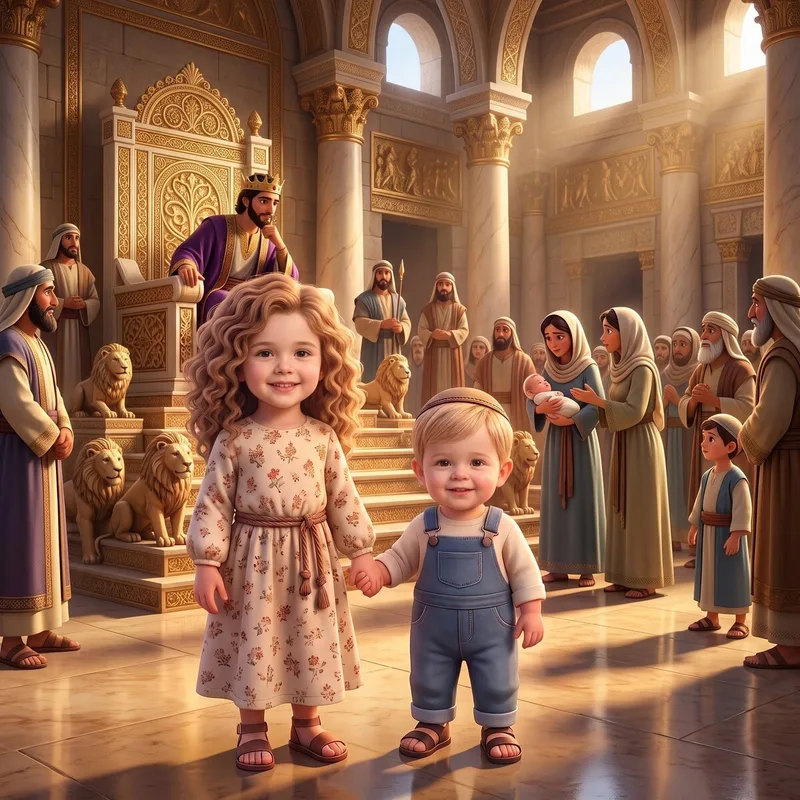
Torah Tale prints Shlomo's Wisdom as its own book in the Nevi'im collection, from Sefer Melachim. Your child is in the story. You upload one photo, and from it their likeness is illustrated in high-resolution 3D animated-film style on every page, with their name in the text, standing in Shlomo's court as the judgment unfolds.
Up to eight siblings, ages 0 to 18, can appear in the same book. If you add parents and grandparents with their photos, they appear with the children on a closing family page, in every format. Softcover and hardcover books open with a dedication page.
Every book ends with a discussion page of ten questions about the story, mixing comprehension with middos. For this story those questions are unusually good at the table, because the whole episode turns on a choice a child can understand: give up winning so that someone else is not hurt.
Formats are the 6"x6" board book with rounded safety corners for ages 0 to 4, the 8"x8" softcover photo book for ages 4 to 8, and the 8"x8" hardcover photo book for ages 5 to 18. A matching 8.5"x11" black-and-white coloring book can be added to a one-time order, and it is a weekday project, for a weekday afternoon or erev Shabbos, never on Shabbos or Yom Tov.

Softcover 8″×8″

Hardcover 8″×8″

Board book 6″×6″

Coloring book 8.5″×11″
Shabbos table questions on Shlomo's wisdom
These are for talking, and they work from about age five upward. Pick two or three, not all of them.
- If Hashem told you to ask for one thing, what would you ask for, and what do you think you should ask for?
- Why did Hashem give Shlomo riches and honor when he did not ask for them?
- How did Shlomo know which woman was telling the truth? What exactly did he listen for?
- The real mother was ready to lose the argument. Has there ever been a time you gave something up so that someone else would be all right?
- What does a "listening heart" mean for a child? Who in our house is good at listening before deciding?
- Why were the people in awe of the king after they heard the judgment?
A weekday activity: the listening test
During the week, when two children come to you mid-argument, try Shlomo's method out loud. Each one gets to say the whole story with no interruptions, and then each one has to repeat back what the other one said before you say anything at all. It takes four minutes and it very often ends the fight before you rule on it.
Afterward you can say the sentence that holds the whole story: Shlomo HaMelech could have asked for anything in the world, and he asked to be able to listen. Children remember that line far longer than they remember the sword.
Say it in one sentence
If you have thirty seconds before lights out: "Hashem told Shlomo HaMelech to ask for anything, and he asked for a heart that listens, and that is how he figured out which woman was really the baby's mother." That is the whole story, and it is enough to send a child to sleep with the right idea.
Shlomo's Wisdom sits in the Nevi'im collection alongside stories like Chana's tefillah at Shiloh and the walls of Yericho. Creating a book takes about five minutes and starts with a free account and a few short questions: each child's name, boy or girl, age and one photo, any siblings, the story, your community (asked once), the language (English, Hebrew or Yiddish) and the printed format. You can create the book whenever you are ready, and see your child standing in Shlomo's court the next time you open it at the Shabbos table.
Frequently asked questions
Where is the story of Shlomo's wisdom in Tanach?
It is in Nevi'im, in Sefer Melachim, Melachim I chapter 3. The chapter tells of Shlomo HaMelech's dream at Givon, where Hashem told him to ask for whatever he wanted, and then the judgment of the two women who came before him with one living baby. Chapter 5 adds that Shlomo's wisdom was greater than all the people of his time and that people came from far away to hear him.
What did Shlomo HaMelech ask Hashem for?
He asked for a lev shomea, a listening heart, so that he could judge the people and understand the difference between good and bad. He said about himself that he was like a small child who did not know how to go out and come in. Hashem was pleased that he did not ask for long life, riches or the lives of his enemies, and gave him wisdom together with riches and honor he had not requested.
How do I explain the judgment with the two women without frightening my child?
Say it plainly and finish the sentence before your child's imagination fills it in: two women both said the baby was theirs, Shlomo said words that sounded terrible on purpose, and the moment the real mother cried out to save the baby, everyone knew the truth. Make clear right away that nothing happened to the baby and that Shlomo never intended it to. For a young child, the whole story can be told as: the mommy who loved the baby more than she wanted to win is the one who got him back.
What is the lesson of Shlomo's wisdom for children?
Two lessons sit side by side. The first is what Shlomo asked for: out of anything in the world, he wanted the ability to judge people properly, which teaches children what is worth wanting and worth davening for. The second is how he used it: he listened before he decided, and he found a way to let the truth show itself instead of guessing.
Which Torah Tale format fits which age for this story?
The board book is 6"x6" with rounded safety corners for ages 0 to 4, the softcover photo book is 8"x8" for ages 4 to 8, and the hardcover photo book is 8"x8" for ages 5 to 18. The child's age is one of the short questions in the book creator, so you choose the format that matches. A matching 8.5"x11" black-and-white coloring book can be added to a one-time order as a weekday activity.
Can I get more stories from Nevi'im as a subscription?
Yes. You can order a single book, or subscribe to a collection on one of two plans: Monthly, which is four books a month in one delivery, billed monthly, or Yearly, where you pay once for the whole collection with $30 off and still receive four books a month until the collection is done.