Shiluach HaKen for Kids: Sending the Mother Bird Away
A nest in a tree, a mother bird sitting on her eggs, and a mitzvah a child can understand in one sentence. Here is Shiluach HaKen as the Torah states it, what Rashi learns from the reward, what a child should actually do if they find a nest, and how to say it to a 4-year-old, a 7-year-old and a 10-year-old.
Published by Torah Tale.
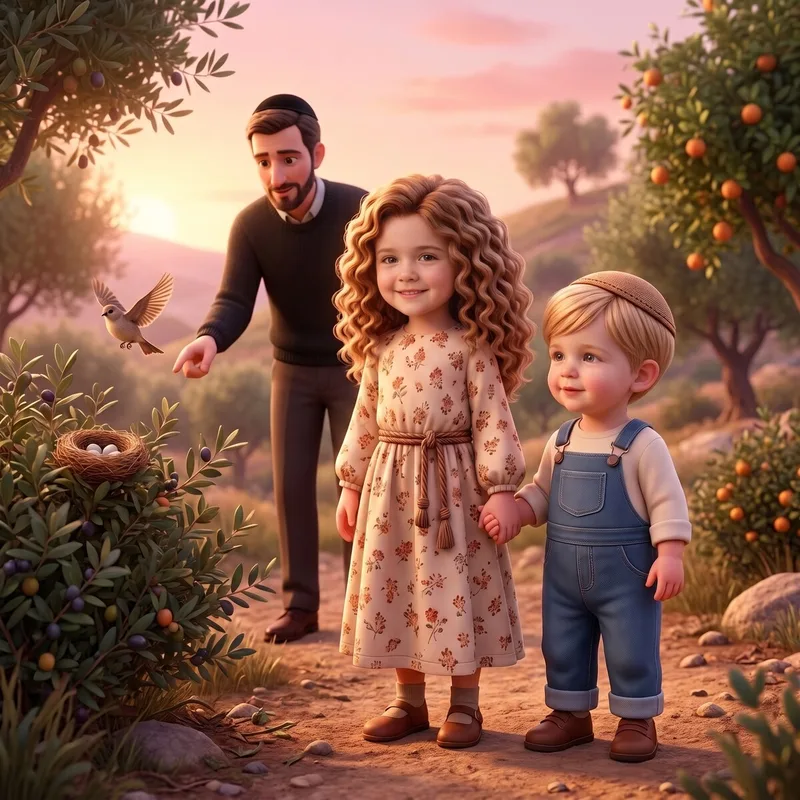
Create this book for your child
Shiluach HaKen is the mitzvah of the Torah, in Devarim 22:6-7 in Parshas Ki Seitzei, that if a person comes upon a bird's nest on the road, in a tree or on the ground, with chicks or eggs in it, and the mother bird is sitting on them, he may not take the mother together with her young. He sends the mother away first. Children take to this one quickly: it is small, it happens outdoors in a place they could really walk past, and the Torah writes its reward right there in the pasuk.
What does the Torah actually say about Shiluach HaKen?
The Torah describes a person walking along and coming upon a nest he was not looking for: ki yikarei kan tzipor lefanecha baderech, in any tree or on the ground, with chicks or with eggs, and the mother bird resting on them. The Torah says not to take the mother together with the young.
Then comes the instruction and the reward: shalei'ach teshalach es ha'eim, send the mother away, and the young you may take for yourself, lema'an yitav lach veha'arachta yamim, so that it should be good for you and your days should be long. The Torah states much the same reward for kibbud av va'em in Devarim 5:16.
Notice what the mitzvah does not say. It does not say to leave the nest alone, and it does not say the eggs may never be used. It says that the mother is not taken along with her young, and that she goes first.
What is the lesson of Shiluach HaKen?
Rashi, on the words of the reward, brings the kal vachomer of Chazal: if the Torah writes good and long days for a mitzvah that is easy and costs a person nothing, how much greater is the reward for the weightier mitzvos. That is a sentence worth saying out loud to a child, because it reframes every small mitzvah in their day. The Mishnah in Avos (2:1) puts it as a practical rule: be as careful with a light mitzvah as with a weighty one, because you do not know the reward of mitzvos.
There is a second layer. The Ramban explains that mitzvos like this one train a person not to have a cruel heart. A Yid who grows up stepping around a mother bird's feelings is not the same person as one who does not.
At the same time, Chazal are careful here. The Mishnah in Berachos (5:3) teaches that one who davens and says "Your mercy reaches the bird's nest" is silenced, and the Gemara there gives as one explanation that he turns the decrees of the King into nothing more than mercy. So the way to say it to a child is in this order: we do it because Hashem commanded it, and while we are doing it, it also makes us softer people. If this theme is live in your house, it fits closely with tzaar baalei chaim and with kibbud av va'em, which carries the same stated reward.
What should a child do if they actually find a nest?
This is the part parents most need, because sooner or later a child spots a nest in a yard, on a fire escape or in a low branch at camp.
- Do not climb, do not touch, do not move the eggs or chicks, and do not chase the bird.
- Come and tell a parent what was seen and where.
- The parent asks a rav.
That last step is not a formality. The halachos are detailed: which birds the mitzvah applies to, nests that belong to nobody as opposed to birds a person owns or raises, whether the mother must be sitting on the young at that moment, and whether a person may go out looking for a nest in order to do the mitzvah at all, which the poskim discuss. Teaching a child "when I find a mitzvah I am not sure about, I ask" is itself a large part of what you are raising.
How to explain Shiluach HaKen at 4, at 7 and at 10
To a 4-year-old: "A mother bird sits on her eggs to keep them warm. Hashem said that if a person needs to take the little birds, the mother gets sent away first, so she does not have to watch. Hashem promised something good to whoever does it." Mother and babies is a concept a four-year-old owns completely.
To a 7-year-old: Read the two pesukim with them and show them the reward written in the second one. Then ask the question the pesukim raise on their own: why would such a small mitzvah get such a big promise? Let the child guess before you give Rashi's answer.
To a 10-year-old: Give the kal vachomer in full, and then the harder idea. We do not keep mitzvos because we worked out the reason; we keep them because Hashem said so, and the reasons we see, like learning not to be cruel, are a gift on top. A ten-year-old can also handle the fact that the practical halachos are complicated enough that a rav is asked, which is a useful thing for him to learn now rather than at fifteen.
What a personalized Torah Tale book of Shiluach HaKen is like
Shiluach HaKen is part of our Mitzvos collection, which takes the mitzvos a child keeps and sets them in everyday life today rather than in a far-off scene. Your child is the hero of the book: their name, and from one uploaded photo their likeness, appear on every page, illustrated in high-resolution 3D animated-film style. Up to eight siblings, ages 0 to 18, can be in the same book.

Softcover 8″×8″

Hardcover 8″×8″

Board book 6″×6″

Coloring book 8.5″×11″
There are three formats: a 6x6 board book with rounded safety corners for ages 0-4, an 8x8 softcover for ages 4-8, and an 8x8 hardcover for ages 5-18. The softcover and hardcover open with a dedication page, and if you add parents and grandparents with their photos, they appear with the children on a closing family page in every format. Every book ends with a discussion page of ten questions about the story, mixing comprehension with middos, which is what turns it from a book you read to a child into something the table talks about. It is also exactly the kind of book to bring out on Shabbos afternoon.
Creating it takes about five minutes at torahtale.com/create: a free account and a few short questions, including each child's name, boy or girl, age, one photo, any siblings, the story, your community (asked once), the language (English, Hebrew or Yiddish) and the format. You can order a single book, or take the Mitzvos collection as a subscription, monthly or yearly, with details on the pricing page.

Five questions for the Shabbos table
All talking, no writing, so they work on Shabbos as they are:
- Why do you think the Torah tells us to send the mother away first and not simply to leave the whole nest alone?
- The Torah says this mitzvah is for a nest you happen upon. What other mitzvos come to us by accident, just because of where we happened to be standing?
- Rashi says that if an easy mitzvah gets such a reward, a hard one gets much more. What is one mitzvah in your day that feels easy, and one that feels hard?
- What would you do if you found a nest at camp and nobody was around to ask?
- Can you think of a time this week when you were careful about an animal's feelings, or when you could have been?
A weekday activity: a nest walk
On a weekday afternoon, take a short walk around the block with one job: find three places a bird could build a nest. A gutter, a ledge, the fork of a branch, a hedge. Nobody touches anything. The point is to get a child to look up, because the mitzvah in the pasuk begins with a person who noticed something on the way.
If you have added the matching coloring book, which is a black-and-white 8.5x11 line-art add-on to a one-time order, that is a weekday or erev Shabbos activity, since coloring is melacha and is not done on Shabbos or Yom Tov. Children can color the nest scene during the week and then tell the story at the Shabbos table from memory. If Parshas Ki Seitzei is coming up, the mitzvah sits inside the parsha with the most mitzvos, which is a good week to have this book on the shelf.
A child who learns Shiluach HaKen properly carries away two things: that Hashem notices a bird, and that Hashem notices a small mitzvah done by a child. You can create the book with your child in it in about five minutes, and let them hear their own name in the pasuk's story.
Frequently asked questions
What is the mitzvah of Shiluach HaKen?
Shiluach HaKen is the mitzvah stated in Devarim 22:6-7. If a person happens upon a bird's nest on the road, in a tree or on the ground, with chicks or eggs in it, and the mother bird is sitting on them, he may not take the mother together with her young. He sends the mother away first, and then the young may be taken. The Torah adds a reward in the very next pasuk: that it should be good for you and that your days be long.
How do I explain Shiluach HaKen to a 5-year-old?
Say it in one sentence: a mother bird sits on her eggs to take care of them, and Hashem told us that if we ever need to take the little birds, we send the mother away first so she does not have to watch. Young children understand mothers and babies immediately, so the picture does the teaching. Then add that Hashem promised something good to a person who keeps this small mitzvah.
What is the lesson of Shiluach HaKen?
Rashi, on the reward stated in the pasuk, brings the kal vachomer of Chazal: if the Torah promises good and long days for a mitzvah that is easy and costs a person nothing, the reward for harder mitzvos is far greater. The Mishnah in Avos (2:1) says the same thing in practical terms, to be as careful with a light mitzvah as with a weighty one. The Ramban explains that mitzvos like this one also train a person not to be cruel.
What should my child do if they find a bird's nest?
Have them leave it alone and come tell you. They should not climb to it, touch the eggs or chicks, or try to do the mitzvah on their own. The halachos of Shiluach HaKen are detailed, including which birds and which nests the mitzvah applies to and whether one may seek out a nest in the first place, and the poskim discuss these points, so ask your rav before doing anything.
Where is Shiluach HaKen in the Torah?
It is in Sefer Devarim, in Parshas Ki Seitzei, in chapter 22, pesukim 6 and 7. Ki Seitzei is the parsha that contains more mitzvos than any other, and Shiluach HaKen sits among a long run of everyday mitzvos there.
Can I get a personalized book about Shiluach HaKen for my child?
Yes. Torah Tale prints Shiluach HaKen as part of the Mitzvos collection, which sets the mitzvos a child keeps in everyday life today. Your child's name and, from one uploaded photo, their likeness appear on every page in 3D animated-film style, and up to eight siblings can be in the same book. It comes as a 6x6 board book with rounded safety corners for ages 0-4, an 8x8 softcover for ages 4-8, or an 8x8 hardcover for ages 5-18.