Honoring Parents (כיבוד אב ואם) for Kids: Teaching Kibbud Av VaEm at Home
Kibbud av va'em is the mitzvah of honoring a father and mother. Here is what the Torah and Chazal say, how to explain it to different ages, and questions for your table.
Published by Torah Tale.
Create this book for your child
Honoring parents, or kibbud av va'em (כיבוד אב ואם), is the mitzvah to treat a father and mother with respect and honor, and the Torah gives it as the fifth of the Aseres HaDibros. Children connect to it quickly because it lives in ordinary moments: being called for supper, a request to put shoes away, how we answer when we are tired.
What does the Torah say about honoring parents?
The Torah says it plainly in the Aseres HaDibros: 'Kabeid es avicha v'es imecha, l'maan yaarichun yamecha al ha'adamah.' Honor your father and your mother, so that your days will be long on the land (Shemos 20:12).
In Parshas Kedoshim the Torah also says 'ish imo v'aviv tira'u', each person shall fear his mother and his father (Vayikra 19:3). Chazal teach in Kiddushin 31b that these are two different things. Honor is mostly what you do for a parent: giving food and drink, helping with clothing, helping him come and go. Fear is mostly how you carry yourself around a parent: not sitting in his place, not standing in his place, and not contradicting him.
Is there a story about honoring parents in Chazal?
Yes. The Gemara in Kiddushin (31a) asks how far honoring a parent goes, and brings the story of Dama ben Nesina, a non-Jew in Ashkelon. This comes from Chazal, not from the pesukim.
The Gemara tells that sages came to buy a stone from him for the ephod. The key to the box was under his father's pillow, and his father was asleep. Dama would not wake his father, and the sale did not happen.
The Gemara relates that Hashem later gave him a reward, and the sages came to him again. Children usually remember one thing from this story: he gave up something he wanted so that his father could rest.
Why do we honor parents? The one-sentence version
You can tell a child: 'Our parents gave us life and take care of us, and Hashem asked us to honor them.' Chazal say there are three partners in every person: Hashem, a father and a mother (Kiddushin 30b). That is a lovely thing for a child to hear, because it shows that honoring parents is part of how we serve Hashem too.
The Torah itself connects the mitzvah to a long life, in the same pasuk quoted above. You do not have to press this on children, but it is nice for them to know that Hashem sees this mitzvah as precious.
What does honoring parents look like for a child today?
Here are everyday examples in the spirit of what Chazal describe. They are examples for the home, not a complete list of the halachos.
- Answering kindly when a parent calls, and coming the first time.
- Saying thank you for supper, a ride or a clean shirt.
- Not sitting in a parent's seat at the table or at the head of the table.
- Disagreeing with a respectful tone, or waiting to ask later, instead of arguing in the moment.
- Helping carry the bags or set the table without being asked twice.
Your child will see these same moments in the Torah Tale story. They are also what the Torah teaches about Yaakov, of whom the pasuk says 'Vayishma Yaakov el aviv v'el imo' (Bereishis 28:7), as we see in Parshas Toldos.
How do I explain it to a 4-year-old, a 7-year-old and an 11-year-old?
- Ages 3 to 4: One sentence and one action. 'Ima and Abba take care of you, so we answer kindly.' Praise the moment it happens: 'You came right away. That is kibbud av va'em.'
- Ages 6 to 7: Tell the story of Dama ben Nesina in a few lines and ask, 'What did he give up?' Then ask what small thing your child could give up for a parent today, such as turning off a game when asked.
- Ages 10 to 12: Talk about the difference between honor and fear that Chazal describe, and ask which one is harder at this age. Older children also appreciate hearing that questions about difficult situations are for a rav.
At every age, your own example does most of the teaching. A child who watches you speak respectfully to your parents learns more than from any explanation.
What is the Torah Tale book about honoring parents like?
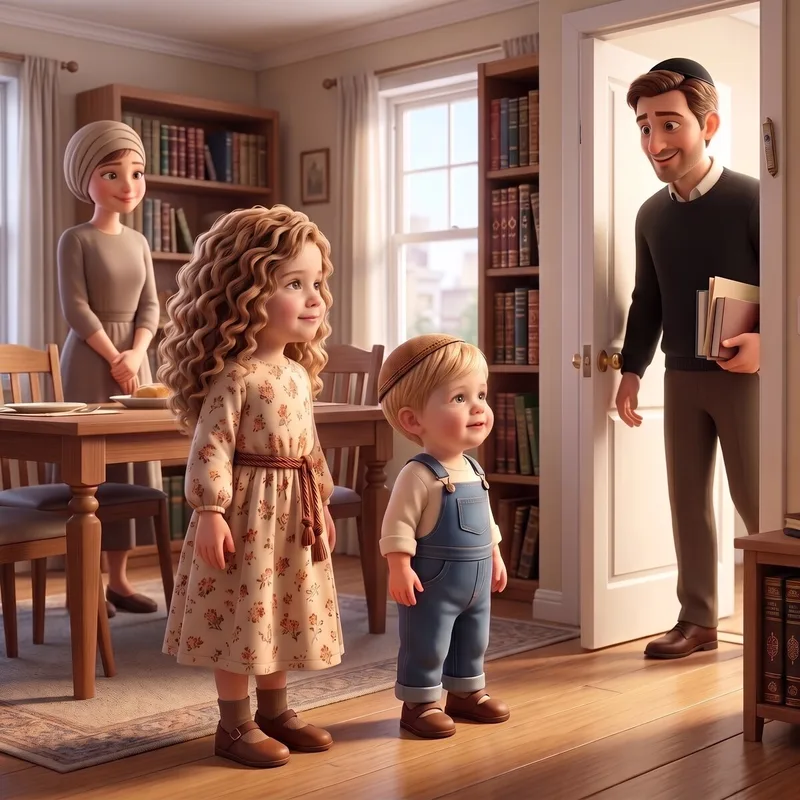
Honoring Parents (כיבוד אב ואם) is part of the Middos collection: the good character a child grows, set in everyday life today. Your child is the hero, with their name and, from one uploaded photo, their likeness, illustrated in a 3D animated-film style.
Every book ends with a discussion page of 10 questions about the story, mixing comprehension with middos: what happened, and what it asks of the child. If you add parents and grandparents with their photos, they appear with the children on a closing family page in every format. That makes it a nice book to read with grandparents in mind, as well as with Mommy and Me and Totty and Me.

Softcover 8″×8″

Hardcover 8″×8″

Board book 6″×6″

Coloring book 8.5″×11″
The formats match the ages: a 6"x6" board book with rounded safety corners for ages 0-4, an 8"x8" softcover for ages 4-8, and an 8"x8" hardcover for ages 5-18. The softcover and hardcover open with a dedication page. Each book is written with careful rabbinical guidance and strict tznius, and reviewed by our team before it goes to print.
Reading it on Shabbos is entirely appropriate. If you add the optional coloring book, keep it for a weekday afternoon or erev Shabbos, not Shabbos or Yom Tov.
What questions can we ask at the Shabbos table?
These are for talking only, and work well after the meal or on a long Shabbos afternoon.
- What is one thing a parent does for you that you do not always notice?
- Why do you think Dama ben Nesina did not wake his father?
- What is a small way to honor a parent in the morning, before school?
- Is it easier to honor a parent when you are happy or when you are tired? Why?
- What did you see someone do for their parents that you would like to copy?
Let parents answer too. Children listen when they hear a parent say, 'I try to honor my own parents by calling them every week.' The same warmth shows up in teaching hakaras hatov.
Ready to make it personal? Create the book with a free account and a few short questions: each child's name, boy or girl, age and one photo, any siblings, the story, your community, the language and the format. It takes about five minutes.
Frequently asked questions
What does the Torah say about honoring parents?
The Torah says 'Kabeid es avicha v'es imecha' in the Aseres HaDibros (Shemos 20:12), and the pasuk adds that this is so that your days will be long on the land. A separate pasuk (Vayikra 19:3) commands each person to fear his mother and father. Chazal learn the details of both mitzvos from these pesukim.
How do I explain kibbud av va'em to a 4-year-old?
Keep it to one sentence and one example: 'Abba and Ima take care of you, so we say thank you and listen kindly.' Then point to something small your child can do today, such as answering when called or helping put something away. At this age the habit matters more than the explanation.
What is the story of Dama ben Nesina?
The Gemara (Kiddushin 31a) tells of Dama ben Nesina, a non-Jew in Ashkelon, whose father was asleep when sages came to buy a stone from him for the ephod. He did not wake his father, and the sale was lost. The Gemara relates that Hashem later rewarded him, and it is brought as an example of how far honoring a parent can go.
What is the difference between honoring and fearing a parent?
Chazal (Kiddushin 31b) explain that honor means things like feeding, giving a drink, clothing and helping a parent come and go. Fear means conduct such as not standing or sitting in the parent's place and not contradicting his words. For children this becomes: help gladly, and speak and act with respect.
What if a child finds it hard to listen to parents?
Start by naming what went well, and keep the expectations small and specific for your child's age. Model the same respect toward your own parents and teachers, since children learn most from what they see. For harder situations, ask your rav, because kibbud av va'em has its own halachos.