Being Kind to Animals (צער בעלי חיים) for Kids: Teaching It at Home
Tza'ar ba'alei chaim means not causing pain to living creatures. Here is where the Torah teaches it, the stories behind it, and how to explain it to children aged 3 to 12.
Published by Torah Tale.
Create this book for your child
Tza'ar ba'alei chaim (צער בעלי חיים) is the mitzvah not to cause pain to living creatures, and children understand it quickly because animals are part of their world. Pets, birds on the sidewalk and a thirsty dog on a hot day all give a child a chance to ask, 'What does Hashem want me to do now?' Torah Tale has a story on this mitzvah in the Mitzvos category, set in everyday life today.
What does tza'ar ba'alei chaim mean for a child?
Literally it means 'the pain of living creatures.' In practice it means two things: we do not hurt animals, and we help them when they are suffering and we are able to.
For a child this is very concrete. It is how they hold a kitten, whether they remember to give the pet water, and whether they leave a bird alone or chase it. Chazal take the mitzvah seriously enough to discuss it at length in the Gemara (see Bava Metzia 32b). Exactly how it applies in a given situation is a matter for a rav, so when a real question comes up, ask.
Where does the Torah teach kindness to animals?
Animals appear in the Torah's mitzvos more often than many of us remember. Here are three places a child can understand:
- Helping an animal under its load. The Torah tells us to help when we see a donkey struggling under its burden (Shemos 23:5), and not to ignore a fallen animal on the road (Devarim 22:4).
- Not muzzling an ox while it threshes. The Torah says not to muzzle an ox as it threshes (Devarim 25:4), so a working animal may eat from the grain it is helping to gather.
- Rest on Shabbos. The Aseres HaDibros include our animals in the day of rest (Shemos 20:10), and Parshas Mishpatim speaks of resting so that your ox and donkey can rest (Shemos 23:12).
The Gemara in Berachos 40a also teaches that a person should not eat before giving food to his animal. This is easy to practice at home: the pet's bowl gets filled first.
Which stories of Chazal and the Torah show this middah?
The best-known story is about Moshe Rabbeinu. The Midrash relates (Shemos Rabbah 2:2) that while Moshe was shepherding Yisro's flock, a young goat ran away. Moshe followed it until it reached a pool and stopped to drink. He said that he had not known it ran because it was thirsty, and that it must be tired, and he carried it back on his shoulders. Hashem then said that since he had such mercy on the flock of a person, he was fit to shepherd Yisrael. We tell this story in full in Moshe and the Thirsty Little Goat.
The Torah itself gives us Rivka at the well. Eliezer had asked Hashem for a sign: a girl who would give him water to drink. Rivka gave him water, and then said she would also draw water for his camels (Bereishis 24:14, 18-20). You can read more in Parshas Chayei Sarah for Kids.
For older children there is also a story from the Gemara (Bava Metzia 85a) about Rebbi. The Gemara relates that a calf being led to slaughter hid its head in his robe and cried, and that suffering came upon Rebbi afterward. It ended when he told a maidservant to leave alone the young weasels she was about to sweep out. This is a more delicate story, so tell it when your child can follow it, and ask your rav or teacher if you want help presenting it.
How do I explain it to a 3-4 year old, a 5-7 year old and an 8-12 year old?
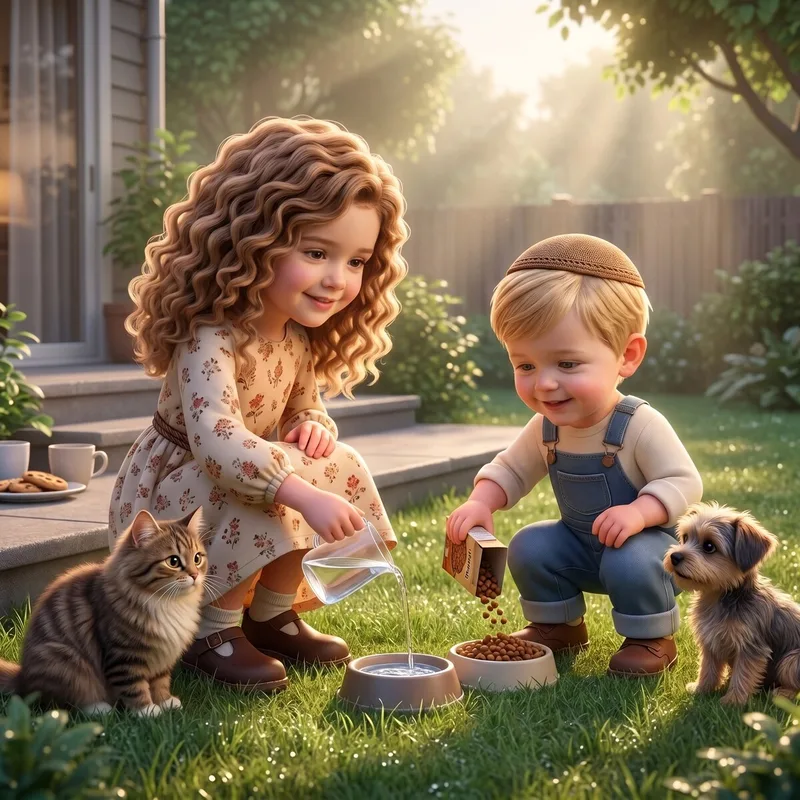
Ages 3-4: Use one sentence and do the mitzvah together. 'Hashem made the animals, so we are gentle with them.' Fill the water bowl, pat the dog softly, and walk away from a bird instead of chasing it. Name the action as it happens: 'Gentle hands.'
Ages 5-7: Tell Moshe and the little goat as a story. Then ask, 'What did Moshe notice?' Children this age love working out why the goat ran, and the answer, that it was thirsty, teaches them that an animal's behavior often has a reason.
Ages 8-12: Bring in the sources. Show them that the Torah mentions animals in the mitzvos of the donkey, the ox and Shabbos, and ask why Hashem included them. Older children can discuss a harder question: what do we do when we are not sure whether something would hurt an animal? Teach them that the answer is to ask a rav, not to guess.
What is the Torah Tale book about being kind to animals like?
The book stars your child. Their name and, from one uploaded photo, their likeness appear on every page, illustrated in 3D animated-film style. It is a story from the Mitzvos category, set in everyday life today, so your child sees the mitzvah in a world like their own rather than only in the past.
Every book ends with a discussion page of 10 questions that mix comprehension with middos: what happened, and what it asks of the child. That page is what turns the book into a conversation at the table.
The formats are a board book (6"x6", rounded safety corners, ages 0-4), a softcover photo book (8"x8", ages 4-8) and a hardcover photo book (8"x8", ages 5-18). An optional matching coloring book (8.5"x11") can be added as a weekday activity. Up to eight siblings can appear in one book. The book is written with careful rabbinical guidance and strict tznius, and is reviewed by our team before it goes to print.

Softcover 8″×8″

Hardcover 8″×8″

Board book 6″×6″

Coloring book 8.5″×11″
What questions can we ask at the Shabbos table?
Reading is entirely appropriate on Shabbos, and so is talking. Shabbos is also a good time for this topic because the Torah includes animals in its rest. Try these, with no writing or drawing needed:
- What do you think the little goat needed when it ran away?
- Why did Moshe carry it instead of just pulling it back?
- Who in our family feeds the pet first, and why?
- What is one way to be gentle with an animal we saw this week?
- How did Rivka show chesed to animals as well as to people?
If you have a pet and a question about caring for it on Shabbos, ask your rav, since the halachos of feeding and handling animals on Shabbos need a clear answer.
What can we do during the week to practice it?
These are weekday activities, so do them on a weekday or erev Shabbos, not on Shabbos or Yom Tov:
- Give your child one regular job for a pet or a neighbor's pet, such as filling the water bowl, and check that it gets done.
- Make a little 'gentle hands' family rule for how to treat animals, and practice it with a toy animal first.
- Take a short walk and notice what animals might need: shade, water, or to be left alone.
- If you add the optional coloring book to the story, use it on a weekday afternoon or before Shabbos, never on Shabbos itself.
This mitzvah is learned by repetition. A child who fills the bowl every day is living in the spirit of tza'ar ba'alei chaim, not just talking about it. If you want a Mitzvos story that puts your child at the center of it, you can create the book in about five minutes, with a free account and a few short questions.
Frequently asked questions
What is tza'ar ba'alei chaim in simple words for a child?
It means we do not hurt animals and we help them when they are in trouble. Hashem made every creature, so we treat them gently. A simple way to say it to a young child is: 'Animals feel things too, so we are kind to them.'
Where does the Torah teach kindness to animals?
The Torah mentions animals' needs in several mitzvos. We are told to help an animal that is struggling under its burden, not to muzzle an ox while it threshes, and to let our animals rest on Shabbos. Chazal also learn from the Torah's words that a person feeds his animal before eating himself (Berachos 40a).
How do I explain tza'ar ba'alei chaim to a 4-year-old?
Keep it to everyday actions: gentle hands with a pet, a bowl of water for a thirsty animal, and not pulling a tail or chasing a bird. Use one short sentence and repeat it whenever the moment comes up. Young children learn this mitzvah by doing it with you.
What is the lesson of Moshe and the thirsty little goat?
The Midrash in Shemos Rabbah 2:2 relates that Moshe chased a young goat that ran off, found it drinking at a pool, and carried it back, saying he had not realized it ran because it was thirsty. Hashem then said that someone who shows such mercy to a person's flock is fit to shepherd Yisrael. The lesson for children is that real kindness notices what an animal needs.
Is there a Torah Tale book about being kind to animals?
Yes. It is a story in the Mitzvos category, starring your child by name and likeness. Creating it takes a free account and a few short questions, and every book ends with a discussion page of 10 questions that mix comprehension with middos.