Moshe and the Thirsty Little Goat for Kids: Shemos Rabbah 2:2
Moshe Rabbeinu chased a runaway young goat, found it drinking, and carried it back. Here is the Midrash, its source, its lesson, and how to explain it to a 3-year-old, a 6-year-old and a 10-year-old.
Published by Torah Tale.
Create this book for your child
Moshe and the Thirsty Little Goat is a Midrash from Shemos Rabbah 2:2 about Moshe Rabbeinu as a shepherd in the midbar, before he ever led Yisrael. A young goat runs away, Moshe follows it, and instead of being annoyed he carries it back because it must be tired. Children connect with it because it is small, concrete and easy to picture: a thirsty animal, a pool of water, and a kind person who understands.
What is the story of Moshe and the thirsty little goat?
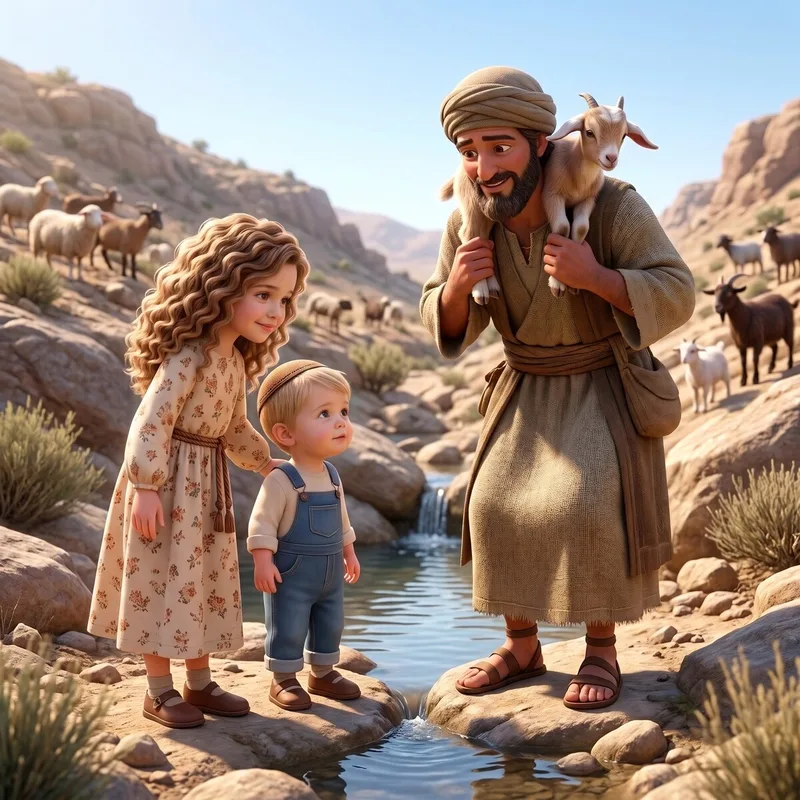
The Midrash relates that Moshe Rabbeinu was shepherding the flock of Yisro in the midbar when a young goat ran away from the flock. Moshe went after it. The goat reached a pool of water and stopped to drink.
When Moshe came up to it, he said that he had not known the goat ran because it was thirsty, and that it must be tired. He then lifted the goat onto his shoulder and carried it back.
Then, the Midrash tells us, Hashem said to Moshe: you have mercy on a flock that belongs to a person of flesh and blood, so by your life, you will shepherd My flock, Yisrael.
Where does this story come from, and what does the pasuk say?
It is important to separate the two. The pasuk in Shemos 3:1 says that Moshe was shepherding the flock of Yisro, his father-in-law, the kohen of Midyan, and that he led the flock to the far side of the midbar and came to Har HaElokim, to Chorev. That is pshat, and it is where the next stage of Moshe's life begins.
The goat is not in the pasuk. The story of the goat is what Chazal tell us in the Midrash, Shemos Rabbah 2:2. When you tell it at home, it helps to say so plainly: the Torah tells us Moshe was a shepherd, and Chazal tell us what kind of shepherd he was.
What is the lesson of this Midrash?
The main lesson is rachamim, mercy. A runaway goat is a problem for a shepherd, and a tired shepherd could easily feel frustrated. In the Midrash, Moshe's first thought is about the goat: why did it run, and what does it need now?
That is a lesson children can use right away. A sibling who grabs a toy, a friend who snaps, or a little one who melts down before supper often has a need underneath the behavior. Moshe's words, that he had not known the goat was thirsty, show a person who notices when he has misjudged and responds with kindness instead of anger.
The second part is about what the Midrash says Hashem saw in this: care for those who are in your charge. Moshe later shepherded Yisrael, and the Midrash connects his caring for one small goat with that role. We do not need to add more than that. If your child enjoys the Moshe stories, Baby Moshe and the Burning Coal is another Midrash about him, and Parshas Shemos for Kids covers the pesukim around the burning bush.
How do I explain it to a 3-year-old, a 6-year-old and a 10-year-old?
Around 3: Tell it in four short sentences. The goat ran away. Moshe ran after it. The goat was thirsty and drank some water. Moshe carried it home because it was tired. Then ask, "Why did Moshe carry the goat?" On a weekday, your child can carry a stuffed animal the same way.
Around 6: Add the part that makes it a Midrash: Moshe did not scold the goat. Ask what Moshe could have said instead, and what he said once he understood. Children this age enjoy the moment of surprise, that the goat was not being naughty at all.
Around 10: Talk about how the story connects to leadership. The Midrash relates that Hashem saw Moshe's rachamim toward a flock belonging to a person and told him he would shepherd Yisrael. Ask what small moments might show what kind of person someone is, and why a shepherd's patience might matter for a leader.
What is a personalized Torah Tale book of this story like?
This story is in the Midrash & Aggadah collection, which tells the stories Chazal relate behind the pesukim, each from its named source in the Gemara or Midrash. In your child's book, your child's name and, from one uploaded photo, their likeness appear on every page in 3D animated-film style. Up to eight siblings, ages 0 to 18, can appear in the same book.
Every book is written with careful rabbinical guidance and strict tznius, and is reviewed by our team before it goes to print. Every book also ends with a discussion page of ten questions about the story, mixing comprehension with middos, so what happened and what it asks of your child can become a conversation at the table.
The formats are a 6"x6" board book with rounded safety corners (ages 0-4), an 8"x8" softcover (ages 4-8) and an 8"x8" hardcover (ages 5-18). Softcover and hardcover books open with a dedication page. If you add parents, grandparents or other relatives with their photos, they appear with the children on a closing family page in every format. An optional matching coloring book is a weekday activity, for erev Shabbos or a weekday afternoon, never for Shabbos or Yom Tov.

Softcover 8″×8″

Hardcover 8″×8″

Board book 6″×6″

Coloring book 8.5″×11″
What can we talk about at the Shabbos table?
Reading is a lovely thing to do on Shabbos, and so is simply talking. Here are five questions that need nothing more than the table:
- Why do you think the goat ran away?
- What did Moshe understand when he found the goat at the water?
- Why did Moshe carry the goat instead of making it walk?
- When did someone understand what you needed before you said it?
- What is one small way each of us can show rachamim this week?
For younger children, the first three are enough. For older children, add what the Midrash says Hashem told Moshe, and ask what a person's small kindnesses show about them.
Which book fits which child?
The child's age is one of the short questions when creating the book. For a child up to four, the board book is made for ages 0-4. For ages 4-8 the softcover fits, and for ages 5-18 there is the hardcover. Choose by your child's age, and the rest of the story setup is the same short process.
To make the book, you need a free account and must answer a few short questions: each child's name, boy or girl, age and one photo, any siblings, the story, your community (asked once), the language and the printed format. Languages are English, Hebrew and Yiddish. The whole thing takes about five minutes.
If you would like this Midrash in your child's hands, with your child as the one who learns what rachamim looks like, you can create the book today.
Frequently asked questions
Where does the story of Moshe and the thirsty goat come from?
It comes from the Midrash, in Shemos Rabbah 2:2. The pasuk in Shemos 3:1 tells us only that Moshe was shepherding the flock of Yisro, his father-in-law. The story of the runaway young goat is what Chazal tell us about how Moshe cared for that flock.
What is the lesson of Moshe and the thirsty little goat?
The lesson is rachamim, mercy. Moshe did not scold the goat for running; he realized it had been thirsty and then carried it because it was tired. Children can learn to ask what someone needs before reacting to what they did.
How do I explain this Midrash to a 3-year-old?
Keep it to a few simple sentences: a little goat ran away, Moshe followed it, the goat was thirsty and found water, and Moshe carried it back because it was tired. Then say that Hashem was happy with how kind Moshe was. A 3-year-old can act out carrying a stuffed animal on a weekday.
Why did Hashem choose Moshe as the leader of Yisrael after this?
The Midrash relates that Hashem told Moshe that since he had mercy on a flock belonging to a person, he would shepherd Hashem's flock, Yisrael. We learn from this that caring for those under your charge, even in small moments, matters greatly. The Midrash does not add more than that.
Is there a Torah Tale book of Moshe and the thirsty little goat?
Yes, the story is in the Midrash & Aggadah collection, which tells the stories Chazal relate behind the pesukim. Your child's name and likeness appear on every page in 3D animated-film style, and the book ends with a discussion page of ten questions mixing comprehension with middos. You can create it at torahtale.com/create.