A Seudas Hoda'ah (סעודת הודאה) for Kids: The Thank-You Meal
A seudas hoda'ah is a festive meal made to thank Hashem after a kindness or a rescue. Here is where the minhag comes from, what happens at one, and how to explain it to young children.
Published by Torah Tale.
Create this book for your child
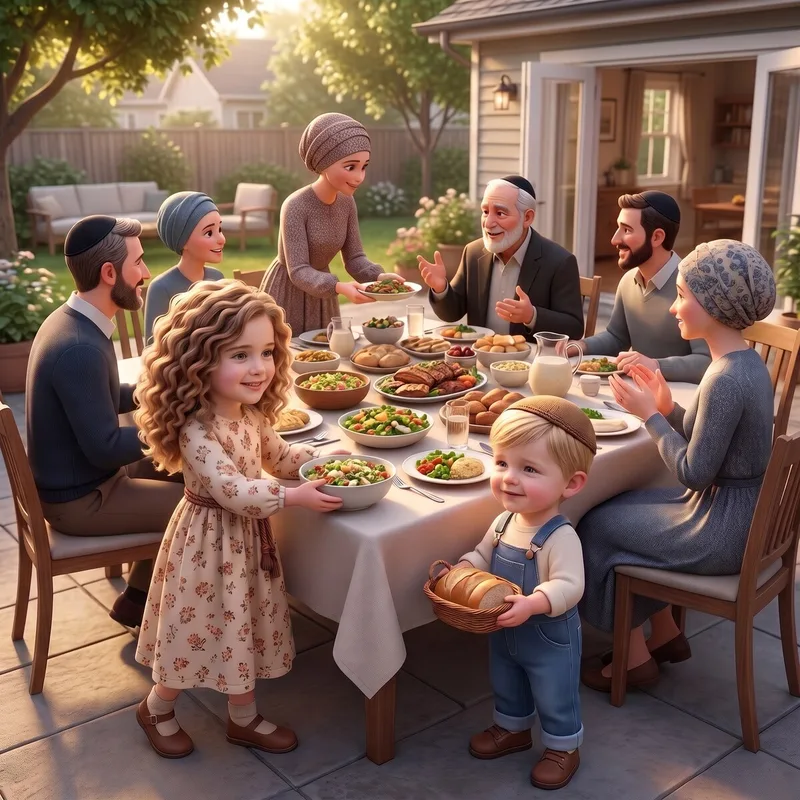
A seudas hoda'ah is a festive meal a family makes to thank Hashem after a personal kindness or rescue, such as recovering from an illness or coming home safely from a journey. Children grasp it quickly, because it is simply a thank-you said out loud, together with family and good food.
What is a seudas hoda'ah?
The words mean a meal of thanks. When something good or frightening has passed, and a family feels that Hashem was kind to them, they gather relatives and friends, tell what happened, say thank you, and eat together.
It is a joyful meal, not a solemn one. The focus is not on the worry that came before but on the good that Hashem did and on saying so in front of others.
Where does the idea of thanking Hashem with a meal come from?
In Parshas Tzav the Torah describes the korban todah, the thanksgiving offering (Vayikra 7:12-15). It was brought with loaves of several kinds, and the pasuk says its meat was to be eaten on the day it was offered, with nothing left until morning. You can read more in our article on Parshas Tzav for kids.
Chazal also tell us, in Maseches Berachos (54b), that four kinds of people must give thanks, learning this from Tehillim 107. They are those who crossed the sea, those who traveled through the desert, someone who was ill and recovered, and a prisoner who was released. The chapter opens with the words הודו לה' כי טוב כי לעולם חסדו.
The seudas hoda'ah is a minhag, and it carries the same spirit: a meal, an invitation to others, and thanks said out loud. Families keep it in different ways, so ask your rav about your own custom.
What happens at a seudas hoda'ah?
There is no single script, but a few things are common. Guests are invited, the person or family who was helped tells what happened, and someone says a dvar Torah about thanking Hashem. Chapters of Tehillim about thanks, such as Mizmor LeSodah, are often said or sung, and the meal ends with bentching.
For children, the most memorable part is usually the telling. They hear Abba or Mommy say plainly, 'Hashem helped us,' and they see grown-ups sing about it. You can find a simple explanation of the song itself in our article on Mizmor LeSodah for kids.
A note on terms: Birkas HaGomel is a separate matter. It is said by the individual who was saved, after recovering from an illness or a dangerous journey. Whether it applies in a particular case, such as a flight, is a question for your rav.
How do I explain a seudas hoda'ah to a young child?
Match the explanation to the child, and keep it to what is true and simple.
- Ages 3-4: 'Hashem helped us, so we make a special party to say thank you.' Give the child a safe job, such as setting out napkins or picking a song.
- Ages 6-7: Ask, 'What do we say when someone gives us a present?' Then connect it: Hashem gives us so much, so we say thank you, and we do it together with people we love.
- Ages 9-12: Show them Tehillim 107 and the four who give thanks, and talk about the korban todah in Parshas Tzav. You can also ask why thanks is said in front of others and not just quietly. One thought you can share is that telling others lets them rejoice and notice Hashem's kindness too. That is a way of understanding the minhag, not a statement of Chazal.
If your child is worried because the story involves someone who was ill or in danger, keep the focus on the good ending and on Hashem's help. A seudas hoda'ah is, by definition, a meal after things turned out well.
What is the Torah Tale book of A Seudas Hoda'ah like?
A Seudas Hoda'ah is a story in the Jewish Life collection, which covers the simchos and minhagim of a Yiddishe life. The book is personalized: your child's name and, from one uploaded photo, their likeness appear on every page, illustrated in 3D animated-film style. Up to eight siblings, ages 0 to 18, can appear in the same book.
Every book is written with careful rabbinical guidance and strict tznius, and it is reviewed by our team before it goes to print. Every book also ends with a discussion page of 10 questions that mix comprehension with middos, asking both what happened and what the story asks of the child. That page is what turns the book from something you read to a child into something the whole table talks about.

Softcover 8″×8″

Hardcover 8″×8″

Board book 6″×6″

Coloring book 8.5″×11″
The formats are a board book (6"x6" with rounded safety corners, ages 0-4), a softcover photo book (8"x8", ages 4-8) and a hardcover photo book (8"x8", ages 5-18). Softcover and hardcover open with a dedication page. If you add parents, grandparents or other relatives, they appear with the children on a closing family page in every format. The book can be ordered in English, Hebrew or Yiddish.
Questions to ask at the Shabbos table
Reading a storybook at the Shabbos table is entirely appropriate, and these questions need only talking and singing.
- What is something good Hashem did for us this week?
- Who do we say thank you to when someone helps us, and how do we say it?
- Why might a family invite others to a thank-you meal and not just say thank you at home?
- What song could we sing to say thank you to Hashem?
- Is there a grandparent or friend we could tell about something good that happened to us?
For a younger child, pick one question and let the answer be a single sentence. Our article on saying thank you and hakaras hatov has more ideas for everyday life.
A weekday activity to go with it
Writing, drawing and coloring are melacha, so they are for weekdays only. On a weekday afternoon, children can draw something Hashem gave them that they are thankful for, and the family can hang the pictures up before Shabbos. An optional matching coloring book (8.5"x11" black-and-white line art) can be added to a one-time book order. It is meant for weekdays, never for Shabbos or Yom Tov.
On Shabbos itself, keep to singing, talking and reading the book together.
If you would like your child to hear the story of a seudas hoda'ah with their own name and face in it, you can create the book in about five minutes. You will need a free account and a few short questions: each child's name, boy or girl, age and one photo, any siblings, the story, your community (asked once), the language and the format.
Frequently asked questions
What is a seudas hoda'ah?
A seudas hoda'ah is a festive meal made to thank Hashem after a personal kindness or a rescue, such as recovering from an illness or arriving home safely from a journey. Family and friends are invited, thanks are said out loud, and divrei Torah and singing are often part of the meal. Details differ between families and communities, so ask your rav about your own minhag.
How do I explain a seudas hoda'ah to a 4-year-old?
You can say, 'Hashem helped us, so we make a special party to say thank you.' Let the child help with something safe, like setting out napkins or choosing a song to sing. At this age one clear sentence and a happy table do the teaching.
Where does the seudas hoda'ah come from?
The idea of thanking Hashem with a meal goes back to the korban todah in Parshas Tzav, which was eaten with loaves and had to be finished within a limited time. Chazal also teach, based on Tehillim 107, that four kinds of people must give thanks. The seudas hoda'ah is a minhag that carries the same spirit of saying thank you publicly and sharing the simcha.
Is a seudas hoda'ah the same as Birkas HaGomel?
No. Birkas HaGomel is a bracha said by the individual who was saved, after recovering from an illness or a dangerous journey. Whether a particular situation, such as a flight, requires it is a question for your rav. A seudas hoda'ah is a meal that some families make in addition, to share the thanks with others.
What is the lesson of a seudas hoda'ah for children?
The lesson is hakaras hatov: noticing the good Hashem gives us and thanking Him out loud rather than keeping it inside. Children also see that thanks can be shared, because family and friends are invited to hear what happened and to rejoice together.
Is there a personalized Torah Tale book about a seudas hoda'ah?
Yes, A Seudas Hoda'ah is a story in the Jewish Life collection. Your child's name and likeness, from one uploaded photo, appear on every page in 3D animated-film style, and the book ends with a discussion page of 10 questions about the story.