Guarding Day and Night in Sefer Nechemia for Kids: Tefillah and a Guard
While the Yidden rebuilt the wall of Yerushalayim, their neighbors mocked and threatened them. The Yidden answered with tefillah and a guard. Here is the story, the lesson, and how to explain it to a 4-year-old, a 7-year-old and a 10-year-old.
Published by Torah Tale.
Create this book for your child
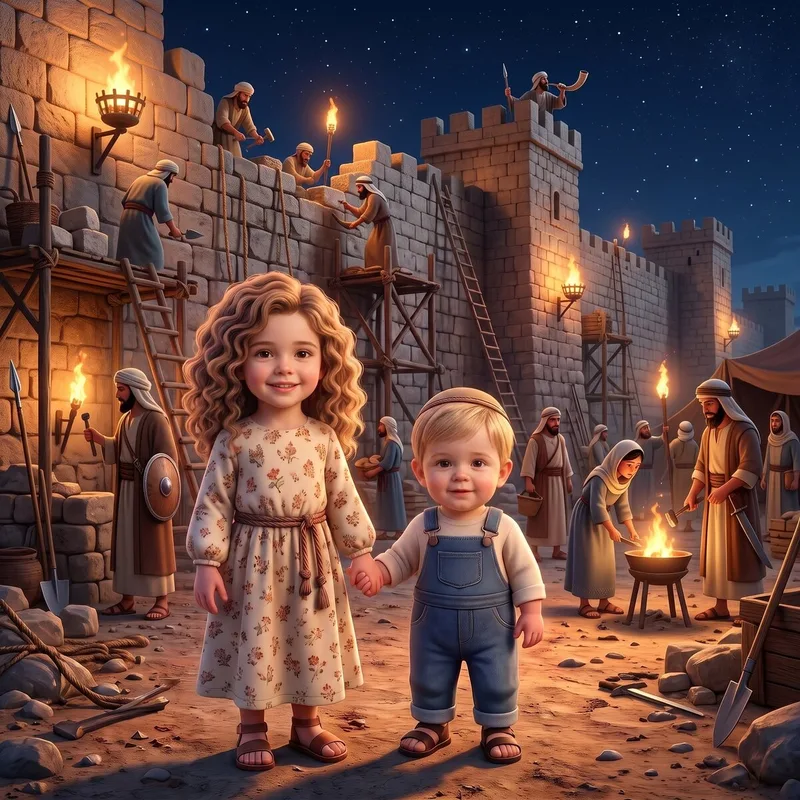
Guarding Day and Night is the part of Sefer Nechemia, in chapter 4, where the Yidden rebuilding the wall of Yerushalayim are mocked and threatened, and they answer by davening to Hashem and setting a guard. Children take to it easily because the idea is clear: do the work, ask Hashem for help, and do not be afraid.
What happens in Guarding Day and Night?
Nechemia had come to Yerushalayim to rebuild its broken walls, and the Yidden were hard at work. The pasuk says the people had a heart to work, and the wall rose until it was joined up to half its height.
Their neighbors, Sanballat and Tuvia the Ammoni among them, did not like it. They laughed and asked what these weak Yehudim thought they were doing. Tuvia said that even a fox climbing on their stone wall would knock it down.
Nechemia davened to Hashem about the mocking, and the work went on. When the neighbors heard that the breaches in the wall were being closed, they grew angry and made a plan to come and stop it.
The pasuk tells us how the Yidden answered: we davened to our G-d and set a watch against them day and night. Nechemia also put people at the exposed places along the wall, by families, with their weapons. He then told everyone not to be afraid, to remember Hashem, who is great and awesome, and to stand up for their families.
How did they build and guard at the same time?
From that day, half of Nechemia's young men worked and half stood ready with spears, shields and bows. The builders worked with one hand and held a weapon in the other. The one who blew the shofar stood beside Nechemia.
The wall was long and the people were spread far apart, so Nechemia gave a simple plan: wherever you hear the shofar, gather to us there. He added that Hashem would fight for them. The work went on from dawn until the stars came out.
He also told the people to stay overnight in Yerushalayim, each man with his na'ar, so that the night would be for guarding and the day for working. Nechemia and those with him stayed at their posts too.
What is the lesson for children?
The clearest lesson is that tefillah and effort go together. The Yidden davened, and they also set a guard. We learn from this that a child can ask Hashem for help and still do the part that is theirs.
A second lesson is about working as a group. Nobody could build or guard the whole wall alone. Each family had its place, and a shofar called everyone together. Children understand this well from class, from a family job, or from clearing the table together.
A third lesson is not letting mockery stop you. Nechemia heard the laughing, davened, and kept going. For a child who has been teased for trying something new, that is worth saying out loud. For a related story, see Nechemia's tefillah for Yerushalayim, and for the wider picture, Sefer Nechemia: rebuilding the walls.
How do I explain it to a 4-year-old, a 7-year-old and a 10-year-old?
Around age 4: Say, "The Yidden were building a big wall. Some people were not nice and wanted to stop them. So the Yidden davened to Hashem, and some built while some watched." Leave out the weapons and keep the picture simple: building, davening, taking turns.
Around age 7: Add the mocking and the plan. Ask, "Why did Nechemia want the guard day and night?" and "What does it mean to remember Hashem when you feel scared?" At this age children enjoy the idea of two jobs, building and watching, and the shofar that called everyone together.
Around age 10: Talk about balance. The pasuk has both tefillah and a guard: the Yidden did not rely on davening alone, and they did not guard without davening. Ask what that looks like in a child's life, such as davening before a test and also studying for it. Later in the sefer, Ezra reads the Torah to the people in public, and you can continue from there with Ezra Teaches the Torah.
What are good questions for the Shabbos table?
These questions need only talking, which makes them a good fit for the Shabbos table:
- What did the neighbors say about the wall? What did Nechemia do first?
- Why did some people build while others guarded?
- What was the shofar for?
- When is it hard to keep going while someone is laughing at you?
- What is one job at home that works better when everyone has a share?
On a weekday afternoon, you can turn it into a game with blocks: half the children build a wall and half keep watch, and then they switch. Keep it a weekday activity, and keep it gentle and playful.
What is a personalized Torah Tale book of this story like?
In a Torah Tale book, your child is the hero. Their name and, from one uploaded photo, their likeness appear on every page, illustrated in high-resolution 3D animated-film style. Up to eight siblings, ages 0 to 18, can appear in the same book. Every book is written with careful rabbinical guidance and strict tznius, and our team reviews it before it goes to print. Customers do not preview or approve the book before printing.
Every book ends with a discussion page of 10 questions that mix comprehension with middos: what happened, and what it asks of the child. That turns the book from something read to a child into something talked about at the table. If you add parents, grandparents and other relatives, they appear with the children on a closing family page in every format.
Three formats are available: a 6x6 board book with rounded safety corners for ages 0-4, an 8x8 softcover for ages 4-8, and an 8x8 hardcover for ages 5-18. Softcover and hardcover open with a dedication page. An optional matching coloring book, 8.5x11 in black-and-white line art, can be added as a one-time add-on. It is a weekday activity, for an afternoon or erev Shabbos, never for Shabbos or Yom Tov. The storybook itself is a good one to read on Shabbos.

Softcover 8″×8″

Hardcover 8″×8″

Board book 6″×6″

Coloring book 8.5″×11″
This story is in the Kesuvim collection. You can see what a collection subscription includes on the pricing page.
How do I order a Nechemia book for my child?
Creating a book takes about five minutes. You open a free account and answer a few short questions: each child's name, boy or girl, age and one photo, any siblings, the story, your community (asked once), the language and the printed format. Languages available are English, Hebrew and Yiddish.
Ready to start? You can create the book and choose Guarding Day and Night from the Kesuvim collection, so your child can read how Nechemia's people davened, guarded and kept building.
Frequently asked questions
What is the story of Guarding Day and Night in Sefer Nechemia?
The Yidden were rebuilding the wall of Yerushalayim when neighbors such as Sanballat and Tuvia mocked them and then plotted to stop the work. Nechemia and the people davened to Hashem and set a guard day and night. Half of the young men worked while half held weapons, and the work on the wall continued.
What is the lesson of Guarding Day and Night for children?
The pasuk shows tefillah and effort together: they davened and they set a watch. We learn from this that a child should ask Hashem for help and also do their own part. A second lesson is that the job got done because everyone carried a share.
How do I explain Nechemia's guard to a 4-year-old?
Keep it short and concrete: the Yidden were building a big wall, some people did not want it built, so the Yidden asked Hashem to help and took turns building and watching. Say that Nechemia told them not to be afraid because Hashem helps. Skip the details about weapons and focus on the building and the davening.
Where is this story found in Tanach?
It is in Sefer Nechemia, in Kesuvim, mainly in chapter 4. The sefer follows Sefer Ezra and tells how Nechemia came to Yerushalayim to rebuild its walls.
Can I read a Torah Tale book about Nechemia on Shabbos?
Yes, reading a storybook is entirely appropriate on Shabbos, and the discussion page at the end gives you 10 questions to talk through at the table. The optional coloring book is different: coloring is melacha, so keep it for a weekday or erev Shabbos.
Which Torah Tale format fits which age?
The board book is 6x6 with rounded safety corners for ages 0-4, the softcover is 8x8 for ages 4-8, and the hardcover is 8x8 for ages 5-18. The child's age is one of the short questions when you create the book.