Ezra Teaches the Torah for Kids: Ezra HaSofer, the Public Reading & Simcha
Ezra HaSofer prepared his heart to learn, do and teach Torah, and then stood before the whole people and read to them. Here is the story, the lesson, how to tell it to children ages 3-4, 5-7 and 8-11, and Shabbos-table questions.
Published by Torah Tale.
Create this book for your child
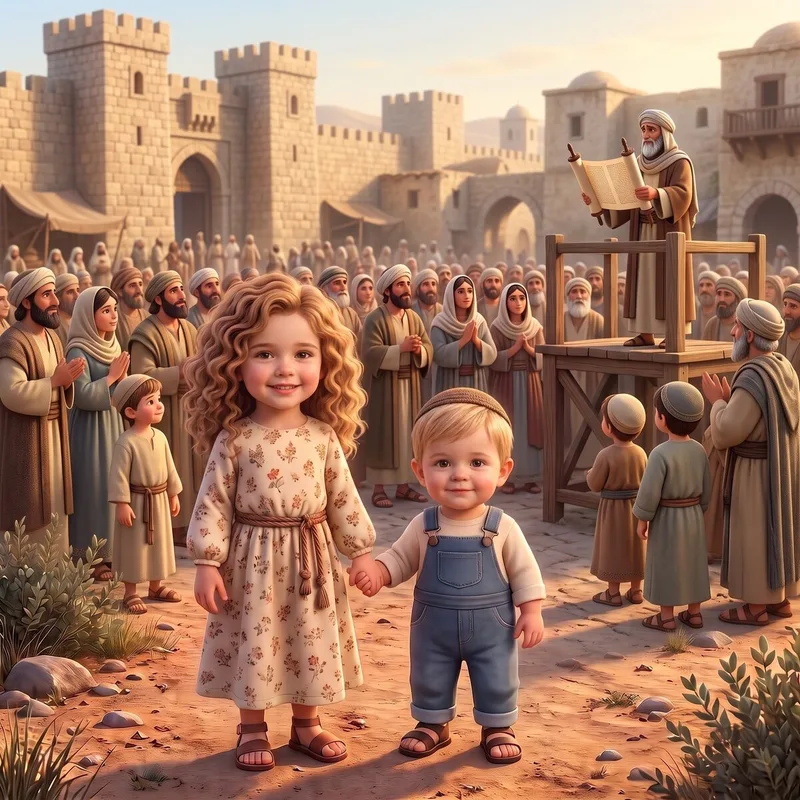
Ezra Teaches the Torah is the story of Ezra HaSofer, a kohen and scribe who prepared his heart to learn Torah, to do it and to teach it to Yidden (Ezra 7:10), and of the day, told in Sefer Nechemiah chapter 8, when he stood before the people and read to them from the Torah. Children connect to it because it is a picture they can see: a crowd, a high wooden platform, an open Torah, and everyone answering Amen.
Who was Ezra HaSofer, and why did he go up to Yerushalayim?
Sefer Ezra introduces Ezra as a descendant of Aharon HaKohen and a scribe skilled in the Torah of Moshe (Ezra 7:1-6). He went up from Bavel to Yerushalayim in the reign of King Artachshasta, and the pasuk says the king gave him everything he asked, as the hand of Hashem his God was upon him.
The pasuk itself tells us what was in his heart: Ezra prepared his heart to seek the Torah of Hashem, to do it, and to teach statute and law in Yisrael (Ezra 7:10). Seek, do, teach, in that order. You can read more about the journey itself in Sefer Ezra for Kids: Return to Yerushalayim and about the building in Building the Second Beis HaMikdash for Kids.
The Gemara (Sanhedrin 21b) says Ezra was worthy of having the Torah given through him, had Moshe Rabbeinu not come before him. That is a good line to share with an older child to show how much Chazal valued him.
What happened when Ezra read the Torah in front of everyone?
This part is told in Sefer Nechemiah chapter 8, which follows Sefer Ezra and describes the same community in Yerushalayim. On the first day of the seventh month, the people gathered as one man in the open square before the Water Gate and asked Ezra to bring the Sefer Torah of Moshe.
Ezra the kohen brought it before the men and women and all who could understand what they heard. He stood on a wooden platform that had been made for the occasion and read from the light of morning until midday. When he opened the sefer in the sight of all the people, they all stood up.
Ezra blessed Hashem, and all the people answered, "Amen, Amen," lifting their hands. Then they bowed down with their faces to the ground.
The Levites helped the people understand. The pasuk says the Torah was read clearly, with the sense given, so that the people understood the reading (8:7-8). Chazal (Nedarim 37b) learn from the word meforash that this included translation.
Why did the people cry, and why were they told to eat?
The pasuk says all the people wept as they heard the words of the Torah (8:9). The pasuk does not spell out why, so with children it is enough to say that the words touched them deeply.
Nechemiah, Ezra the kohen and scribe, and the Levites told them not to mourn or weep, because the day was holy to Hashem. They said to go and eat rich foods, drink sweet drinks, and send portions to the one for whom nothing is prepared, and not to be sad, for chedvas Hashem hi ma'uzchem, the joy of Hashem is your strength (8:10). The people went and made a great simcha because they understood the words that had been made known to them (8:12).
On the second day the heads of the families gathered to Ezra to study the words of the Torah more deeply. They found written that Bnei Yisrael should dwell in sukkos in the festival of the seventh month, and they made sukkos (8:13-17). The pasuk adds that the Torah was read day after day throughout the Yom Tov (8:18). The picture of the whole people gathering to hear the Torah may remind you of Hakhel.
What is the lesson of Ezra Teaches the Torah?
There are a few lessons here, and each fits a child's world.
- Get ready before you learn. The pasuk says Ezra prepared his heart. A child can take a moment before learning to settle down and be ready.
- Torah should be understood. The Levites made sure the people could follow. A child who asks "what does that mean?" is doing exactly what the story values.
- Learning, doing and teaching go together. A child can tell a younger sibling something from the parsha or from cheder.
- Torah brings simcha, and simcha is shared. The people were told to send portions to someone with nothing prepared.
One more link for older children: the Gemara (Bava Kamma 82a) says Ezra instituted that the Torah be read on Monday, Thursday and at Shabbos Mincha. Next time your child hears krias haTorah, you can say that this goes back to Ezra.
How do I explain it to a 3-year-old, a 6-year-old and a 10-year-old?
Ages 3-4. Keep it very short: "Everyone came to hear the Torah. Ezra stood up high and opened it. Everyone stood up and said Amen. Then they ate and were happy." Stand up together and say Amen, and you have told the story.
Ages 5-7. Ask why Ezra stood up high (so everyone could see and hear) and why everyone stood when he opened the sefer. Explain that the Levites helped the people understand, just like a morah explains a story. Mention the portions sent to someone who had nothing ready.
Ages 8-11. Talk about the pasuk that Ezra prepared his heart to seek, do and teach. Ask what it means to get your heart ready before learning, and why the pasuk makes a point of the Torah being read clearly and understood. You can bring in the Gemara about translation and about the Monday and Thursday reading.
What is a personalized Torah Tale book of Ezra like?
Torah Tale's book of this story is from the Kesuvim collection. Your child's name and, from one uploaded photo, their likeness appear on every page, illustrated in high-resolution 3D animated-film style, so your child is the hero of the story. Up to eight siblings, ages 0 to 18, can appear in the same book, and it can be ordered in English, Hebrew or Yiddish.

Softcover 8″×8″

Hardcover 8″×8″

Board book 6″×6″

Coloring book 8.5″×11″
There are three formats: a 6x6 board book with rounded safety corners (ages 0-4), an 8x8 softcover (ages 4-8) and an 8x8 hardcover (ages 5-18). Softcover and hardcover open with a dedication page. If you add parents, grandparents or other relatives with their photos, they appear with the children on a closing family page in every format.
Every book ends with a discussion page of 10 questions mixing comprehension with middos, so it becomes something talked about at the table and not only read. Each book is written with careful rabbinical guidance and strict tznius, and is reviewed by our team before it goes to print.
An optional matching coloring book (8.5x11, black-and-white line art) can be added. Coloring is melacha, so it is a weekday activity, for erev Shabbos, a weekday afternoon or Chol HaMoed, and never for Shabbos or Yom Tov. The storybook itself is perfect to read on Shabbos.
What questions can we ask at the Shabbos table about Ezra?
These are talking questions only, so they work at the Shabbos table or on a Yom Tov afternoon.
- Why do you think Ezra stood up high when he read the Torah?
- What did the people do when Ezra opened the sefer, and what did they answer?
- Why was it important that the Levites helped everyone understand?
- What can we do to get our hearts ready before we learn?
- Who do you know that might have nothing prepared for a Yom Tov, and how could we share with them?
- What is something you learned this week that you can teach to someone else?
When you are ready, create the book for your child. It takes a free account and a few short questions, and about five minutes.
Frequently asked questions
What is the story of Ezra teaching the Torah?
Ezra HaSofer was a kohen and a scribe skilled in the Torah of Moshe who went up from Bavel to Yerushalayim. Sefer Ezra tells us he prepared his heart to seek Hashem's Torah, to do it and to teach it in Yisrael. Later, Sefer Nechemiah tells how the people gathered, Ezra read the Torah to them from a wooden platform, and they answered Amen, Amen.
Where in Tanach does Ezra read the Torah to the people?
Ezra's background and his purpose in coming to Yerushalayim are in Sefer Ezra, chapter 7. The public reading itself is in Sefer Nechemiah, chapter 8, which follows Sefer Ezra. Both describe the Yidden living in Yerushalayim after the return from Bavel.
What is the lesson of Ezra Teaches the Torah?
We learn that Torah is meant to be understood, not only heard, and that learning, doing and teaching belong together. The story also shows the simcha of Torah and the chesed of sending portions to someone who has nothing prepared. A child can take away something simple: get ready before you learn, and share what you learned.
How do I explain Ezra HaSofer to a 4-year-old?
Keep it to a few sentences: everyone came to hear the Torah, Ezra stood up high and opened it, everyone stood up and said Amen, and then they ate and were happy. Let your child act out standing up and saying Amen. There is no need to explain the weeping at this age.
Which Torah Tale format suits this story?
Torah Tale offers a 6x6 board book with rounded safety corners for ages 0-4, an 8x8 softcover for ages 4-8, and an 8x8 hardcover for ages 5-18. In every format your child's name and likeness appear in 3D animated-film style, and the book ends with a discussion page of 10 questions. Choose by your child's age, which is one of the short questions when you create the book.
Can we read the book on Shabbos, and when do we use the coloring book?
Reading a storybook is entirely appropriate on Shabbos and Yom Tov, and the discussion page works well at the Shabbos table. The optional matching coloring book (8.5x11, black-and-white line art) involves coloring, which is melacha, so it is for weekdays only, such as erev Shabbos, a weekday afternoon or Chol HaMoed.