Hakhel for Kids: The Mitzvah When All Yisrael Gathered to Hear the Torah
Hakhel is the mitzvah in Parshas Vayeilech of gathering all Yisrael, little children included, to hear the Torah read at the end of shemitah. Here is the story, what Chazal say about the children, and how to explain it at ages 4, 7 and 10.
Published by Torah Tale.
Create this book for your child
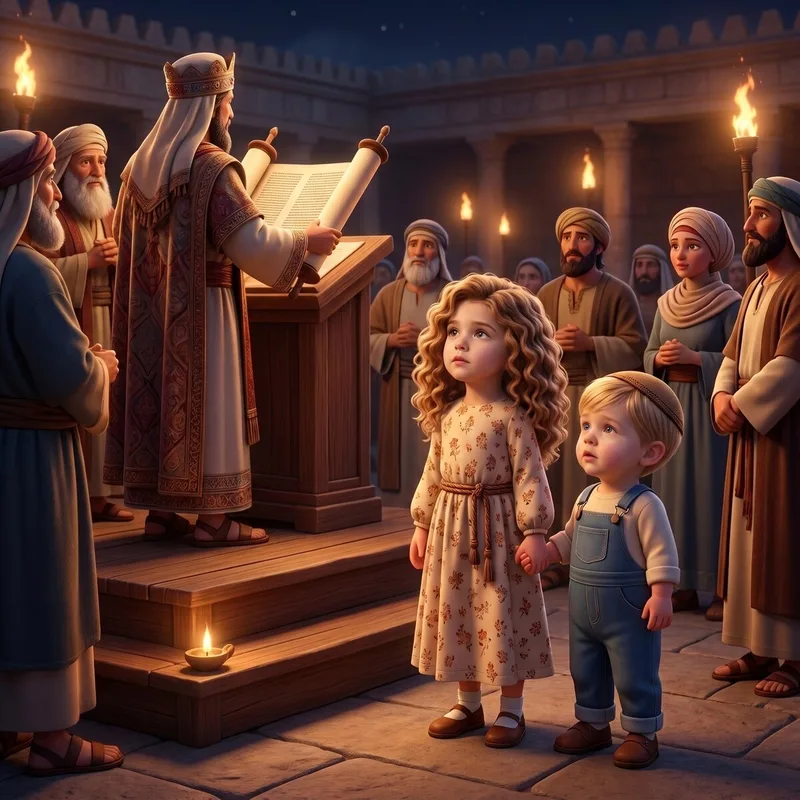
Hakhel is the mitzvah, in Parshas Vayeilech, of gathering all Yisrael - men, women, children and the ger - to hear the Torah read at the end of shemitah. Children connect to it because they are named in the pasuk itself: the Torah wants the little ones there, listening along with everyone else.
What is the mitzvah of Hakhel and when does it happen?
Toward the end of his life, Moshe Rabbeinu wrote the Torah and gave it to the kohanim and the zekeinim of Yisrael (Devarim 31:9). Then he commanded Hakhel. The Torah says that at the end of seven years, in the shemitah year, on the Yom Tov of Sukkos, when all Yisrael comes to appear before Hashem in the place He will choose, the Torah is to be read before all Yisrael, in their hearing.
The pasuk then says: "הקהל את העם האנשים והנשים והטף וגרך אשר בשעריך" - gather the people, the men and the women and the little ones, and your ger who is within your gates. It comes once in seven years, so it is a rare and special day.
Because the pasuk speaks of the place Hashem will choose, Hakhel is tied to the Beis HaMikdash. Today, ask your rav how your community remembers it. To explain to children why it follows shemitah, you can read The Shmita Year for Kids together.
What happened at Hakhel, step by step?
Picture the Yidden who came up for Sukkos after a whole year when the fields had rested. They gathered in the Beis HaMikdash. The pasuk simply says "tikra", you shall read, without saying who. The Mishnah (Sotah 7:8) tells us it was the king who read, and that a wooden platform was made for him in the Azarah.
The Mishnah describes him reading sections of Sefer Devarim, including the Shema. The people listened as he read.
The Rambam (Hilchos Chagigah) writes that everyone should listen with awe and joy, as if the Torah were being commanded now and heard from Hashem Himself. That is the feeling for children: this is not an old story, it is Torah meant for each of us to hear.
Why were little children brought to Hakhel?
This is the question children ask first. If a three-year-old cannot understand the words, why come? The Gemara in Chagigah 3a answers it with a teaching: the men came to learn, the women came to hear, and the children came "liten sachar lemevi'ehem" - to give reward to those who bring them.
We learn from this that a parent who carries a small child to Torah has done something great, even if the child cannot follow every word. The pasuk adds a further hope: "ובניהם אשר לא ידעו ישמעו ולמדו" - their children who do not yet know will hear and learn. The Torah is already thinking about the child who does not know yet.
The pasuk also gives the purpose of the gathering: "למען ישמעו ולמען ילמדו", so that they will hear and so that they will learn. Listening comes first, and learning grows from it. That is a middah a child can practice today: sitting still, looking at the speaker, and really hearing.
How do I explain Hakhel to a 4-year-old, a 7-year-old and a 10-year-old?
Age 4. Keep it to a picture and a feeling. Say: "Once every seven years, all the Yidden came to the Beis HaMikdash, even the littlest children, to hear the Torah. Everybody listened together." Then ask: "What do we do when we listen well?" Let your child show you with their ears and their quiet hands.
Age 7. Add the details. After shemitah, on Sukkos, the king read from Sefer Devarim from a wooden platform. Ask why the Torah wanted the children there. Share the Gemara: children came to give reward to those who brought them. A child this age loves hearing that bringing them mattered.
Age 10. Look at the pesukim themselves. Read Devarim 31:10-13 and notice the order: hear, learn, keep. Ask what it means that the Torah says to gather everyone, men, women, children and the ger. Then ask how a family today can make time to hear Torah together, for example at the Shabbos table or at a shiur.
What questions can we ask at the Shabbos table?
Reading and talking are right for Shabbos and Yom Tov. Here are questions that need no pencil and no props:
- When did Hakhel happen, and how often?
- Who did the Torah say should come? Who is on the list?
- Why would the Torah want little children to be there?
- What is the difference between hearing and really listening?
- What is one thing from the parsha this week that we could all hear together as a family?
Every Torah Tale book ends with a discussion page of 10 questions that mix comprehension with middos. It turns the book from something read to a child into something talked about at the table. That fits Hakhel well, since the whole mitzvah is about hearing and talking about Torah together.
What is a personalized Torah Tale book about Hakhel like?
Hakhel is a story in the Jewish Life collection, which covers the simchos and minhagim of a Yiddishe life. In a Torah Tale book your child is the hero: their name and, from one uploaded photo, their likeness appear on every page, in 3D animated-film style. Siblings, up to eight children aged 0 to 18, can appear in the same book. If you add parents, grandparents and other relatives, they appear with the children on a closing family page, in every format. Softcover and hardcover books also open with a dedication page.

Softcover 8″×8″

Hardcover 8″×8″

Board book 6″×6″

Coloring book 8.5″×11″
There are three formats: a 6"x6" board book with rounded safety corners (ages 0-4), an 8"x8" softcover (ages 4-8) and an 8"x8" hardcover (ages 5-18). The book can be ordered in English, Hebrew or Yiddish. Every book is written with careful rabbinical guidance and strict tznius, and reviewed by our team before it goes to print.
You can also add a matching 8.5"x11" coloring book in black-and-white line art. Coloring is a weekday activity, so save it for erev Shabbos, a weekday afternoon, or Chol HaMoed. The storybook itself is lovely to read at the Shabbos table or on a long Yom Tov afternoon.
For a related story from the same time of year, you can read The Sukkos Story for Kids. Hakhel also sits inside the parsha at Nitzavim-Vayeilech, where Moshe speaks to everyone standing together.
When you are ready, you can create the book. It takes a free account and a few short questions: each child's name, boy or girl, age and one photo, any siblings, the story, your community (asked once), the language and the format. The whole flow takes about five minutes.
Frequently asked questions
What is Hakhel in simple words for a child?
Hakhel means gathering. Once every seven years, after shemitah, all the Yidden came together on Sukkos to hear the Torah read aloud. The Torah says to bring the men, the women, the children and the ger, so that everyone would hear and learn.
Why were small children brought to Hakhel?
The Gemara in Chagigah 3a teaches that the men came to learn, the women came to hear, and the children came to give reward to those who brought them. The pasuk also says that their children who do not yet know will hear and learn to fear Hashem. Even the youngest were part of the gathering.
When does Hakhel happen?
The Torah says it takes place at the end of seven years, in the shemitah year, on Sukkos. The mitzvah is connected to the place Hashem chooses, meaning the Beis HaMikdash. Ask your rav how your community remembers Hakhel today.
What is the lesson of Hakhel for kids?
The Torah belongs to everyone, and it is meant to be heard together, from the oldest to the youngest. Children learn the middah of listening and the joy of being counted in a big gathering of Yidden. It also shows that parents bring their children to Torah.
How can I explain Hakhel to a 4-year-old?
Tell it in one sentence: once every seven years, all the Yidden, even the littlest children, came together to listen to the Torah. Then ask what it would feel like to sit with everyone and listen quietly. Keep it short and let the child answer.
Is there a Torah Tale book about Hakhel?
Yes, Hakhel is a story in the Jewish Life collection. The book stars your child with their name and likeness, in 3D animated-film style, and ends with a discussion page of 10 questions about the story. You can choose English, Hebrew or Yiddish, and the board book (ages 0-4), softcover (ages 4-8) or hardcover (ages 5-18).