Rabbi Yitzchak Abarbanel for Kids: Lisbon, the Court & Torah Questions
Rabbi Yitzchak Abarbanel was a Torah scholar, a royal adviser and a leader of Yidden during the expulsion from Spain. Here is his story retold for children, with the lesson and questions for the Shabbos table.
Published by Torah Tale.
Create this book for your child
Rabbi Yitzchak Abarbanel was a great Torah scholar who lived about five hundred years ago. He advised kings, helped his fellow Yidden through the expulsion from Spain, and wrote commentaries on the Torah and Nevi'im. Children connect with his story because it shows a person with a very busy life who never stopped learning, and who used what he had to help others.
Who was Rabbi Yitzchak Abarbanel?
Rabbi Yitzchak Abarbanel, often called Don Yitzchak Abarbanel, was born in Lisbon, Portugal, in 1437. His family was wealthy and respected, and he grew up learning Torah. As a grown man he became known for two things at once: his understanding of Torah and his skill with money and government.
He is counted among the early authorities whose seforim we still learn from. Today he is remembered mainly for his commentaries on the Torah and on much of Nevi'im, and for other seforim, among them Nachalas Avos on Pirkei Avos and Zevach Pesach on the Haggadah.
What happened in the story of the Abarbanel?
In Portugal, Don Yitzchak worked as a financial adviser to the king. He had a place at the royal court, but he was still a Torah scholar, and he kept learning and writing seforim.
When a new king came to the throne, Don Yitzchak was in danger and left Portugal for Spain. There he again served in the royal treasury, this time for King Ferdinand and Queen Isabella.
In 1492 the Jews of Spain were ordered to leave the country. It is told that Don Yitzchak pleaded with the king and queen for his brothers and sisters and offered a large sum of money, but the decree was not cancelled. He left Spain along with many other Yidden, and he did not leave alone in spirit, since he stayed close to his people.
He made his way to Italy, living in several places, including Naples and later Venice. Even there he served in government for a time and kept writing seforim. He passed away in Italy in 1508.
What is the lesson for children?
The lesson is that a person can use whatever Hashem gave him for others and for Torah. Rabbi Abarbanel had understanding and a position at court. He did not keep those only for himself, and he did not let a busy life push Torah aside.
There is a second, smaller lesson that children enjoy. His commentary on a parsha is known for opening with a list of questions about the text before giving answers. For a child this is a good message: asking a question is not a problem, it is a real part of learning Torah.
- Use what you have: a kind word, a skill, a bit of time or a few coins can all help someone else.
- Keep learning: Torah has a place even in a full day.
- Ask good questions: a question shows that you want to understand.
How do I explain it to a 4-year-old, a 7-year-old and a 10-year-old?
For a 4-year-old: keep it to a few sentences. Rabbi Abarbanel was a very smart man who helped the king. He also learned Torah and wrote seforim. When the Yidden had to leave Spain, he helped his brothers and sisters. Then ask, how can you help someone today?
For a 7-year-old: add the journey. He lived in Portugal, moved to Spain, and then had to leave Spain with the Yidden in 1492. Ask your child what might be hard about leaving home, and what a person could still carry with him. The answer is Torah.
You can link it to other Rishonim your child may already know, such as the Rashba, whose teshuvos helped Yidden in Spain, or Rabbi Yosef Albo.
For a 10-year-old: talk about balance. Here was someone with a demanding job who still produced seforim. Show them how a seder or a regular time for learning can work, and ask what they could keep fixed each day. This also fits well with learning Torah every day.
What can we talk about at the Shabbos table?
Reading and talking are right for Shabbos. These questions need no screens or writing, only conversation:
- Rabbi Abarbanel worked for kings and was also a Torah scholar. How can a person do both?
- What did he do when the Yidden had to leave Spain?
- What do you have that you could use to help someone?
- His commentary starts with questions. What is one question you have about this week's parsha?
- What do Yidden carry with them wherever they go?
Let the youngest answer first, and let a parent or grandparent share their own question about the parsha. Children love hearing that grown-ups ask questions too.
What is a personalized Torah Tale book about the Abarbanel like?
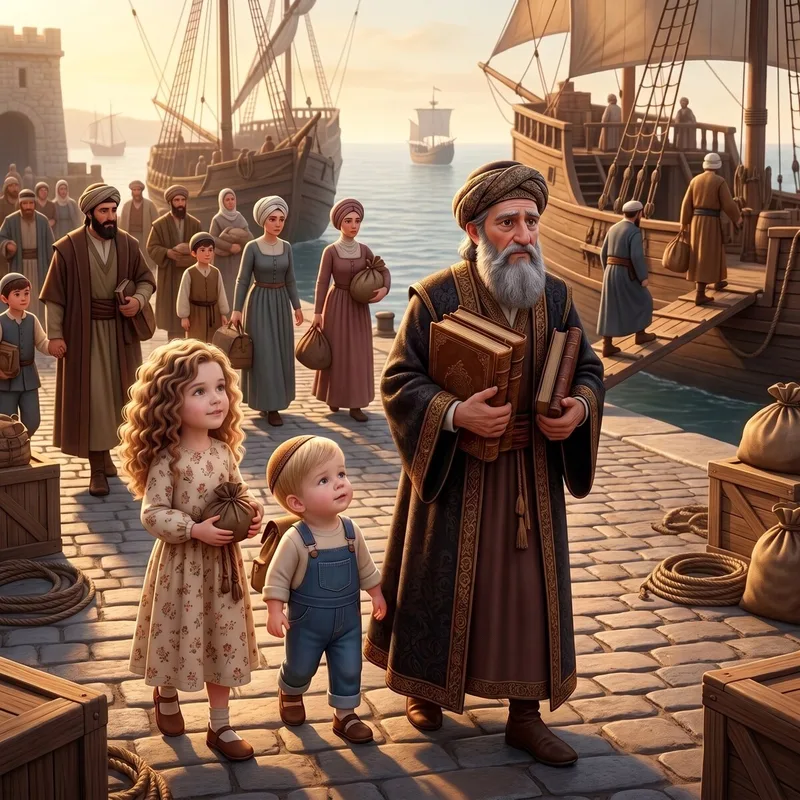
In Torah Tale's book on Rabbi Yitzchak Abarbanel, from the Stories of Tzaddikim collection, your child's name and likeness, taken from one uploaded photo, appear on every page in 3D animated-film style. Up to eight children can appear in the same book, ages 0 to 18, so siblings can share one story. If you add parents and grandparents, they appear with the children on a closing family page in every format.
Every book ends with a discussion page of 10 questions, mixing comprehension with middos: what happened, and what it asks of the child. That page is what turns a book your child reads into a book your family talks about. The book is written with careful rabbinical guidance and strict tznius, and is reviewed by our team before it goes to print.

Softcover 8″×8″

Hardcover 8″×8″

Board book 6″×6″

Coloring book 8.5″×11″
Which format fits which age?
Torah Tale offers three formats, matched to age: a 6x6 board book with rounded safety corners (ages 0-4), an 8x8 softcover (ages 4-8) and an 8x8 hardcover (ages 5-18). The softcover and hardcover open with a dedication page. You can also add a matching coloring book, which is a one-time add-on to a book. It is a weekday activity, for an afternoon or erev Shabbos, never for Shabbos itself.
The story can be ordered in English, Hebrew or Yiddish. Creating a book needs a free account and a few short questions: each child's name, boy or girl, age and one photo, any siblings, the story, your community (asked once), the language and the format. The whole flow takes about five minutes.
To give your child a story about a Yid who used what he had for others and never stopped learning, you can create the book and choose Rabbi Yitzchak Abarbanel from the Stories of Tzaddikim collection.
Frequently asked questions
Who was Rabbi Yitzchak Abarbanel?
Rabbi Yitzchak Abarbanel (Don Yitzchak Abarbanel) was a Torah scholar born in Lisbon in 1437. He also served as a financial adviser to kings in Portugal, Spain and later Naples. He is best known for his commentaries on the Torah and on Nevi'im, and for his seforim such as Nachalas Avos and Zevach Pesach.
How do I explain the expulsion from Spain to a young child?
For a young child, keep it simple and calm: in 1492 the king and queen of Spain told the Yidden they had to leave their homes, and Yidden helped each other and kept davening and learning Torah wherever they went. Leave out frightening details and focus on the chesed and the Torah that traveled with them. Older children can hear more about the journeys and about how Rabbi Abarbanel helped his brothers and sisters.
What is the lesson of the Abarbanel story for kids?
The main lesson is using what Hashem gave you for others and for Torah. Rabbi Abarbanel had wisdom and a position at court, and he used them to help Yidden and kept writing seforim all his life. A child can apply this by asking, what can I do for someone else with what I have?
What is special about the Abarbanel's commentary on the Torah?
His commentary on a parsha is known for opening with a list of questions about the text, and only afterward giving his answers. This makes it a good model for children that asking a question is a real part of learning Torah. The commentary is written for adults, so children meet this idea through the story, not the text itself.
Is there a personalized children's book about Rabbi Yitzchak Abarbanel?
Yes. Torah Tale has a personalized storybook on Rabbi Yitzchak Abarbanel in its Stories of Tzaddikim collection, with your child's name and likeness on every page in 3D animated-film style. Every book ends with a discussion page of 10 questions about the story, mixing comprehension with middos.