Rabbi Yosef Albo (רבי יוסף אלבו) for Kids: Sefer HaIkkarim
Rabbi Yosef Albo was a Rishon in Spain who wrote Sefer HaIkkarim on the foundations of emunah. Here is his story, the lesson for children, and how to explain it to a 4-year-old and an 11-year-old.
Published by Torah Tale.
Create this book for your child
Rabbi Yosef Albo was a Rishon in Spain who wrote Sefer HaIkkarim, a sefer that explains the foundations of emunah. Children connect with him because his message is short enough to remember: Hashem is real, Hashem gave us the Torah, and Hashem notices the good we do.
Who was Rabbi Yosef Albo?
Rabbi Yosef Albo (רבי יוסף אלבו) lived in Spain in the late 1300s and the first half of the 1400s. He is known as a talmid of Rabbi Chasdai Crescas, and he served as a rav and a teacher of Torah among Yidden in the kingdom of Aragon.
He belongs to the later Rishonim. If your children have already met the earlier Spanish Rishonim, such as the Rashba in Barcelona, Rabbi Albo comes some generations after them, and his famous work is not a commentary on the Gemara but a sefer on what Yidden believe and why.
What is Sefer HaIkkarim, and what are the three ikkarim?
An ikkar is a foundation, something without which the whole building cannot stand. Rabbi Albo asked a clear question: what are the true ikkarim of the Torah? His sefer, Sefer HaIkkarim (the Book of Principles), is his answer.
He teaches that there are three:
- Hashem exists.
- The Torah is from Heaven (Torah min haShamayim).
- Hashem gives reward for good and holds us accountable for what we do (schar v'onesh).
He then explains further ideas that grow out of these three, the way branches grow from a root. If your family knows the Rambam and his thirteen ikkarim, you can tell older children that Rabbi Albo looked at the same question from his own angle and asked what the most basic foundations are.
Why did Rabbi Albo write it? The Disputation of Tortosa
Rabbi Albo lived in a hard time for Yidden in Spain. In 1413-1414 the Church held the Disputation of Tortosa, a public debate in which Jewish representatives from the communities of Aragon had to stand before Church leaders and defend the Torah. Rabbi Yosef Albo was one of those representatives.
For a parent, the point to share is simple: Yidden were asked tough questions in public, and the Jewish leaders needed to know clearly what they believed and why. Sefer HaIkkarim is a sefer written to give Yidden that clarity. For young children you can leave out the debate and say only that Rabbi Albo was a rav who wanted every Yid to understand the basics of emunah.
What is the lesson for children?
There are two lessons, and both are easy to bring home.
Know what you believe. A child who knows the three ikkarim has something solid underneath everything else they learn. Rabbi Albo shows that asking what is basic and what is branch is part of learning Torah, and it is a good habit for a child who asks "why" a lot.
What I do counts. The third ikkar tells a child that Hashem notices good deeds. A kind word to a sibling, a bracha said carefully or a coin put in the pushka is not forgotten. You can lead with the good side of this: Hashem sees and loves when we do what is right.
How do I explain Rabbi Albo to a 4-year-old, an 8-year-old and an 11-year-old?
Age 4. Use three short sentences with hand motions if you like: Hashem is real. Hashem gave us the Torah. Hashem sees when we do good. Say that Rabbi Albo was a rav who wrote a sefer to teach Yidden these three things.
Age 8. Introduce the word ikkar as a foundation. Ask: if a house is built on three big pillars, what happens if one is missing? Then name the three ikkarim and let your child say why each one matters. Mention that Rabbi Albo lived in Spain a long time ago and that the sefer is still learned today.
Age 11. Talk about why a rav would sit down and write out the foundations of emunah at a time when Yidden were being asked hard questions. Ask what your child would say if a friend asked them what Yidden believe in three sentences. You can also compare the three ikkarim to the thirteen of the Rambam and ask what it means to put the foundations in order.
Questions to ask at the Shabbos table
Reading a book about a tzaddik at the Shabbos table is entirely appropriate, and these questions need only talking, no writing. Try a few:
- What is an ikkar, and why is it important?
- Can you say the three ikkarim of Rabbi Albo in your own words?
- Why do you think Rabbi Albo wanted Yidden to know the basics clearly?
- What is one thing we do that shows we believe Hashem gave the Torah?
- What is one good thing you did this week that you know Hashem saw?
Torah Tale books also end with a discussion page of 10 questions about the story, mixing comprehension with middos. It gives you a ready-made table conversation about what happened and what it asks of your child.
What is a personalized Torah Tale book about Rabbi Albo like?
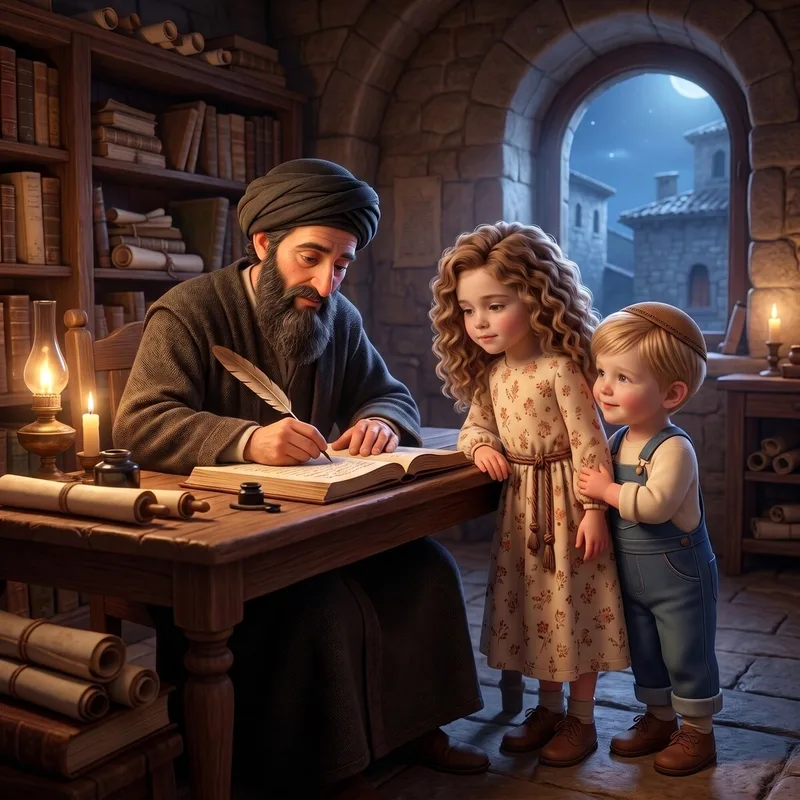
Rabbi Yosef Albo is one of the stories in the Stories of Tzaddikim collection. Your child's name and likeness, from one uploaded photo, appear in the illustrations in 3D animated-film style, and up to eight children can appear in the same book. Every book is written with careful rabbinical guidance and strict tznius and is reviewed by our team before it goes to print.
Three formats are available: a 6"x6" board book with rounded safety corners (ages 0-4), an 8"x8" softcover photo book (ages 4-8) and an 8"x8" hardcover photo book (ages 5-18). An 8.5"x11" black-and-white coloring book can be added as a one-time extra. It is a weekday activity, for an erev Shabbos or a weekday afternoon, and never for Shabbos or Yom Tov. If you add parents and grandparents with their photos, they appear with the children on a closing family page in every format.

Softcover 8″×8″

Hardcover 8″×8″

Board book 6″×6″

Coloring book 8.5″×11″
The book is for reading together, including on Shabbos, and it makes a good gift when a child is starting to ask real questions about what we believe.
When you are ready, create the book with a free account and a few short questions: your child's name, boy or girl, age and one photo, any siblings, the story, your community, the language and the format. The whole process takes about five minutes.
Frequently asked questions
Who was Rabbi Yosef Albo?
Rabbi Yosef Albo was a Rishon who lived in Spain in the late 1300s and the first half of the 1400s. He is best known for Sefer HaIkkarim, a sefer about the foundations of emunah. He is also remembered as one of the Jewish representatives at the Disputation of Tortosa.
What are the three ikkarim of Rabbi Albo?
Rabbi Albo teaches that the Torah rests on three foundations: that Hashem exists, that the Torah comes from Hashem (Torah min haShamayim), and that Hashem gives reward for good and holds us accountable for what we do. In his sefer he then explains further ideas that grow out of these three.
How do I explain Rabbi Yosef Albo to a 4-year-old?
Keep it to one sentence and a few words a child can repeat: Hashem is real, Hashem gave us the Torah, and Hashem sees when we do good. You can add that Rabbi Albo was a great rav who wrote a sefer so Yidden would remember these things. Say it again at bedtime or on Shabbos, and let your child say it back.
What is the lesson of Rabbi Yosef Albo for children?
The lesson is to know what we believe and why it matters. Rabbi Albo wrote clearly about the basics of emunah, so a child can learn that questions are worth asking and that the answers are worth learning from the Torah. It also teaches children that what they do counts, because Hashem notices our good deeds.
Is Rabbi Yosef Albo's story suitable for young children?
The story can be told gently at any age by focusing on the sefer and the three ikkarim and leaving out the details of the debate for younger children. Older children, around 9 to 12, can hear more about why Rabbi Albo wrote the sefer and the idea of an ikkar. Torah Tale offers the story in a board book (ages 0-4), a softcover (ages 4-8) and a hardcover (ages 5-18).
Does Torah Tale have a book about Rabbi Yosef Albo?
Yes, Rabbi Yosef Albo is among the stories in the Stories of Tzaddikim collection. Your child's name and likeness, from one uploaded photo, appear in the illustrations in 3D animated-film style, and the book ends with a discussion page of 10 questions.