The Rashba (הרשב״א) for Kids: Barcelona, Teshuvos & Helping Yidden
Who was the Rashba, and why does a child need to know him? A plain retelling of the Rishon of Barcelona, how to explain his teshuvos at different ages, and questions for the Shabbos table.
Published by Torah Tale.
Create this book for your child
The Rashba, Rabbeinu Shlomo ben Avraham Aderes, was a Rishon who lived in Barcelona, Spain, and became a rav whom Yidden turned to with their halachic questions. Children connect with him because the picture is easy to hold: a rav at his table, a letter with a question, and a Yid somewhere waiting for an answer. For a child, the Rashba shows what a talmid chacham does with his Torah.
Who was the Rashba?
Rashba is an acronym for Rabbi Shlomo ben Avraham. His family name is written Aderes or Adret. He was born in Barcelona around the year 1235 and passed away around 1310, so he lived in the thirteenth and early fourteenth centuries.
He learned Torah from the Ramban, and he grew into one of the leading rabbanim of his generation. Among his own talmidim was the Ritva, whose chiddushim on the Gemara are learned to this day. If your child already knows the Ramban, the Rashba is a natural next step, because here is a talmid carrying a rebbi's Torah forward.
What did the Rashba do all day?
Much of what we know about the Rashba comes from his teshuvos. A teshuvah is a written answer to a question in halacha, and thousands of the Rashba's teshuvos have come down to us. The questions reached him from many communities, and he wrote back.
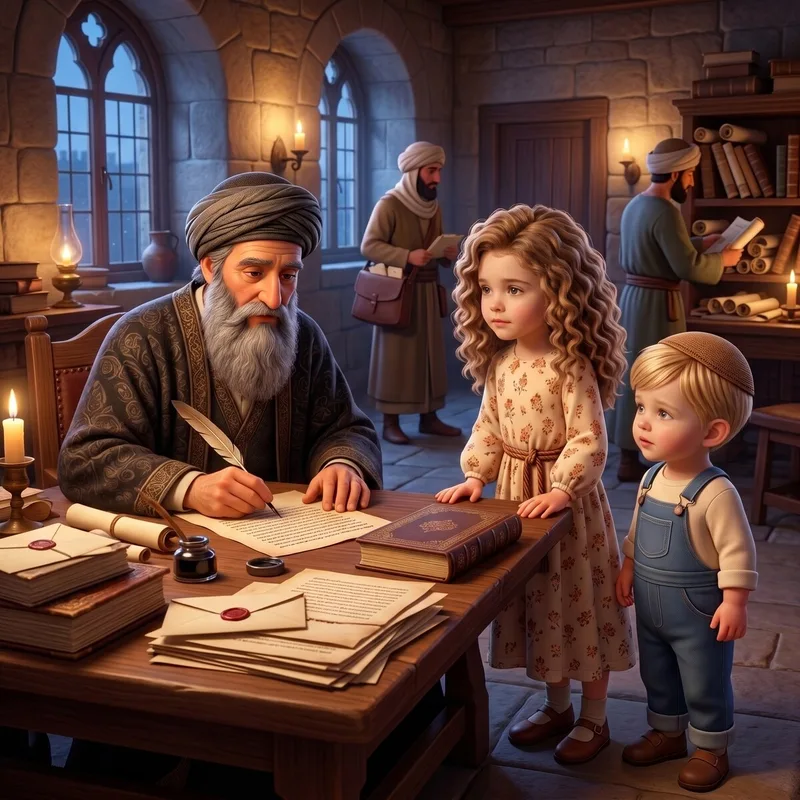
For a young child, you can paint it like this: a person has a real question, such as how to handle a situation that came up in his home or his business. He cannot ask a rav down the street, so he sends the question to the Rashba. The Rashba looks into the Gemara and the earlier Rishonim, thinks carefully, and sends back a reply. That picture is how we can tell it to children. The sefarim are the proof of how much he answered.
What did the Rashba write?
Three kinds of Torah from the Rashba are worth naming for children and for yourself:
- Teshuvos - the many answers he wrote to questions from Yidden. Rav Yosef Karo, the Mechaber of the Shulchan Aruch, quotes them often in the Beis Yosef.
- Chiddushim on the Gemara - his explanations and new insights on many masechtos, which are still learned in yeshivos.
- Toras HaBayis - a work on halachos that apply in the Jewish home.
If your child asks why a Rishon who lived so long ago still matters, this is the answer. His words are still open on the table in batei medrash today.
What is the lesson of the Rashba for children?
The main lesson we can take is that Torah is learned in order to be used. The Rashba did not keep his learning to himself. He put it to work for a Yid with a real question, and he did so carefully, because an answer in halacha affects how someone lives.
This gives parents three practical middos to talk about:
- Using what you know to help others. A child who can read well can read to a younger sibling. A child who knows a bracha can help a friend remember it.
- Answering with care. When someone asks us something, we think before we reply, and we do not brush them off.
- Asking real questions. The whole story of the Rashba begins with people who were not embarrassed to ask. At home, you can show a child that a question is a good thing in the Torah world.
How do I explain the Rashba to a 4-year-old, a 7-year-old and a 10-year-old?
Age 4. Say it in two sentences: "The Rashba was a big rav who knew so much Torah. When Yidden had a question about what to do, they asked him, and he wrote back to help." Then ask, "Who do we ask when we have a question?"
Age 7. Add the names and the places. His rebbi was the Ramban, he lived in Barcelona, and the questions came from many communities. Explain that a teshuvah is a letter with an answer. A child at this age enjoys the idea that a rav sat down and wrote back to someone he might never meet.
Ages 10 to 12. Talk about the sefarim themselves. The chiddushim and the teshuvos are both still learned, and you can mention that the Ritva was his talmid and that the Beis Yosef quotes him. Ask your child what makes a good answer: that it is accurate, that it is clear, and that it comes from knowing the sources.
For a wider picture of the Rishonim, the articles on the Ramban, the Rambam and the Rif make good companions.
What questions can we ask at the Shabbos table?
These are talking questions only, which suit the Shabbos table well:
- Why do you think people wrote to the Rashba with their questions?
- What is a question you have asked a rebbi or a parent that you were glad you asked?
- How can you use something you learned this week to help someone else?
- Why is it important to answer a question carefully and not in a rush?
- The Rashba learned from the Ramban. Who taught you something you still remember?
Let the youngest answer first. A four-year-old's answer to the fourth question is often wiser than ours.
What is a personalized Torah Tale book about the Rashba like?
Torah Tale makes personalized Torah storybooks in which your child is the hero, with their name and, from one uploaded photo, their likeness on every page in high-resolution 3D animated-film style. The Rashba's book is part of the Stories of Tzaddikim collection, which tells of the Jewish leaders of the last two thousand years. Up to eight siblings can appear in the same book, ages 0 to 18.
Every Torah Tale book ends with a discussion page of 10 questions that mix comprehension with middos, so the story becomes something your family talks about, not just something read to a child. If you add parents and grandparents with their photos, they appear with the children on a closing family page in every format. The softcover and hardcover open with a dedication page, and every book is written with careful rabbinical guidance and strict tznius and reviewed by our team before it goes to print.

Softcover 8″×8″

Hardcover 8″×8″

Board book 6″×6″

Coloring book 8.5″×11″
There are three formats. The 6x6 board book with rounded safety corners is for ages 0-4, the 8x8 softcover is for ages 4-8, and the 8x8 hardcover is for ages 5-18. Reading is entirely appropriate on Shabbos and Yom Tov, so the book can sit with the other sefarim at the Shabbos table. Creating one takes a free account and a few short questions: name, boy or girl, age, one photo, any siblings, the story, your family's community (asked once), the language and the format. The languages are English, Hebrew and Yiddish.
If you would like your child to meet more tzaddikim over time, a collection subscription on the Monthly or Yearly plan brings four books a month from that collection. Details are on the pricing page.
When you are ready, you can create the book in about five minutes, and give your child a Rishon who used his Torah to help Yidden near and far.
Frequently asked questions
Who was the Rashba?
The Rashba, Rabbeinu Shlomo ben Avraham Aderes, was a Rishon who lived in Barcelona, Spain, from about 1235 to about 1310. He was a talmid of the Ramban and became one of the leading rabbanim of his generation. He is best known for his thousands of teshuvos and his chiddushim on the Gemara.
Why is he called the Rashba?
Rashba is an acronym for Rabbi Shlomo ben Avraham, his name and his father's name. Many Rishonim and Acharonim are known by acronyms like this, such as the Ramban, the Rambam and the Rif.
How do I explain the Rashba to a 5-year-old?
Keep it to one picture: the Rashba was a rav who knew a great deal of Torah, and when Yidden had a question about what to do, they asked him and he wrote back to help them. You can add that he learned from his own rebbi, the Ramban. For this age the point is simply that Torah knowledge is something we use to help other people.
What are the Rashba's teshuvos?
Teshuvos are written answers to halachic questions that people sent to a rav. The Rashba wrote thousands of them, and they were collected and are still learned today. Rav Yosef Karo quotes the Rashba's teshuvos often in the Beis Yosef.
What is the lesson of the Rashba for children?
One lesson we can learn from the Rashba is that learning is meant to be shared and used. A child can apply it by helping a younger sibling or a friend with something they know, and by asking real questions without embarrassment. It is also a good moment to talk about answering someone carefully and patiently.
Is there a personalized children's book about the Rashba?
Yes. Torah Tale has a personalized storybook about the Rashba in its Stories of Tzaddikim collection, with your child's name and likeness illustrated in 3D animated-film style. Like every Torah Tale book, it ends with a discussion page of 10 questions mixing comprehension with middos.