Pidyon HaBen (פדיון הבן) for Kids: Redeeming a Firstborn
Pidyon HaBen is the mitzvah of redeeming a firstborn son from a kohen on the thirty-first day. Here is the story behind it, what happens, and how to explain it to your children.
Published by Torah Tale.
Create this book for your child
Pidyon HaBen is the mitzvah in which a father redeems his firstborn son from a kohen when the baby is thirty-one days old. Children connect to it because it is a real simcha they may attend, with a baby, a kohen, silver coins and a seudah. It also carries a simple message a child can hold onto: this baby is a gift from Hashem, and we say thank you.
What is Pidyon HaBen?
Pidyon HaBen means "redeeming the son." The Torah sets aside a firstborn son for Hashem, and the father redeems him by giving silver to a kohen. The baby himself does nothing at all except be there, usually in someone's arms, while everyone around him celebrates.
The mitzvah applies to a son who is the first child his mother bore in the way the halacha describes. It does not apply in every family. If the father is a kohen or levi, or the mother is the daughter of a kohen or levi, or there are questions about the birth, you should ask your rav.
Why do we redeem a firstborn son?
The Torah tells us the reason itself. In Shemos 13:15 the pasuk says that Hashem struck the firstborn of Mitzrayim, and therefore every firstborn son of Yisrael is redeemed. The firstborn Yidden were spared in Mitzrayim, and so they belong to Hashem in a special way. You can read about that night in Parshas Bo for Kids, since the mitzvah of the bechor appears in the last part of the parsha.
The amount is given in Bamidbar 18:16: a redemption from one month old, at five shekalim of silver. In Bamidbar chapter 3 the Torah also tells us that Hashem took the Levi'im in place of the firstborn of Yisrael. The redemption money goes to a kohen, and a rav will guide a family on which silver to use.
What happens at a Pidyon HaBen?
Customs differ between families and communities, but the main steps are well known:
- The pidyon is held on the thirty-first day of the baby's life. If that day is Shabbos or Yom Tov, it is held afterward.
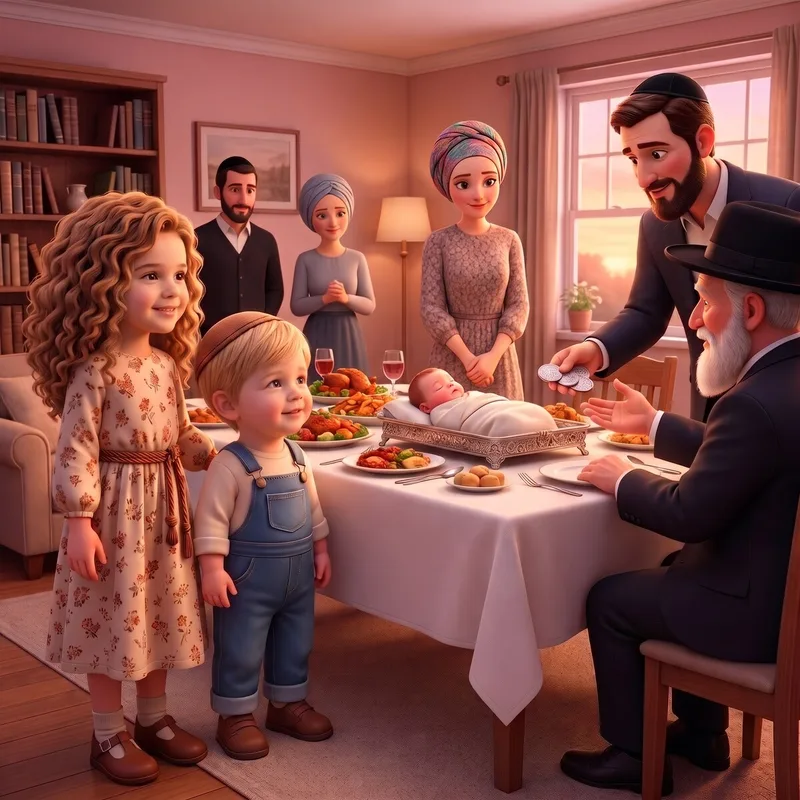
- Family and friends gather, along with a kohen. In many families the baby is brought in on a decorated tray.
- The kohen asks the father whether he would rather keep his firstborn son or redeem him for the five shekalim. The father answers that he wants to redeem his son.
- The father makes the brachos and gives the silver to the kohen.
- The kohen declares the baby redeemed, makes a bracha on wine and blesses the baby.
- Everyone joins the seudas mitzvah.
If your child is going to attend, walking through these steps beforehand makes the day much easier for them to follow. Children love knowing what comes next.
What is the lesson of Pidyon HaBen for children?
The first lesson is hakaras hatov, saying thank you. Hashem saved the firstborn of Yisrael, and a family can look at a new baby and say that he is a gift. If you want to build the habit at home, see Saying Thank You for Kids.
The second lesson is that a child is precious, and a child's life has a purpose. The Torah calls the firstborn kadosh, set apart for Hashem. We can teach children that they are not just a person in the family, but someone Hashem cares about and has hopes for.
The third lesson is that a mitzvah can be a family simcha. The father does the mitzvah, the kohen takes part, the siblings dance, and the whole room is happy for one small baby.
How do I explain Pidyon HaBen to a child?
Ages 3 to 4. Keep it to one picture. "When Hashem took the Yidden out of Mitzrayim, He saved the Yiddishe firstborn boys. So when a family has a first baby boy, Abba gives a kohen special coins to say thank you to Hashem. Then we make a happy seudah." Let your child hold a toy coin and give it to a toy kohen.
Ages 5 to 7. Add the Torah's words. Tell them that the Torah says every firstborn son is set apart for Hashem, and that the father redeems him. Children sometimes hear "buying the baby" and are worried by it, so say plainly that the baby is not for sale. Redeeming is a mitzvah, and Hashem gave it to us.
Ages 9 to 12. Open the pesukim. Look at Shemos 13:15 for the reason and at Bamidbar 18:16 for the five shekalim. Ask why the kohen is the one who receives it, and talk about the Levi'im being taken in place of the firstborn. Older children can also ask the halachic questions themselves, such as who is exempt, and learn that the answer is to ask a rav.
What can we ask at the Shabbos table about Pidyon HaBen?
Shabbos is a good time for talking and questions, and the pidyon itself is not held on Shabbos or Yom Tov, so this is a conversation only. A few questions that work:
- What happened to the firstborn of Yisrael in Mitzrayim, and why do we remember it?
- What does the father give to the kohen, and what does he say?
- Why do you think the Torah wants us to thank Hashem for a baby?
- How can we help a new baby in our family feel welcome?
- What is one thing you are grateful to Hashem for this week?
If a new baby is on the way or has just arrived, My New Baby Brother and Bris Milah for Kids pair well with this conversation.

Softcover 8″×8″

Hardcover 8″×8″

Board book 6″×6″

Coloring book 8.5″×11″
What is a personalized Torah Tale Pidyon HaBen book like?
Torah Tale makes a Pidyon HaBen book in its Jewish Life collection. Your child's name and, from one uploaded photo, their likeness appear on every page, illustrated in high-resolution 3D animated-film style. Up to eight siblings, ages 0 to 18, can appear in the same book. It is written with careful rabbinical guidance and strict tznius, and our team reviews it before it goes to print.

Every book ends with a discussion page of 10 questions, mixing comprehension with middos, so the book becomes something talked about at the table and not only read. If you add parents, grandparents and other relatives with their photos, they appear with the children on a closing family page, in every format. Softcover and hardcover books open with a dedication page.
For a baby, the board book (6"x6" with rounded safety corners, ages 0-4) is the fitting size. The softcover (8"x8", ages 4-8) and the hardcover (8"x8", ages 5-18) suit older brothers and sisters. You can choose English, Hebrew or Yiddish. There is also an optional matching coloring book (8.5"x11") in black-and-white line art, which is a weekday activity for an erev Shabbos or a weekday afternoon, never for Shabbos or Yom Tov. The book itself is a good one to read at the Shabbos table.
Creating the book needs a free account and a few short questions: each child's name, boy or girl, age and one photo, any siblings, the story, your community (asked once), the language and the format. It takes about five minutes. When you are ready, create the book.
Frequently asked questions
What is Pidyon HaBen in simple words?
Pidyon HaBen means redeeming the son. When a mother's first baby is a boy, his father gives a kohen silver as the Torah commands, and the baby is redeemed. It is a mitzvah, and the family celebrates it with a seudah.
Why do we do Pidyon HaBen?
The Torah says in Shemos 13:15 that because Hashem struck the firstborn of Mitzrayim and spared the firstborn of Yisrael, every firstborn son of ours is redeemed. The amount, five shekalim of silver, is given in Bamidbar 18:16. We do it as an act of thanks and as a reminder that every child is a gift from Hashem.
When is Pidyon HaBen done?
It is done when the baby is a month old, which means on the thirty-first day. If that day falls on Shabbos or Yom Tov, the pidyon is held afterward. Your rav can help you count the exact date.
How do I explain Pidyon HaBen to a 4-year-old?
You can say: when Hashem took the Yidden out of Mitzrayim, He saved the Yiddishe firstborn boys. So when a family has a first baby boy, the abba says thank you to Hashem by giving a kohen special coins, and then everyone makes a happy seudah. Avoid saying the baby is being bought, because small children can take that literally.
Does every firstborn boy have a Pidyon HaBen?
No. The mitzvah applies to a son who is the first child his mother bore in the way the halacha describes, and there are exceptions, for example when the father is a kohen or levi, or the mother is the daughter of one. There are also questions about births by caesarean and earlier miscarriages. Ask your rav about your own situation.
Is there a Torah Tale book about Pidyon HaBen?
Yes, it is in the Jewish Life collection. The child's name and, from one uploaded photo, their likeness appear on every page in 3D animated-film style, and the book ends with a discussion page of 10 questions that mix comprehension with middos. Creating it takes a free account and a few short questions, about five minutes in all.