Bris Milah for Kids: How to Explain the Mitzvah and the Simcha
A bris milah is the mitzvah Hashem gave Avraham Avinu, kept on the eighth day of a baby boy's life. Here is how to explain it to children of different ages, and what a Torah Tale book about it offers.
Published by Torah Tale.
Create this book for your child
A bris milah is the mitzvah Hashem gave Avraham Avinu, and Yidden have kept it on the eighth day of a baby boy's life ever since. Children are naturally curious about it, because a bris is a day when the whole family gathers, a new baby receives his name, and the house fills with simcha. This article explains the mitzvah in words a child can hear, and offers some practical ways to talk about it at home.
What is a bris milah, in simple words?
A bris milah is a mitzvah that Hashem commanded Avraham in Sefer Bereishis, chapter 17. The Torah calls it a sign of the bris, the covenant, between Hashem and Avraham and his children after him. That is why we tell children that a bris is how a Jewish baby boy becomes part of Avraham's family in a special way.
The pesukim tell us a few things children love to hear. Avraham was ninety-nine years old, and his son Yishmael was thirteen. The Torah says Avraham did the mitzvah on that very day, together with his household. He did not wait, because Hashem had commanded it.
The Torah also tells us that when Yitzchak was born, Avraham circumcised him at eight days old, as Hashem had commanded him. This is the pattern Yidden follow today.
What actually happens at a bris?
For a young child, it helps to describe the day as a simcha with a few clear parts. This is the outline most families will recognize:
- The bris is on the eighth day after the baby is born, when he is healthy enough. If the eighth day is Shabbos, the bris still takes place on Shabbos.
- A mohel, a person trained in this mitzvah, performs it. The father has a central role in the mitzvah.
- A sandak, an honored person such as a grandfather, holds the baby. Families give this honor to someone they love.
- Brachos are said, and everyone answers Amen.
- In the minhag we know, a baby boy is given his name at the bris.
- A seudas mitzvah follows, a festive meal with family and friends.
Many families also set aside a chair known as the kisei shel Eliyahu, which is a well-known minhag. If your family or community has its own customs, your rav or mohel can explain them best.
How do I explain a bris to a 3-year-old, a 6-year-old and a 10-year-old?
Ages 3 to 4. Keep it to one idea: Hashem told Avraham Avinu about a special mitzvah, and Jewish baby boys have it when they are eight days old. Say that everyone is happy, the baby gets his name, and there is a seudah. If the child asks whether the baby will cry, you can honestly say that a baby may cry, and that the mohel is trained to be careful and everyone who loves the baby is close by.
Ages 5 to 7. Add the story of Avraham: Hashem commanded him, and he did it that very day. Explain that a bris is a sign that Yidden belong to Hashem. A child this age will often ask why we do it so early, and a good answer is that the Torah tells us to do it on the eighth day, and we do what the Torah says.
Children at this age enjoy having a role. They can help set up for the seudah, say Mazel Tov to the family, or practice answering Amen with the right timing.
Ages 9 to 12. Older children can learn the places where the mitzvah appears: Bereishis chapter 17, Bereishis 21:4 for Yitzchak, and Vayikra 12:3, which states the eighth day. Ask them what it means that a mitzvah is given to a baby who cannot yet choose. A thoughtful answer is that parents bring a child into the mitzvos with love, and the child grows up carrying them. Questions about how a mohel is trained, or about medical timing, are good ones to take to a rav or mohel.
What does a bris teach children?
The first lesson is zerizus, doing a mitzvah with enthusiasm. The pasuk tells us that Avraham did the mitzvah on that same day, and children can understand this from their own lives: when Abba or Mommy asks for something important, we do it right away and gladly.
The second lesson is belonging. A bris happens before a baby can say a word, and yet the whole family stands behind him. This can be a quiet comfort to an older child, who learns that his place among the Yidden was something his family prepared for him with love.
A third lesson is joy in mitzvos. The bris is celebrated with a seudah, and children see grown-ups singing and saying l'chaim. A mitzvah can be serious and a simcha at the same time.
There is also a connection to the next parsha. Rashi on the opening of Vayeira, based on the Gemara in Bava Metzia 86b, explains that Hashem came to ask after Avraham as he recovered. We learn from this how much a person in recovery should be visited and cared for. You can read more in our article on visiting someone sick and on Parshas Lech Lecha, where the mitzvah of milah is given.
What is a Torah Tale book about a bris milah like?
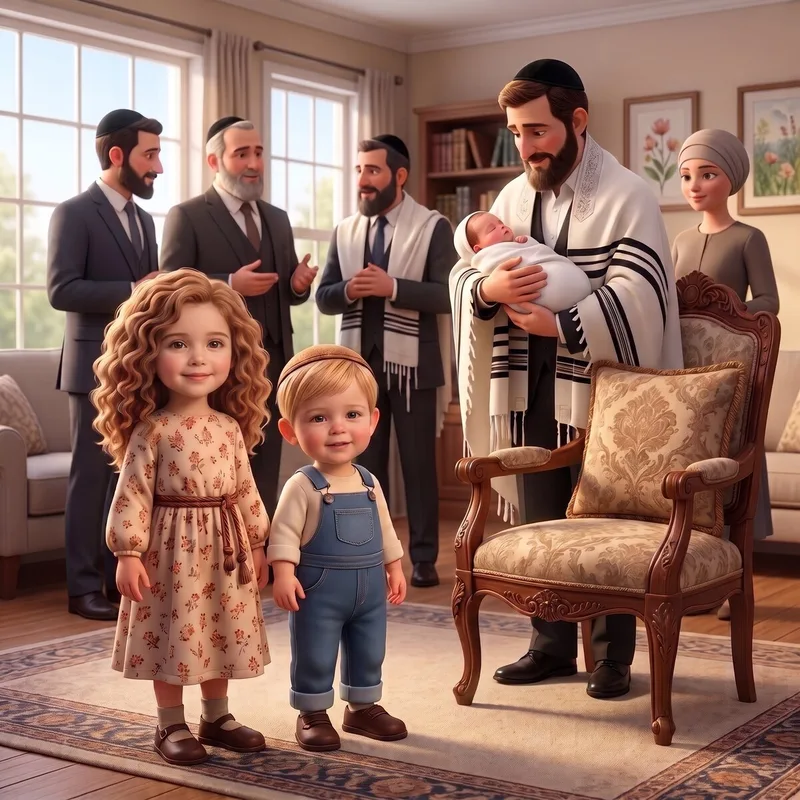
A Bris Milah is part of the Jewish Life collection, which covers the simchos and minhagim of a Yiddishe life. It is a personalized storybook: your child's name appears throughout, and from one uploaded photo your child's likeness appears on every page, illustrated in high-resolution 3D animated-film style. Up to eight siblings, ages 0 to 18, can appear together in the same book.
Every Torah Tale book ends with a discussion page carrying 10 questions about the story, mixing comprehension with middos. That is what turns a book into something talked about at the table, not only read to a child. If you add parents, grandparents and other relatives, they appear with the children on a closing family page in every format. Each book is written with careful rabbinical guidance and strict tznius, and it is reviewed by our team before it goes to print.

Softcover 8″×8″

Hardcover 8″×8″

Board book 6″×6″

Coloring book 8.5″×11″
Choose the format by the child's age. The 6x6 board book with rounded safety corners is for ages 0-4. The 8x8 softcover is for ages 4-8, and the 8x8 hardcover is for ages 5-18. Softcover and hardcover books open with a dedication page. There is also an optional matching coloring book, 8.5x11 in black-and-white line art, which is a weekday activity only, for a weekday afternoon or erev Shabbos, never for Shabbos or Yom Tov.
A book like this can be a good fit when a new baby brother is coming, when a child is about to attend a bris, or simply when a child asks what happens at one. Reading it on Shabbos is entirely appropriate.
What questions can we ask at the Shabbos table?
Shabbos is a good time for talking, and these questions need nothing more than conversation. Choose the ones that suit your children's ages:
- Who gave Avraham Avinu the mitzvah of bris milah?
- Why do you think Avraham did the mitzvah that very day?
- Who is the sandak at a bris, and why is it an honor?
- What do we do when we hear brachos at a simcha? (Answer Amen.)
- How can we help make a simcha happier for a family?
- What mitzvah does your family do with joy, and how can you tell it is a simcha?
Let the youngest answer first, and do not correct their answers too quickly. A four-year-old who says that a bris is when everyone eats cake is already telling you it is a simcha.
Where to start
If you would like a book about a bris milah for your child, create the book in about five minutes: a free account, then a few short questions covering each child's name, boy or girl, age and one photo, any siblings, the story, your community, the language and the format. For a step-by-step look at how it works, see how to create a personalized Torah storybook.
Frequently asked questions
How do I explain a bris milah to a 4-year-old?
Keep it short and happy: a bris is a mitzvah Hashem gave Avraham Avinu, and every Jewish baby boy has one when he is eight days old. The family and friends gather, the baby gets his name, and everyone makes a seudah to celebrate. You can add that the mohel is trained to be very careful, and that the baby is held close by people who love him.
Why is a bris milah done on the eighth day?
The Torah says so explicitly, both when Hashem commanded Avraham (Bereishis 17) and in Parshas Tazria. Avraham himself circumcised Yitzchak when he was eight days old, as the Torah tells us in Bereishis 21:4. If a baby is not healthy enough, the timing can change, so a rav or mohel should be asked.
Can a bris milah take place on Shabbos?
Yes. When the eighth day falls on Shabbos and the baby is healthy, the bris takes place on Shabbos. Questions about a baby's health or about timing should always go to a rav and the mohel.
What is a Torah Tale book about a bris milah?
It is a personalized storybook in the Jewish Life collection, with the child's name and likeness, made from one uploaded photo, illustrated in 3D animated-film style. Every Torah Tale book ends with a discussion page of 10 questions that mix comprehension with middos, which gives the family something to talk about after reading.
Which format suits a child whose baby brother is having a bris?
Choose by the child's age: the 6x6 board book with rounded safety corners is for ages 0-4, the 8x8 softcover for ages 4-8 and the 8x8 hardcover for ages 5-18. Up to eight siblings can appear in the same book, so brothers and sisters can share one.