Parshas Va'eschanan for Kids: Moshe's Tefillah & the Shema
Moshe Rabbeinu davens to enter Eretz Yisrael and hears no, then teaches Bnei Yisrael the Shema and how to pass the Torah to their children. Here is how to explain it at ages 3 to 4, 6 to 7 and 9 to 12.
Published by Torah Tale.
Create this book for your child
Parshas Va'eschanan is the second parsha of Sefer Devarim, and it opens with Moshe Rabbeinu davening to Hashem to be allowed into Eretz Yisrael. Hashem tells him no, and Moshe spends the rest of the parsha teaching Bnei Yisrael what matters most: the Aseres HaDibros, the Shema, and how to hand the Torah to their children. Children connect with it because it begins with a feeling they know well, wanting something very much, and shows what Moshe did when the answer was no.
What happens in Parshas Va'eschanan?
Moshe tells Bnei Yisrael that he davened to Hashem at that time, asking to cross the Yarden and see the good land. The pasuk records Hashem's answer: enough, do not speak to Me any more about this matter. Instead, Moshe is told to go up to the top of the Pisgah and look west, north, south and east with his own eyes.
Moshe is also told to charge Yehoshua, to strengthen and encourage him, because Yehoshua will lead the people across. The words of Sefer Devarim begin in Parshas Devarim, and here they continue.
Moshe then turns to the people. He urges them to listen to the chukim and mishpatim, not to add to the Torah or take away from it, and to guard themselves so they never forget what they saw at Har Sinai. The pasuk says they heard a voice speaking from the fire but saw no form, and he tells them to make it known to their children and grandchildren. He also sets apart three cities east of the Yarden, where someone who caused a death by accident could flee.
Next Moshe repeats the Aseres HaDibros, and then comes the Shema. Toward the end of the parsha he reminds them that Hashem did not choose them because they were many, for they were the fewest of the nations, but out of love. Va'eschanan is always read on Shabbos Nachamu, the Shabbos after Tisha B'Av, with the haftarah that begins "Nachamu nachamu ami."
Why did Moshe daven so much if Hashem said no?
The parsha's name comes from its first word, va'eschanan. Rashi explains that this is a language of a free gift: even tzaddikim, who could point to their good deeds, ask Hashem for a gift rather than claim a reward. The Midrash relates that Moshe davened 515 tefillos, which is the gematria of the word va'eschanan.
Hashem did not grant the request as Moshe asked it, yet the pasuk tells us that Moshe was brought to the top of the mountain and shown the land. A child can take from this that when we daven, Hashem hears us, even when the answer is not the one we hoped for. For more on teaching this at home, see Davening to Hashem for Kids.
What do the Aseres HaDibros and the Shema in this parsha teach children?
The Shema is the heart of the parsha: "Shema Yisrael Hashem Elokeinu Hashem Echad," followed by the command to love Hashem with all your heart, all your soul and all your strength. We say it morning and night. The Torah continues: these words should be on your heart, and you should teach them to your children. The pesukim go on to mention the tefillin and the mezuzos on the doorposts of your home.
The parsha also pictures a child asking, "What are these mitzvos?" and gives the answer a parent should give: we were slaves to Pharaoh in Mitzrayim, and Hashem took us out. So the Torah itself expects children to ask questions, and expects parents to answer. Our article on Saying Shema for Kids has ideas for teaching the words.
One detail for older children: in the Aseres HaDibros here the mitzvah says shamor et yom haShabbos, while in Parshas Yisro it says zachor. Chazal teach that shamor and zachor were said together in a single utterance.
What is the lesson of Va'eschanan for children?
- Daven with your whole heart. Moshe asked again and again, and tefillah is never wasted.
- Keep caring about others after hearing no. Moshe was told to charge and strengthen Yehoshua, who would lead the people across.
- Pass it on. Teach the Shema, the mitzvos and the story to your children, and answer when they ask.
How do I explain Parshas Va'eschanan at different ages?
Ages 3 to 4: Say it in a few sentences. Moshe asked Hashem for something he wanted very much. Hashem said no, and Moshe still loved Hashem and taught everyone to say Shema Yisrael. Then say the first line of the Shema together, perhaps at bedtime.
Ages 6 to 7: Ask, "Have you ever wanted something and heard no?" Then tell how Moshe davened, was told no, and was shown the land from the mountain. Add the child who asks "what are these mitzvos?" and the answer the Torah gives, and let your child be the one who asks at the table.
Ages 9 to 12: Bring in Rashi on the word va'eschanan, the Midrash about 515 tefillos, and the command not to add or take away. Ask what it means to ask Hashem for a gift rather than a reward, and why Moshe was told to strengthen Yehoshua at that very moment.
What is a personalized Parshas Va'eschanan book like?

Softcover 8″×8″

Hardcover 8″×8″

Board book 6″×6″

Coloring book 8.5″×11″
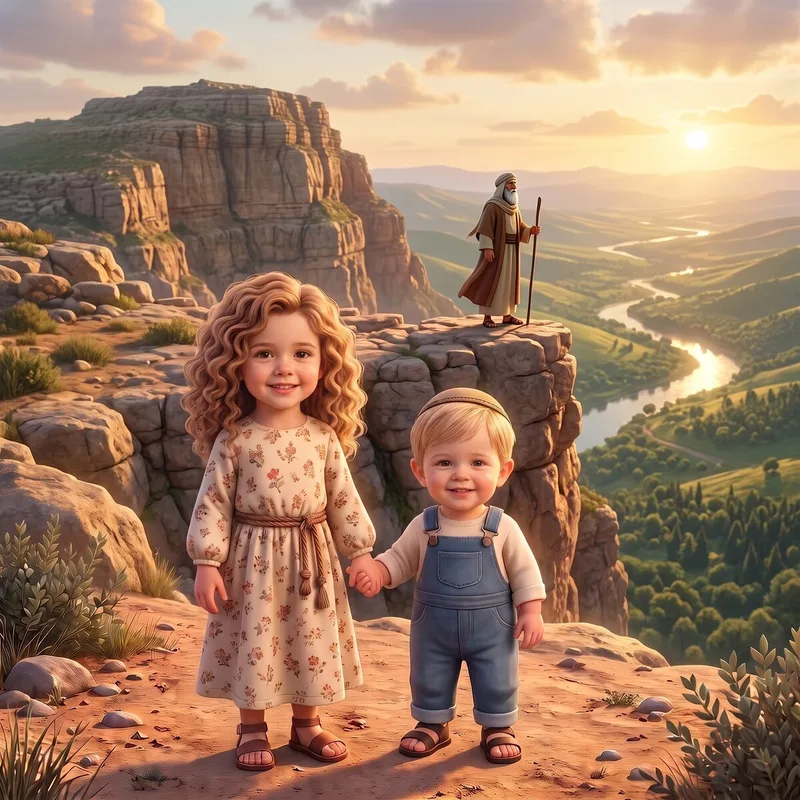
A Torah Tale book of Va'eschanan comes from the Torah collection. Your child's name and likeness, from one uploaded photo, appear on every page, illustrated in 3D animated-film style, and up to eight children can appear in the same book. The book is written with careful rabbinical guidance and strict tznius, and reviewed by our team before it goes to print.
Every book ends with a discussion page of ten questions that mix comprehension with middos, asking what happened and what it asks of the child. That page turns the book from something read to a child into something talked about at the table. If you add parents and grandparents, they appear with the children on a closing family page in every format.
There are three formats: a 6x6 board book with rounded safety corners (ages 0-4), an 8x8 softcover (ages 4-8) and an 8x8 hardcover (ages 5-18). The softcover and hardcover open with a dedication page. An optional matching coloring book is a one-time add-on, and it is for a weekday afternoon or erev Shabbos, not for Shabbos. The storybook itself is just right to read at the Shabbos table.
Creating the book takes about five minutes: a free account and a few short questions, including your child's name, age and photo and your community. The creator suggests the first parsha that can still arrive before its Shabbos, usually two to three weeks out. Va'eschanan is read in the summer, after Tisha B'Av, so look for it in the story picker.
What can we ask at the Shabbos table about Va'eschanan?
Shabbos is for talking, singing and reading together. These questions need no preparation:
- What did Moshe ask Hashem for, and what was Hashem's answer?
- Have you ever davened for something? How does it feel to wait, or to hear no?
- How did Moshe help Yehoshua, even though Moshe would not cross the Yarden?
- What are the words of the Shema, and when do we say it?
- Who taught you to say Shema, and whom will you teach one day?
- When a child asks why we keep the mitzvos, what does the Torah say to answer?
When you are ready, you can create the book and make your child the hero of Moshe's last words to Bnei Yisrael.
Frequently asked questions
What is Parshas Va'eschanan about?
Parshas Va'eschanan opens with Moshe Rabbeinu davening to Hashem to cross the Yarden into Eretz Yisrael. Hashem answers that it is enough and that Moshe will not cross, but tells him to go up the Pisgah and see the land. Moshe then reminds Bnei Yisrael of Har Sinai, repeats the Aseres HaDibros, and teaches the Shema and the mitzvah to teach Torah to their children.
Why did Hashem not let Moshe enter Eretz Yisrael?
In this parsha the Torah tells us that Moshe pleaded, and that Hashem said it was enough and he would not cross the Yarden. The Torah speaks of this earlier, in Parshas Chukas, and the meforshim discuss it. For young children it is enough to say that Hashem said no, and that Moshe was shown the land from the top of the mountain.
What is the lesson of Parshas Va'eschanan for kids?
One lesson is to daven with your whole heart, even when the answer may be no. A second is to keep caring for others, as Moshe was told to charge and strengthen Yehoshua, who would lead the people across. A third is that every generation passes the Torah to the next, as the Shema says: teach it to your children.
How do I explain Parshas Va'eschanan to a 4-year-old?
Keep it to a few sentences: Moshe asked Hashem for something he wanted very much, Hashem said no, and Moshe still loved Hashem and taught everyone to say Shema Yisrael. Then say the first line of the Shema together. A young child connects more to saying the words with you than to the details of the story.
Is there a personalized Torah Tale book for Parshas Va'eschanan?
Yes. Torah Tale makes personalized storybooks for the weekly parsha, with your child's name and likeness on every page, illustrated in 3D animated-film style. Every book ends with a discussion page of ten questions mixing comprehension with middos. Creating one takes about five minutes at torahtale.com/create, with a free account and a few short questions.