Parshas Devarim for Kids: Moshe's Words, the Judges & Shabbos Chazon
What Parshas Devarim teaches children: Moshe's words, fair judges, trusting Hashem instead of fear, and why it is read before Tisha B'Av, with ideas for ages 3 to 4, 6 to 7 and 9 to 12.
Published by Torah Tale.
Create this book for your child
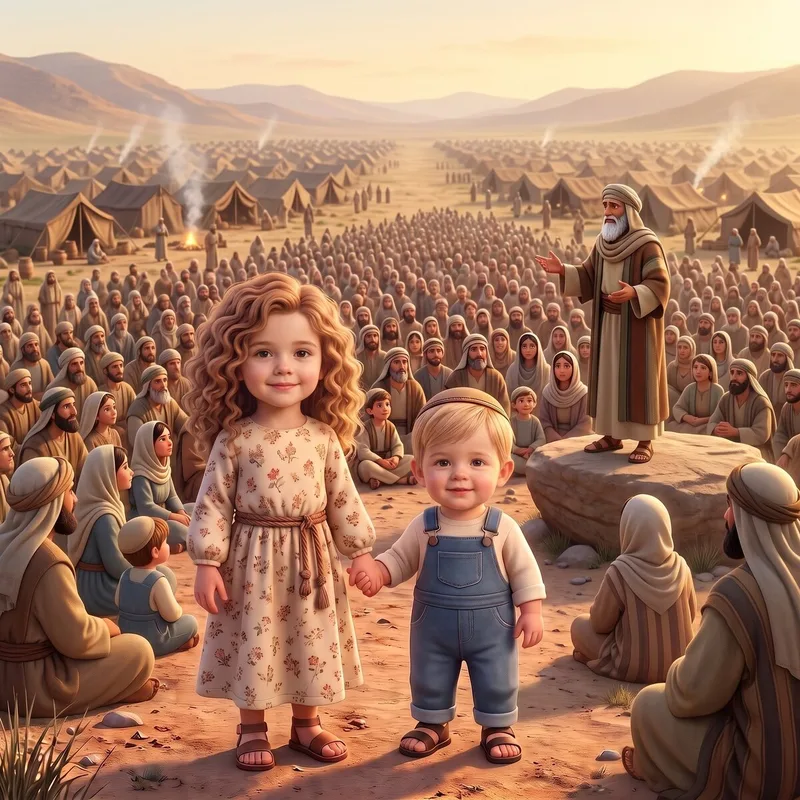
Parshas Devarim is the first parsha of Sefer Devarim, where Moshe Rabbeinu speaks to all Yisrael in the last stretch of his life and reviews the journey from Har Sinai to the edge of Eretz Yisrael. For children it lands as the story of a leader who loves his people enough to tell them the truth with care, and who reminds them that Hashem was with them every step of the way. It is always read during the Three Weeks, on Shabbos Chazon, the Shabbos before Tisha B'Av.
What happens in Parshas Devarim?
The Torah tells us exactly when Moshe spoke: on the first day of the eleventh month of the fortieth year in the midbar, after Sichon and Og had been defeated, on the far side of the Yarden. There Moshe began to explain the Torah to Bnei Yisrael. Sefer Devarim is also known as Mishneh Torah.
Moshe recalls that Hashem told them at Chorev that they had stayed long enough at that mountain and should set out toward the land promised to the Avos. He then reminds them of the judges, and of the meraglim, whose report left the people afraid to go up. The generation that wept was told it would not enter the land, except for Kalev ben Yefuneh, and the Torah says the children would be the ones to come in.
After many years of wandering, Hashem told them not to provoke the children of Eisav in Seir, and to buy food and water from them with money. They were likewise not to start a war with Moav and Ammon. Moshe adds that for forty years Hashem had been with them and they had lacked nothing.
When Yisrael came to Sichon's land, Moshe sent messengers with words of peace, asking to pass through. Sichon refused, and Sichon and Og, king of Bashan, were defeated. Reuven, Gad and half of Menashe settled east of the Yarden, and their fighting men were to cross ahead of their brothers to help. Toward the end of the parsha Moshe tells Yehoshua not to be afraid, because Hashem is the One who fights for Yisrael.
Why did Moshe appoint judges, and what did he tell them?
Moshe reminds the people that he had told them he could not carry them alone. Hashem had made them as many as the stars of the sky, and the load of their needs and disputes was great. So he asked them to choose wise, understanding and well-known men from each shevet, and he appointed them as heads.
His instructions to the judges are simple enough for a child to repeat. Listen to both sides, judge fairly, and do not favor anyone: lo sakiru fanim bamishpat, a small person and a great person are heard the same way. Do not be afraid of any person, because justice belongs to Hashem. A case that was too hard for them could be brought to Moshe.
For a child this means two things. A good leader shares the work, and fairness means the same rule for everyone. For more on seeing the best in people, see Judging Favorably for Kids.
Why is Parshas Devarim read before Tisha B'Av?
The Shabbos of Parshas Devarim is called Shabbos Chazon because its haftarah is the Chazon Yeshayahu. It always falls in the Three Weeks. Chazal tell us (Taanis 29a) that the night the people wept over the report of the meraglim was the night of Tisha B'Av, and Moshe recalls that story in this parsha.
The Midrash on Eichah also draws a connection between the word eichah in Moshe's words about carrying the people, and the word that opens Megillas Eichah. You do not need to teach this to a young child. A parent can simply say that this Shabbos reminds us to love every Yid, to trust Hashem and to look forward to better days.
To prepare children for the days that follow, see Tisha B'Av for Kids. The story of the meraglim itself is told in Parshas Shelach for Kids.
What is the lesson of Parshas Devarim for children?
- Speak with respect, even when correcting. Rashi explains on the opening words that Moshe mentioned the places where Yisrael had angered Hashem only by hint, out of respect for them.
- Be fair. The judges were told to treat small and great the same.
- Share the load. Moshe did not try to carry everything alone.
- Trust Hashem over fear. Moshe told the people not to be afraid, because Hashem goes before them and fights for them.
- Try peace first. Moshe sent words of peace to Sichon before any fighting.
How do I explain Parshas Devarim at different ages?
- Ages 3 to 4: One picture is enough. Moshe was a leader who loved Bnei Yisrael and spoke to them before they went into Eretz Yisrael. He asked wise people to help him be fair, and we are fair at home too, when we take turns.
- Ages 6 to 7: Tell the story in order: the judges, the meraglim, Hashem being with them for forty years, and Moshe's words of peace to Sichon. Ask what it means that Hashem fights for us, and when we feel afraid, what we can say.
- Ages 9 to 12: Talk about how Moshe corrected the people with respect, and about the idea of a leader who shares responsibility. Connect it to Shabbos Chazon and the Three Weeks, and ask why the Torah tells us that the generation of the meraglim wept.
What can we ask at the Shabbos table about Parshas Devarim?
These are for talking only, and they work well at the Shabbos table or on a long Shabbos afternoon.
- Why did Moshe ask the people to choose judges instead of deciding everything himself?
- What did Moshe tell the judges about a small person and a great person? When is it hard to be fair?
- Why were the people afraid, and what did Moshe tell them?
- What did Moshe do before Sichon, and when could we try words of peace first?
- Hashem was with Yisrael for forty years and they lacked nothing. What are we thankful for this week?
- How can we tell a friend that something was wrong in a way that keeps his kavod?
What is a personalized Parshas Devarim book like?
A Torah Tale book of Parshas Devarim comes from the Torah collection. Your child's name and likeness, from one uploaded photo, appear on every page in 3D animated-film style, and up to eight children can appear in the same book. Every book is written with careful rabbinical guidance and strict tznius, and is reviewed by our team before it goes to print.
Every book ends with a discussion page of 10 questions that mix comprehension with middos, so the parsha becomes something talked about at the table. If you add parents, grandparents or other relatives, they appear with the children on a closing family page in every format. The softcover and hardcover open with a dedication page.

Softcover 8″×8″

Hardcover 8″×8″

Board book 6″×6″

Coloring book 8.5″×11″
The formats are a 6x6 board book with rounded safety corners (ages 0-4), an 8x8 softcover (ages 4-8) and an 8x8 hardcover (ages 5-18). An optional matching coloring book, 8.5x11 in black-and-white line art, can be added. Coloring is melacha, so keep it for a weekday or erev Shabbos, never Shabbos itself. The storybook is the one to read on Shabbos.
You choose the story in the story picker. The creator suggests the first parsha that can still arrive before its Shabbos, with a live countdown to the order deadline, so if you are planning for Shabbos Chazon, order ahead of the deadline for delivery before the Shabbos the parsha is read. For more on choosing, see How to Choose the Weekly Parsha for Your Child's Book.
Creating a book takes a free account and a few short questions: each child's name, boy or girl, age and one photo, any siblings, the story, your community (asked once), the language (English, Hebrew or Yiddish) and the format. The whole flow takes about five minutes. When you are ready, create the book and let your child hear Moshe's words with themselves in the story.
Frequently asked questions
What is Parshas Devarim about?
Parshas Devarim opens Sefer Devarim, where Moshe Rabbeinu begins to explain the Torah to Bnei Yisrael in the fortieth year in the midbar. He reminds them of the judges he appointed, the meraglim and the years that followed, and the victories over Sichon and Og. Toward the end of the parsha he tells Yehoshua not to be afraid, because Hashem fights for Yisrael.
Why is Parshas Devarim read before Tisha B'Av?
Parshas Devarim is read on Shabbos Chazon, the Shabbos before Tisha B'Av, and that Shabbos is named for the haftarah of Chazon Yeshayahu. Chazal tell us that the night the people wept over the report of the meraglim was the night of Tisha B'Av, and Moshe recalls that episode in this parsha. The parsha also speaks of the judges and of Hashem's care for Yisrael, so it sets the tone for the Three Weeks.
What is the lesson of Parshas Devarim for kids?
One lesson is fairness: Moshe told the judges to treat a small person and a great person the same way. Another is trusting Hashem instead of giving in to fear, as Moshe told the people when they were afraid to enter the land. A third is speaking to others with respect even when you must correct them, since Rashi explains that Moshe mentioned the places where Yisrael had sinned only by hint, out of respect for them.
How do I explain Parshas Devarim to a 3-year-old?
Keep it to one picture: Moshe was a leader who loved Bnei Yisrael, and he spoke to them before they went into Eretz Yisrael. Add one idea a child can act on, such as that Moshe asked wise people to help him judge fairly, so we share and play fairly too. You can say it in a single sentence at the Shabbos table and let your child repeat it.
Can I order a personalized Parshas Devarim book for my child?
Yes. Torah Tale makes personalized storybooks for the weekly parsha, with your child's name and likeness from one uploaded photo on every page, and up to eight children can appear in the same book. Creating a book needs a free account and a few short questions, and it starts at torahtale.com/create.
Which format of the Parshas Devarim book fits my child's age?
The board book is 6x6 with rounded safety corners and is for ages 0-4. The softcover is 8x8 and is for ages 4-8, and the hardcover is 8x8 and is for ages 5-18. Your child's age is one of the short questions when you create the book, and an optional matching coloring book is a weekday add-on.