Parshas Pinchas for Kids: The Covenant of Peace, Bnos Tzlafchad & Yehoshua
Parshas Pinchas holds a covenant of peace, a second counting, five sisters who loved Eretz Yisrael and a new leader for Klal Yisrael. Here is how to tell it to your child.
Published by Torah Tale.
Create this book for your child
Parshas Pinchas is the parsha in Sefer Bamidbar where Hashem gives Pinchas a covenant of peace, Bnei Yisrael are counted again, five sisters ask for a share in Eretz Yisrael, and Moshe Rabbeinu asks Hashem for a leader to take his place. Children connect with it because it is full of people who care enough to step forward: Pinchas, the daughters of Tzlafchad, Moshe and Yehoshua.
What happens in Parshas Pinchas?
Pinchas comes right after Parshas Balak. At the end of Balak, a plague breaks out among Bnei Yisrael after serious sins connected to Baal Peor, and the Torah tells there that Pinchas ben Elazar ben Aharon HaKohen rose up and acted, and the plague stopped. Parshas Pinchas opens with Hashem telling Moshe what that meant.
- Hashem tells Moshe that Pinchas turned back His anger from Bnei Yisrael, and gives him His covenant of peace and a covenant of kehunah for him and his children after him.
- After the plague, Hashem tells Moshe and Elazar to count Bnei Yisrael again, by families.
- The land is to be divided by lot among the shevatim, according to the number of names in each family.
- The daughters of Tzlafchad ask for a share in the land, and Hashem tells Moshe that they speak rightly.
- Hashem tells Moshe that he will see the land from Har HaAvarim, and Moshe asks for a leader. Hashem names Yehoshua bin Nun.
- The parsha lists the korbanos: the daily Tamid, the Shabbos, Rosh Chodesh and the Yamim Tovim. We read from these pesukim in the Torah reading on the Yamim Tovim.
Why does Hashem give Pinchas a covenant of peace?
The Torah says that Pinchas acted out of a deep caring for Hashem's honor among Bnei Yisrael, and that is why Hashem did not destroy them. Hashem's answer to that act is shalom, a gift of peace.
Rashi explains that the Torah traces Pinchas back to Aharon HaKohen because the other shevatim were speaking against him. The Torah wants everyone to know exactly who he was.
This is a part of the Torah that needs care with children. It describes a unique moment, and it is not an example for a child to copy by taking matters into his own hands. What a child can take from it is that Hashem's honor matters to us, that we do not just stand by when something is wrong, and that the right response is to tell a parent or teacher and to stay loyal to what Hashem wants. If your older child asks more about what happened, answer simply and ask your rav how to present the details.
Who were Bnos Tzlafchad, and what did they ask?
Tzlafchad's five daughters were Machlah, Noa, Choglah, Milkah and Tirtzah. Their father had passed away in the Midbar and had no sons, so they came to the Ohel Moed and stood before Moshe, Elazar, the nesiim and the whole assembly. They asked why their father's name should disappear from his family, and requested a portion among their father's brothers.
Moshe brought their case before Hashem, and Hashem said, in the pasuk itself, that the daughters of Tzlafchad speak rightly. Rashi, bringing Chazal, explains that they loved Eretz Yisrael. For a child, this is a clear picture of someone who wants a share in the land and asks respectfully, with the right people listening.
It also shows Moshe's humility. When the question was one he had not been given an answer to, he did not decide on his own. He brought it before Hashem.
Why did Moshe ask for a new leader?
Hashem tells Moshe that he will go up Har HaAvarim, see the land, and then be gathered to his people. Moshe's first words in response are not about himself. He asks Hashem to appoint a man over the assembly who will go out and come in before them, so that the people will not be like sheep with no shepherd. Rashi points out, bringing Chazal, that when tzaddikim know they are about to leave this world, they think first of the needs of the community.
Hashem names Yehoshua bin Nun, a man with ruach in him. Moshe places his hands on Yehoshua in front of Elazar and the whole assembly, as Hashem commanded. Children understand this easily: a good leader makes sure the people who come after him will be taken care of. If you want to connect it to Yehoshua's earlier years, the story of the meraglim in Parshas Shelach is where Yehoshua and Kalev stood firm.
How do I explain Parshas Pinchas to a 4-year-old, a 7-year-old and a 10-year-old?
- Age 4: Keep it to the happy parts. Hashem was pleased with Pinchas and gave him a gift of peace, five sisters loved Eretz Yisrael and asked for a share, and Moshe asked Hashem for a good leader who is Yehoshua. One sentence each is plenty.
- Age 7: Add the details of the daughters' request and Moshe bringing their question to Hashem. Ask what a good leader does, and why it matters that Moshe thought of the people first.
- Age 10: Talk about how Pinchas cared about Hashem's honor, why this is only for a moment the Torah itself describes, and how we show that caring in daily life. Ask why Hashem answers with peace, and why Bnei Yisrael are counted again after the plague.
For the counting, Rashi brings a mashal from Chazal that it is like a shepherd counting his flock after a hard time, an act of love. That is an easy picture for a child. If your child enjoys that idea, Parshas Bamidbar tells the first counting.
Questions to ask at the Shabbos table
Reading and talking are very much at home at the Shabbos table. These questions need nothing but conversation:
- Why do you think Hashem gave Pinchas a covenant of peace?
- When something is wrong, what is the right thing to do, and who can we ask for help?
- What did Bnos Tzlafchad want, and how did they ask?
- Why did Moshe bring their question to Hashem?
- What do you think a good leader is like?
- Why do you think Bnei Yisrael were counted again?
What is a personalized Parshas Pinchas book like?
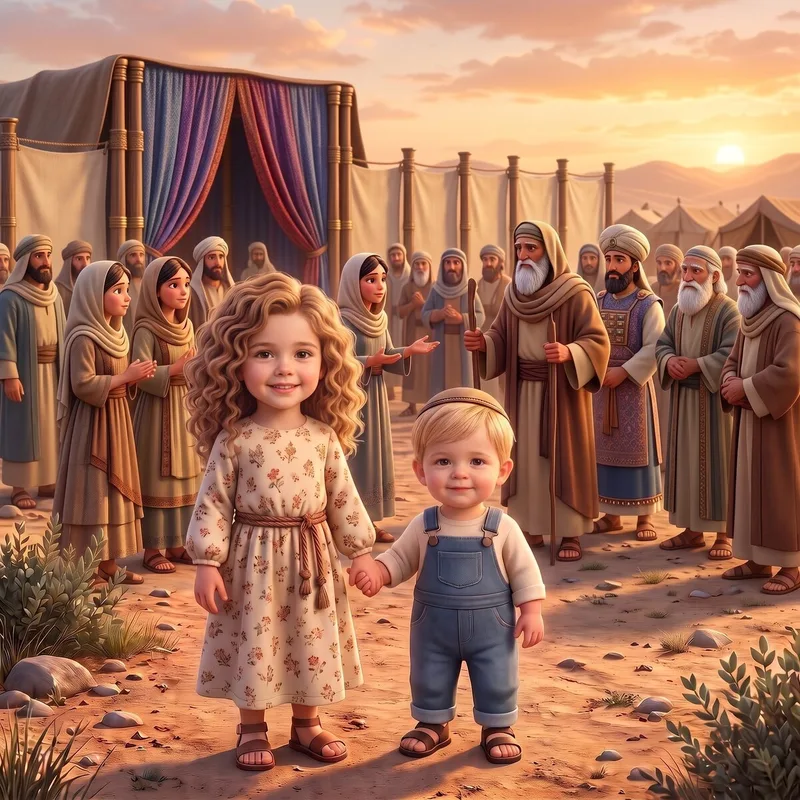
A Torah Tale book of Parshas Pinchas comes from the Torah collection, with your child's name and likeness, taken from one uploaded photo, on every page in 3D animated-film style. Up to eight children can appear in the same book, ages 0 to 18. The text is written with careful rabbinical guidance and strict tznius, and reviewed by our team before it goes to print.
Every book ends with a discussion page of 10 questions mixing comprehension with middos, so the book can be talked about at the table and not only read to a child. Softcover and hardcover books open with a dedication page. If you add parents, grandparents and other relatives, they appear with the children on a closing family page in every format.

Softcover 8″×8″

Hardcover 8″×8″

Board book 6″×6″

Coloring book 8.5″×11″
The formats are a 6x6 board book with rounded safety corners (ages 0-4), an 8x8 softcover (ages 4-8) and an 8x8 hardcover (ages 5-18). A matching 8.5x11 coloring book in black-and-white line art can be added to a one-time order. Coloring is melacha, so keep it for a weekday afternoon or erev Shabbos, and keep the storybook for Shabbos, where reading is just right.
Creating a book takes about five minutes with a free account and a few short questions: each child's name, boy or girl, age and one photo, any siblings, the story, your community (asked once), the language (English, Hebrew or Yiddish) and the format. The creator suggests the first parsha that can still arrive before its Shabbos, with a countdown to that parsha's order deadline. To order Pinchas specifically, pick it in the story picker. Our guide on how to choose the parsha for your child's book explains the timing in more detail.
When you are ready, you can create the book and make your child part of the parsha.
Frequently asked questions
What is Parshas Pinchas about, in simple words?
Hashem tells Moshe that Pinchas stopped a plague among Bnei Yisrael and rewards him with a covenant of peace. Then the people are counted again, the five daughters of Tzlafchad ask for a share in Eretz Yisrael, and Moshe asks Hashem for a leader, who is Yehoshua. The parsha also lists the korbanos of the Shabbos, Rosh Chodesh and the Yamim Tovim.
What is the lesson of Parshas Pinchas for children?
One lesson is that we care about Hashem's honor and do not just stand by when something is wrong. For a child, that means saying no to something wrong, telling a parent or teacher, and being a loyal friend. Another lesson comes from Bnos Tzlafchad, who loved Eretz Yisrael and asked their question respectfully, and from Moshe, who thought of the people's needs first.
How do I explain Pinchas to a 4-year-old?
Keep it short and leave out the details of the sin. You can say that Bnei Yisrael were in trouble, Pinchas did the brave thing, and Hashem was very happy with him and gave him a gift of peace. Then move to the happier parts: five sisters who loved Eretz Yisrael, and Yehoshua becoming the new leader.
Who were Bnos Tzlafchad?
They were five sisters named Machlah, Noa, Choglah, Milkah and Tirtzah. Their father had no sons, so they came to Moshe, Elazar and the whole assembly and asked for a share in the land. Moshe brought their question before Hashem, and Hashem said that the daughters of Tzlafchad speak rightly. Rashi, bringing Chazal, explains that they loved Eretz Yisrael.
Why did Moshe ask Hashem to appoint a leader?
Hashem had told Moshe that he would see the land from Har HaAvarim but would not enter it. Moshe then asked that the people not be like sheep without a shepherd. Hashem answered by naming Yehoshua bin Nun, a man with ruach in him, and Moshe placed his hands on him in front of Elazar and the whole assembly.
Is there a Torah Tale book for Parshas Pinchas?
Yes, Parshas Pinchas is available as a personalized book from the Torah collection, with your child's name and likeness from one uploaded photo on every page. Formats include a 6x6 board book with rounded safety corners (ages 0-4), an 8x8 softcover (ages 4-8) and an 8x8 hardcover (ages 5-18). Every book ends with a discussion page of 10 questions about the story.